Mecca draws influx of foreign capital as Saudi Arabia eases property rules
MECCA, Saudi Arabia – The train from Jeddah glides into town with a reminder on the travel app that this stop is “for Muslims only.”
The station could be anywhere in the Gulf – dotted with souvenir shops, mobile phone counters and a Costa coffee kiosk. Once you step outside, though, a sense of history and holiness reigns.
For more than 1,400 years, Mecca has been defined by worship. Now, increasingly, it’s also shaped by real estate, with construction cranes dominating the skyline.
“Why would people like me, and others who can afford it, want to buy there? To relax, to be close to God,” Anis Alhabshi, Vice President of real estate developer Arabian Dyar, said in an interview with The Circuit. “It has spiritual value.”
Muslims are drawn to Mecca because it is the birthplace of the Prophet Muhammad and home to the Kaaba, the cube-shaped sanctuary at the center of the Grand Mosque. Every day, millions around the world face it during prayers. The Hajj pilgrimage – one of the five core obligations of Islam – must be performed at least once in a lifetime by Muslims who are physically and financially able.
Many also visit the city and nearby Medina year-round on Umrah, a shorter pilgrimage involving rituals such as circling the Kaaba and walking between two small hills to recall the story of Hagar and her son.
The sanctity of the city means only Muslims are permitted to enter – making Mecca a global spiritual capital with an audience limited by religious law. That exclusivity has always set Mecca apart from Saudi Arabia’s other tourism sites.
Just a four-hour drive away, the kingdom is building resorts at the Red Sea, opening up archaeological marvels like AlUla, and promoting futuristic attractions such as NEOM – all designed to bring in Western travelers and non-Muslim spenders.
In Mecca, the balance is shifting. Saudi Arabia is overhauling the holy city at breakneck speed to accommodate a new kind of pilgrim: those who want to stay longer, return often, and even buy a second home in sight of the Grand Mosque.
Developers such as Jeddah-based Arabian Dyar are racing to meet that demand. State-backed giants, including Jabal Omar Development Co., which has already built one of the world’s largest hotel and residential complexes in Mecca, are expanding.
A pivotal shift came in 2025, when Riyadh passed a real estate law allowing foreigners to buy or lease property in the kingdom for the first time in decades. The rules introduce “designated zones” for non-Saudis to own homes, including parts of Mecca. Details remain limited, and ownership is expected to be restricted to Muslims, but developers say the policy has already triggered calls from investors across the Middle East and Asia.
Dyar’s first project two years ago was marketed only to Saudis because foreigners were excluded by law. Under the eased rules, the company is trying to sell Muslims from abroad on the prospect of buying second homes in close proximity to the Grand mosque.
Religious tourism is one of Saudi Arabia’s most valuable non-oil assets – worth roughly $12 billion a year, about 20% of the non-oil economy. Planners of the kingdom’s Vision 2030 development blueprint want that number to soar, projecting $350 billion in annual pilgrimage-linked revenue early next decade.
“The devil is in the details,” Alhabshi said. “But the country is… opening up to the world.”
On the ground, the transformation is visible block by block. Entire neighborhoods are wrapped in scaffolding, and glass towers rise beside century-old streets once lined with pilgrim hostels.
Longtime residents are adjusting. “Having 1,000 hotels is not like having 100,” said Talal Alghuraybi, a retired soldier in his 60s. “Mecca has changed a lot. We don’t always recognize it anymore.”
Saudi Crown Prince launches massive Mecca expansion project
Saudi Crown Prince Mohammed bin Salman launched a gigantic development alongside the Grand Mosque in Mecca that aims to almost double the holy city’s capacity to host Muslim pilgrims coming from around the world.
The new plan, introduced by the Saudi leader on Wednesday as the King Salman Gate project, is part of a broader push to modernize Mecca’s municipal services and accommodate 30 million visitors annually by 2030, up from about 18 million last year.
The development will span nearly a quarter the size of Manhattan, covering 12 million square meters of space (130 million square feet). Managed by RUA AlHaram AlMakki Co., a subsidiary of Saudi Arabia’s Public Investment Fund, the project will include residential towers, hotels and retail space in addition to worship areas.
The real estate surrounding Islam’s holiest sites in Mecca and Medina has become a magnet for hotel chains, developers and apartment owners, drawn by the guaranteed demand that comes from the religious obligation of Hajj. High-end lodging and property rentals in the surrounding districts have produced strong returns, encouraging more private and institutional participation.
Saudi authorities are also updating regulations to open parts of Mecca and Medina to additional foreign capital. While special restrictions will remain for property ownership in the holy cities, broader reforms in Riyadh and Jeddah are designed to attract outside investors and integrate the religious tourism sector into the kingdom’s diversification plans.
Arab fashion struts into Saudi Arabia
RIYADH, Saudi Arabia – In shimmering gold headscarves, embroidered capes and floor-length leather coats, models from more than 25 fashion labels will take to the catwalk this week at the Saudi capital’s swank Al-Faisaliah Hotel.
The event, which opens Thursday, is the first time that the Modest Fashion Show, a growing biannual display of couture designed for Muslim women, will be staged in Riyadh, where black robes, veils and hijab head coverings are more familiar apparel. The three-day lineup of designers, held previously in cities such as Dubai, Jakarta, Indonesia and London, is aimed at a growing Islamic market around the world that is estimated to be worth more than $300 billion.
“For us, modest fashion is not a trend,” Ozlem Sahin Ertas, CEO of the Istanbul, Turkey-based Modest Fashion Weeks organization, told The Circuit. “It was always big but it had no global platform for us to come together and speak out through our fashion. We believe in democratizing fashion, making it more inclusive and diverse.”
Apparel and footwear purchases by Muslim consumers grew by 5.7 percent last year to $295 billion, with Iran, Turkey and Pakistan ranked as the top spenders, according to the State of the Global Islamic Economy Report 2022. The market is forecast to grow to $375 billion by 2025. With close to 2 billion adherents, Islam is the world’s fastest-growing religion.
Fashion shows have been held in private for years in Saudi Arabia, but the events now coming to Riyadh and other cities have been made possible by the conservative Islamic kingdom’s easing of rules governing women since 2016 that included lifting the requirement for head coverings and a ban on driving. Dolce & Gabbana staged its first fashion show in the historic desert region of AlUla earlier this year and other prominent brands are also holding events as Saudi Arabia vies to become a hub for both Arab and international fashion.
Though it has gradually become the personal choice of women across the Gulf Arab states whether to wear traditional Islamic dress, neighboring Iran still enforces the covering of women’s hair, a practice that has sparked widespread protest and led to violent clashes with government forces. The demonstrations in which thousands of women have marched with their heads uncovered started in September after the arrest by the country’s morality police of 22-year-old Mahsa Amini for allegedly wearing her headscarf too loosely. She died three days later in police custody. The women’s movement was further galvanized by Iranian rock climber Elnaz Rekabi, who came under public criticism for taking off her hijab in October at the International Federation of Sport Climbing’s Asian Championships in Seoul.
The better-known side of the international fashion world that often flouts the region’s adherence to modesty was on display at Arab Fashion Week (AFW) in Dubai, which emerged more than 10 years ago as a Middle East hub for designer and luxury products. Major brands such as Chanel, Dior, Gucci and Louis Vuitton anchor the glittery Mall of the Emirates and the city’s other commercial palaces.
Chanel went so far as to take over a small island off the coast of Dubai to show off its 2014 “Cruise Collection,” designed by creative director Karl Lagerfeld. Guests arrived on traditional wooden boats for the event which presented a modern twist on the Arabian Nights theme with models parading in tunic tops, harem pants and Aladdin slippers.
The UAE and surrounding Gulf states are also beginning to embrace lesser-known brands closer to home, emblemized by the wide range of designers from across the MENA region at AFW, staged at the Dubai Design District, known as d3.
“The event is great,” Ibrahim Shebani, a Libyan designer who founded the label Born in Exile, told The Circuit. “The buzz, media, we meet plenty of press, network like crazy. For a young Arab brand, it’s the only way we can show our collection to press, influencers, industry people and buyers.”
Jacob Abrian, the Lebanese-born founder and chief executive of the Arab Fashion Council, which stages Arab Fashion Week, says the new interest in homegrown Middle Eastern designs is a major shift from accustomed preferences for expensive clothes from the fashion capitals of Europe and the U.S.
“One of the obstacles we used to face was that regional consumers only wanted to buy brands imported from the West and there was little attention placed on regional emerging brands,” Abrian told The Circuit. “This has changed immensely over the last five years. In 2022 consumers in the Middle East are more supportive of regional designers.”
Neawear model at Dubai Modest Fashion Show in 2021
AFW, started in 2015, aspires to be a regional landmark on the international fashion industry calendar. Its catwalk shows, networking sessions and business huddles attract young designers in the region who have struggled to participate in international shows in London, Paris, or New York.
Organizers are working to arrange representation from each of the 22 member nations of the Arab League to create a Middle East fashion infrastructure that would position the fashion industry as a main pillar for growth of the regional economy. The council envisions categorizing the countries into three industrial clusters, with Arab North African states leading the raw materials and textile group; Jordan, Egypt, Lebanon and Iraq leading the garment manufacturing group; and the Gulf countries representing the marketing and merchandise group.
Revenue from the fashion industry in Dubai is projected to reach $4.6 billion this year, according to Statista, an 11 percent increase from 2021, driven by customers in China, Japan, South Korea, India and Indonesia. The great purchasing power of Gulf customers alongside a flood of international residents to Dubai since after the COVID 19 pandemic anchors the industry.
“Dubai used to be a place where brands would come, make some quick money and leave,” said Lori Rhodes, founder of Red Letter MENA, a marketing and communications consulting firm specializing in retail and fashion. “The growth of the luxury market here made the fashion much more relevant and gave an opportunity for homegrown brands to take advantage of selling to consumers all over the world from here,” she told The Circuit.
“There is an important local fashion voice that needs to be expressed,” said Hatem Alakeel, a Saudi designer who founded The Luxury Brand agency. “There need to be platforms to show regional fashion and bring the community together,” he told The Circuit. Alakeel added that the fashion industry has to develop a stronger professional system, including apprenticeships for young designers to work with established Arab houses. “Many of us don’t have the education and I am one of them,” he said.
Other brands among the 35 represented at AFW included Iraqi Mena Talal and Iranian designer Mohammad Amin Pour Eskandarian, demonstrating Dubai’s pull for designers from around the region, particularly from poorer countries and areas in conflict. Eskandarian, who showed his Zardouz collection in Dubai amid the ongoing women’s protests in Iran, creates genderless designs that feature sweeping dresses with hoods and layers of fabrics that are meant to reflect a society in transition.
The latest edition of AFW also presented the designs of sustainable start-up brand Atelier Forger, led by Syrian-born Tarek Abou Samr. His chic casual style is made by abiding to the principle of “slow fashion,” focusing on the environment and supporting local businesses. The fashion industry has been identified as one of the major contributors to global warming through its massive waste of water in factories, cheap synthetic materials that pile up in landfills and wide use of toxic dyes.
While noting the progress that was evident in the Dubai shows and the work of Saudi Arabia’s Fashion Commission, Alakeel said the Arab fashion industry has a lot of work to do before it can compete with major global players. “We have come a long way, but we still don’t have the infrastructure and know-how needed to further grow the scene.”
Growth across the region has also been limited by political turmoil in Syria and Lebanon, once centers for the region’s textile industry, that has led many Arab designers to source material and manufacture their products in India and other more stable areas with low labor costs.
Ihab Jiryis, a Palestinian designer, said AFW is key for any Arab fashion designer wishing to reach an international audience. Jiryis’s designs are replete with references to political conflict and the struggles that Palestinians endure. Jiryis’s latest collection is called “Dialogue with Death.” Featuring highly embroidered floor-length gowns and dresses in vibrant shades of red, black, green and purple, the Dubai show culminated with a series of white garments, evoking resurrection.
“I don’t need to say anything,” he told The Circuit. “My designs do the talking.”
The Arab influencer pushing the Abraham Accords from Abu Dhabi
At the age of 28, when Loay Alshareef, then a French language student from Saudi Arabia, stumbled into his homestay in Paris to discover he was surrounded by Stars of David — his instinct was to turn on his heels and find another family to stay with. “I didn’t feel comfortable at the beginning,” he told The Circuit.
Putting it mildly, Alshareef said he “didn’t have positive views about Israel or about the Jewish people,” at that time, in 2010.
“I called the school and they said ‘take your time’” — and with the gentle guidance of his “wise” host mother, he did.
That accidental and intimate almost year-long encounter with a Jewish family proved to be a turning point for Alshareef, an observant Muslim, whose father is originally from Egypt and who also has family from Bahrain, which he described as “a very nice mix.” Alshareef grew up in a middle-class household in Jeddah with his brother and sister.
Today, he is a prominent face among movers and shakers in the region who have embraced the Abraham Accords, normalization deals signed in September 2020 between Israel, the United Arab Emirates and Bahrain, and are working to strengthen people-to-people ties between those countries and beyond. He’s caught the attention of Israeli, U.S. and Gulf leaders, and frequently meets with prominent figures visiting the UAE, where he has lived since 2020.
Alshareef owns a PR company in Abu Dhabi and works with both governmental and non-governmental entities, and also teaches English and Arabic. He has also learned Hebrew, largely from watching TV and listening to songs and podcasts, which he readily explained to The Circuit in the language. Prior to moving to the UAE, Alshareef lived in Bahrain, and spent a couple of years in the U.S., where he earned a master’s degree in software engineering from Pennsylvania State University.
He hasn’t yet visited Israel, but hopes to do so when the COVID-19 situation isn’t so rife — he’s waiting to visit his mother back in Jeddah for the same reason. Ultimately, he strives to get an academic degree in Israel and study the history of the Dead Sea Scrolls, further embracing his love of Biblical Hebrew which he describes as “very authentic and very deep.”
He said that while he appreciates the focus on Israel as a startup nation, “the history of Israel itself is also a beacon in our world and deserves to have more attention to it.”
Alshareef’s initial U-turn toward Jewish-Arab understanding wasn’t a sharp one, but a gradual process. “I was going through an inner struggle,” Alshareef recalled in a Zoom call from Abu Dhabi. “And this change wasn’t easy, but I really wanted it.”
Having been raised in a country where anti-Israel and antisemitic messaging was imbued in him, integrating into a Jewish home opened his eyes, his mind and his heart.
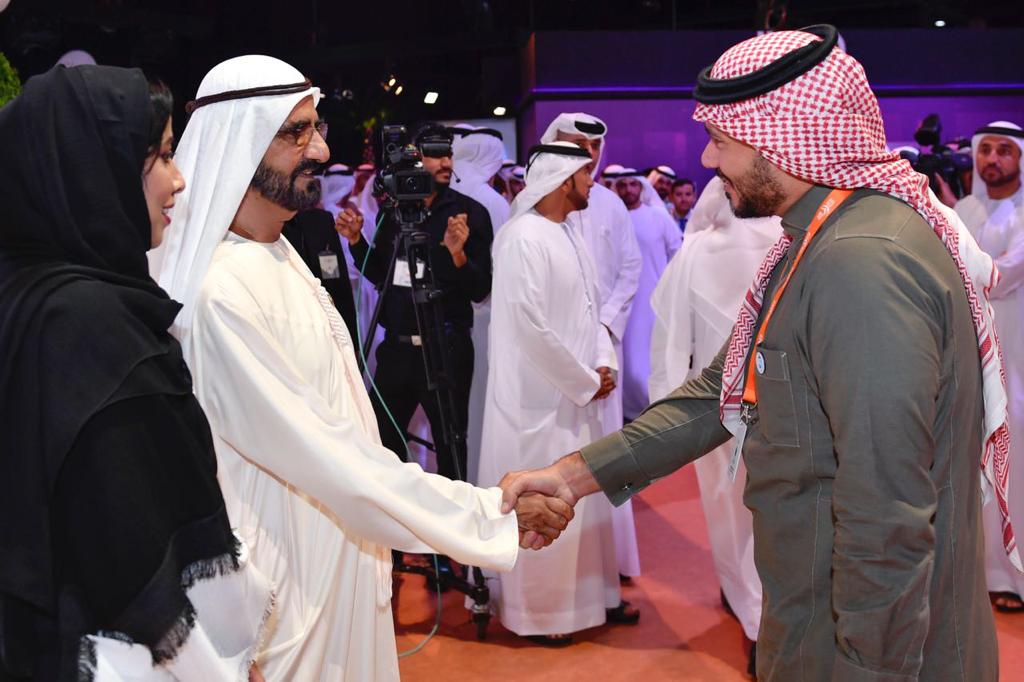
Loay Alshareef shakes hands with Dubai ruler Sheikh Mohammed bin Rashid Al Maktoum at the Arab Media Forum in 2018.
“When I engaged more and more with them [the Parisian Jewish family], it changed lots of negative views,” he said.
It took courage, he said, to leave “the herd,” among whom hatred of Jews was the norm.
“There are good Jews, bad Jews, good Christians, bad Christians, good Muslims, bad Muslims — but this is not what we were taught. We were told that the Jews are conspiring against Muslims and the Jews are evil, the Jews hate Muslims from the bottom of their hearts. And to me, it was very baffling.”
Being a history buff, reading the Bible was a significant element of Alshareef’s transformation. As he studied, he began to understand the connection of the Jewish people to the land of Israel.
“The Bible is all about the story of the relationship between Israel, the people of Israel and their neighbors, and the people of Israel and God. So when you dig deep into it, you start to realize how connected the Jews are to this land and why this land specifically, and from the times of Joshua bin Nun entering the land to the times of the Maccabees taking control over Judea, you get to know the real history of Israel,” he said. “And then you start to believe in the legitimacy of the Jewish belonging to the land of Israel, or to the land of Canaan.”
Today, Alshareef is fully invested in building bridges between Jews and Arabs, but understands the inherent challenges in doing so. “You cannot blame” people, he said, for “being taught for 70 years hatred towards Jews and Israel.” Today, he noted, Saudi Arabia is undergoing a “great change,” leaving behind previous education curricula that he described as “disastrous.”
Marcus Sheff, CEO of The Institute for Monitoring Peace and Cultural Tolerance in School Education (IMPACT-se), pointed out that 15 of the hijackers in the September 11 attacks grew up in Saudi Arabia, as did Osama bin Laden.
“There is a clear and direct link between school education,” Sheff told The Circuit. Changes to the education system were slow in coming but in recent years, he said, there has been an institutional effort for change and “there is a clear strategic approach to modernizing the curriculum.”
IMPACT-se has been monitoring the curriculum since 2003, and on an annual basis since 2019, when they presented a report and a list of examples of necessary changes to Saudi Arabian authorities, after which significant changes were made. The organization has seen the removal of “a great deal of content” that demonized Jews, Christians and non-believers and promoted violent jihad.
“Ideas which forbade friendships with Jews and Christians have been taken out, which is what we see now — the Saudi effort to do business with the outside world,” he added. “You can’t do that if you forbid relations with them.”
Alshareef promotes such relations through social media videos, which he shares with his 180,000 followers on Twitter and 38,000 followers on Instagram, as well as educational and face-to-face encounters.
He said he often responds to questions about how relations can be friendly now with Israel after leaders in the UAE used to express negative sentiments towards the Jewish state. “I always say this answer: You have to know that in politics, circumstances change. And when circumstances change, you have to adapt with this. Israel, we saw it as a threat, to be very honest. In the first creation of Israel, it was viewed as a threat. Time proved that Israel is part of the region and wants to blend with its neighbors. It never poses a threat. The country that really poses a threat to us is Iran.”
Alshareef also uses his social media platforms to promote and defend the UAE. Ahead of the launch of Expo 2020 in Dubai, he posted a video on social media pushing back against a European Parliament resolution calling on member states not to participate in the event due to human rights violations by the country.
“Human rights is all about protecting individuals and groups against discrimination and providing, without ommissions, healthcare, education and human dignity, and that is all encompassed in the UAE,” he said.
Since 2016, when he started traveling to the UAE, he developed a love for the country.
He found the UAE to be “ahead of everyone else” in its “openness and acceptance of others.”
“It’s a metropolitan country, we have different cultures, different sects, different religions, different people, and the harmony that they are living and they feel that they are accepted is phenomenal to be very honest,” he said.
“I speak with knowledge and with evidence and I always say that my ultimate goal is to bring Jews and Muslims together. So for that sake, if I have haters, that’s fine.”
“So I believe me and the UAE, we have the same agenda. The same agenda of accepting, the same agenda of embracing other cultures and other people and especially when it comes to Israel — after the Abraham Accords, I would never be able to live in a Gulf state better than the UAE.“
He wouldn’t be able to engage in the same peace-building activities with Israelis in Saudi Arabia, he said, because there is not yet the same acceptance of Israel among the people as in the UAE. “They will accept when the time is right,” he added.
He has been branded a “normalizer,” a “Zionist wannabe” and the like. “But Saudis are changing, to be very honest, to the better, to more accepting of the fact that Israel is part of our region, the Jews are indigenous to the land of Israel and this is what I’m trying to say to people.”
Alshareef accepts that he is met with some online backlash.
“I speak with knowledge and with evidence and I always say that my ultimate goal is to bring Jews and Muslims together. So for that sake, if I have haters, that’s fine.”
Alshareef and other like-minded influencers have been holding joint gatherings — such as Shabbat meals — with Jewish community members, and have celebrated both Jewish and Muslim festivals as a group.
Rabbi Levi Duchman, the first resident rabbi of the United Arab Emirates and head of Chabad in the UAE, who has engaged Alshareef in various Jewish community activities in the UAE, first met him in 2018, when Alshareef was living in Bahrain. “I was super impressed by his knowledge and by his enthusiasm of learning about other cultures, about building bridges and about learning from each other,” he told The Circuit.
“I am proud of this courageous relationship with Loay, and all the other young Arab youth that have been playing a very instrumental role in bringing different cultures and traditions together,” Duchman added. “I think it very well resonates with the warm welcome our community has very gratefully received from UAE leadership, together shaping a very bright future.”
Rabbi Yehuda Sarna, chief rabbi of the Jewish Community of the Emirates, described Alshareef as the “consummate cultural translator.”
He first met Alshareef in 2018 when he joined the Jewish community for a service in Dubai — “One of the few non-Jews who attended in those years,” Sarna told The Circuit. “We opened up the Torah to show him our scroll and he started reading. It happened to be [Torah portion] Yitro — as he read aloud he exclaimed, ‘The ten commandments!” Sarna recalled.
He added that this past November, at the Abu Dhabi Forum for Peace gathering, Alshareef was quoting freely from Jewish prophets “and applied them seamlessly to contemporary situations.”
“He sees the potential connection between people and lies over the divide to bridge them,” Sarna said. “He has no fear except the fear of being untruthful to himself and his principles.”
“I want to open a new page of Muslim-Jewish relations, and I will do whatever I have to do for this reason,“ he said.“I believe the Abraham Accords are here to stay and will flourish — I hear people saying they will survive — I say they will flourish.”
Alshareef also meets with Jewish organizations working in or visiting the country. Last week, together with fellow regional peace activists Saoud bin Hamoodah and Majed Alseyabi, Alshareef joined a roundtable hosted by the American Jewish Committee for an interfaith group of undergraduate students visiting from the U.S.
Reva Gorelick, program director for AJC in Abu Dhabi, said Alshareef’s contributions to the discussion, during which he spoke about the importance of personal identity, “underscore his genuine and passionate support of Israel and Muslim-Jewish relationships, and his demonstrated commitment to the ongoing dialogue about and in the aftermath of the Abraham Accords.”
Alshareef says that he is seeing people changing their perspectives before his very eyes, and that is what keeps him motivated.
At the Expo, for instance, many of his Saudi friends had the opportunity to interact with Israelis. “They liked how the Israelis are open to them. One of them told me, ‘I didn’t feel that I’m speaking to an enemy.’ Because we were told for 70 years you are the enemy. And so it will not change overnight. But with these continuous efforts and struggle, it will change, inshallah,” Alshareef predicted.
“I want to open a new page of Muslim-Jewish relations, and I will do whatever I have to do for this reason,“ he said.“I believe the Abraham Accords are here to stay and will flourish — I hear people saying they will survive — I say they will flourish.”
Abu Dhabi grants first civil marriage in move to modernize legal system
On Dec. 27, 2021, Abu Dhabi’s newly opened Non-Muslim Personal Status Court issued its first civil marriage contract to a Canadian couple — the first to marry under a new law on the personal status of non-Muslims in the capital of the United Arab Emirates, according to WAM, the country’s official state news agency.
In early November, UAE President and Emir of Abu Dhabi Sheikh Khalifa bin Zayed Al Nahyan made history for the federation of seven emirates when he issued a law to regulate personal status matters for non-Muslims in Abu Dhabi; the law provided an advanced judicial mechanism for the determination of personal status disputes for non-Muslims.
Previously, all personal-status laws regarding marriage and divorce in Abu Dhabi were based on Islamic Sharia principles, as in other Gulf states.
Under the new law, which contains 20 articles divided into several chapters, non-Muslims are allowed to marry, divorce and get joint child custody under civil law in Abu Dhabi. It also covers alimony, proof of paternity and inheritance.
After a divorce, the law says that joint and equal custody of children will automatically be granted to parents, with procedures set in place to settle disputes.
The new Non-Muslim Personal Status Court in Abu Dhabi operates in both English and Arabic.
Yousef Saeed Al Abri, Undersecretary of Abu Dhabi Judicial Department (ADJD), stressed according to WAM how “the establishment of civil marriage contract procedures for the first time before Abu Dhabi courts sets a qualitative precedent in the Arab region.”
Rabbi Levi Duchman, the first resident rabbi of the United Arab Emirates and head of the Jewish Community Center of the UAE, says the move is a reflection of the “tolerance and coexistence” that he sees in the country.
“We have been licensed since 2020 to conduct Jewish marriages in Abu Dhabi, and our marriages were always recognized,” Duchman told Jewish Insider. “Our marriages were always recognized by the UAE government, by the royal court and by the Ministry of Justice.”
In New York, for instance, one would have to have a Jewish marriage as well as a civil marriage. “Here in the UAE, we were licensed to do just a Jewish marriage that will also be recognized as a civil marriage,” Duchman added.
The law is the latest in a series of legal changes in the UAE at the federal level introduced in November 2020. Those include statutes to decriminalize premarital sexual relations and alcohol consumption and to cancel legal clauses allowing judges to issue overly lenient sentences in defense of “honor” killings — crimes that will now be treated by UAE courts as murder cases.
Given that nearly 90 percent of UAE’s population of 10 million people are foreigners, such moves make practical sense. Especially, as these reforms, in addition to the issuance of longer-term visas to select expatriates, have been viewed as a way for the UAE to make itself more attractive for foreign investment and extended residency.
“I am from the United States and New York City and as the first resident Rabbi to reside in the UAE, from the day I landed seven years ago, I have seen the amazing openness, respect and tolerance of the government not just as a statement but in actions,” added Rabbi Duchman. “What we have here is amazing – we have our places of worship, government-certified Kashrut, a Jewish educational system. We are so lucky to have the community we have here and are profoundly thankful to the Emirati leadership for enabling all of this.”