Dubai installs Chief AI Officers across government departments
The C-suites have gotten a bit bigger in Dubai’s government offices.
Over the weekend, Sheikh Hamdan bin Mohammed, Crown Prince of Dubai, installed 22 Chief Artificial Intelligence Officers across departments that govern areas such as community development, human resources, customs, policing and civil aviation.
“The appointment of the new Chief AI Officers in the Dubai government marks the initial phase toward realizing our vision for the future of government work,” Sheikh Hamdan said. “We are confident that these officers will intensify their efforts and go the extra mile in translating our vision into reality.”
It is a quintessentially Dubai move. The UAE’s biggest city has long sought to be known for flexible policymaking, a business-friendly environment and smart government services as it looks to lure private sector development, with the likes of Microsoft, Meta and Google taking up regional headquarters in the glitzy city.
The Dubai Future Foundation, which shares an office tower with UAE Prime Minister and Ruler of Dubai Sheikh Mohammed Al Maktoum, for example, is a think tank designed to help guide government policy as it gears for the future.
While Dubai has prioritized business-friendliness and agile governance amid the artificial intelligence revolution, Abu Dhabi has taken a different tact.
The UAE capital, a bit more than an hour south of Dubai, has leveraged its deep sovereign wealth fund pockets to plow cash into government-backed entities, investment vehicles and startups both at home and abroad.
Locally, this has yielded AI champion G42, the applied research group Advanced Technology Research Council and an AI-dedicated research university, the Mohamed bin Zayed University of Artificial Intelligence.
It has also given Abu Dhabi Inc. a footprint in tech hubs like Silicon Valley, with major investments in companies like semiconductor startup Cerebras and self-driving firm Waymo.
UAE foreign assets pegged at $2.5 trillion by investment chief
Jamal Bin Saif Al Jarwan, Secretary-General of the UAE International Investors Council (UAEIIC), also told the Emirates New Agency WAM that the portfolio is doing well despite economic headwinds.
The UAE’s international investment footprint is topped by sovereign wealth funds holding 72% of the assets, Al Jarwan noted.
Abu Dhabi Investment Authority (ADIA) is the leading foreign investor, followed by Mubadala Investment Co., Investment Corporation of Dubai, Emirates Investment Authority and ADQ.
All told, the UAE owns seven sovereign wealth funds with assets exceeding $2 trillion, trailed by government-owned and quasi-governmental companies with 18%, UAE banks with 2.5% and 7.5% originating from family-owned and private companies.
The “most prominent” deal in 2023 was between U.S. private equity firm Apollo and ADIA to acquire chemicals manufacturer UniVar for $8.1 billion, he said.
As of this morning, Dubai has IPO’d six out of the 10 government entities it plans to take private as the emirate looks to boost trading volumes on its stock exchange and join the capital markets action picking up speed in Abu Dhabi and Riyadh.
The Dubai public parking company, Parkin, debuted on the DFM today with a 31% surge in its stock price. Parkin’s $429 million IPO was 165 times covered and attracted $71 billion in orders – a record for Dubai. The company pitched to shareholders a growth story on the back of Dubai’s population boom: it forecasts demand for public parking to grow by 60% by 2033, Bloomberg reports.
Strong post-listing performance is becoming a signature of the region’s companies – returning an average of 40% to investors – and spurring international interest in IPOs here. Strong investor demand has been bolstered by government reforms, particularly in the UAE and Saudi Arabia, amid a privatization push.
Nearly 30 IPOs are expected in the Gulf this year. Two of the region’s biggest grocers are in line: Lulu Group is reportedly eyeing a $1 billion dual listing in Abu Dhabi and Riyadh. Spinneys Dubai, the franchisee of the supermarket chain in the UAE and Oman, is also expected to go public in 2024. No word yet on what the Dubai government may sell off next.
Qatar makes bid for young tech firms ahead of Web Summit
As Qatar prepares to host next week’s Web Summit extravaganza, government planners are trying to attract early-stage tech companies to set up shop in the country.
One of those efforts, Startup Qatar, was rolled out on Wednesday, offering free visas, tax waivers, licenses, office space and funding to promising tech firms.
All the services are described and accessible through the campaign’s website and will be promoted heavily at Web Summit Qatar.
The conference, which opens Feb. 26 at the Doha Exhibition and Convention Centre, expects more than 1,100 startups from 80 countries. Tickets are already sold out.
Will Saudi Arabia’s plan work to become the Middle East’s new corporate HQ?
The deadline has passed for international companies vying for big contracts with Saudi Arabia to relocate their corporate headquarters to the kingdom.
From Jan. 1, government-backed entities are restricted from doing business with large foreign firms that don’t have regional headquarters in the country, as Saudi Arabia looks to diversify its economy away from oil. Ultimately, the kingdom is squaring off with the UAE, which has long held the majority of regional headquarters and attracted the lion’s share of corporate expenditure and foreign investment.
“A superficial nameplate saying ‘this is the regional headquarters’ will not fly,” Saudi Arabia’s Minister of Investment Khalid Al-Falih said back in 2021, when the mandate was first announced. The expectation is that businesses will employ executive-level staff and oversee operations in other Middle East countries from their kingdom-based offices.
By October 2021, 44 companies had received government licenses to set up headquarters in the country. The companies that had already relocated their regional headquarters included PepsiCo, DiDi, Unilever, Siemens, KPMG, Novartis, Baker Hughes, Halliburton, Philips, Schlumberger, SAP, PwC, Oyo, Boston Scientific and Tim Hortons. Since then, a total of 200 have been granted licenses for regional HQs.
In tandem with the corporate push, quality of life is becoming a larger emphasis for the kingdom. In 2016 the religious police was tamped down. Two years later, an investment initiative was launched to rapidly develop more cultural, entertainment, sports and tourism activities, which was quickly followed by opening up to global tourism and a broader acceptance of Western dress in corporate settings. Women’s workforce participation has also gone up, from 18% in 2009 to 30% in 2020, according to the Atlantic Council.
Saudi Arabia is now aiming to lure 480 companies to open regional HQs by 2030. For context, as of 2021, 196 of the Fortune 500 had a dedicated office for the Middle East and Africa to service the region, with 70% opting to locate in Dubai.
Analysts and recruitment experts predict executives are scrutinizing the policy for loopholes.
The feeling among those already doing business in the region is “we’re going to try and get around it in some way, shape or form,” Oscar Orellana-Hyder, co-founder of Cordell Partners, a financial services headhunting firm based in the UAE, told The Circuit.
“The decision on where to locate a headquarters also depends on who the anchor investor is in a firm, the amount invested and what type of capital has been raised from the region,” he added.
The move comes at a time when the region’s sovereign wealth funds are writing bigger checks and becoming more strategic in their investment decisions – with more strings attached.
Three sovereign wealth funds from the UAE invested a combined $36.5 billion in 2023, according to Global SWF, which tracks the world’s sovereign investment funds. Abu Dhabi’s Mubadala was ranked third in the top 10 list of SWFs with investments of $17.5 billion, followed by Abu Dhabi Investment Authority (ADIA) with $13.2 billion.
Qatar Investment Authority (QIA) was ranked seventh at $5.9 billion. Abu Dhabi’s ADQ took the eighth spot with investments of $5.8 billion.
But it is Saudi Arabia’s Public Investment Fund, known as the PIF, that is the world’s most active and prolific: it was the leading sovereign investor in 2023 with $31.5 billion deployed in 48 deals, a 33% increase over 2022.
“If you’re pitching to the PIF, and if you’re pitching to other parts of Saudi Inc. then it’s all about this commitment piece,” Orellana-Hyder said. “Commitment has to flow both ways.”
The Weekly Circuit: Prepping for COP28 + Saudi cybersecurity
👋 Hello from the Middle East!
With the U.N. global climate summit just four weeks away, some 70 government ministers from around the world, including U.S. Special Envoy for Climate John Kerry, convened in Abu Dhabi this week for final discussions ahead of the annual gathering.
The president-designate for the COP28 conference, Sultan Al Jaber, who is also head of the Abu Dhabi National Oil Co. and its renewables arm, said on Monday that he understands countries have strong views on whether or not to include fossil fuels in the summit’s negotiated pact. Burning coal, oil and gas is a main contributor to climate change, but so far a timeline for reduction has been left out of all U.N. climate agreements, which have been negotiated annually for nearly three decades.
The energy executive has previously called the drawdown of oil and gas “inevitable” and this morning asked for compromise at the upcoming meeting: “I need you to work together to come forward with solutions that can achieve alignment, common ground and consensus between all parties,” Al Jaber told the Pre-COP28 Meeting.
A tripling of renewable energy by 2030 is expected to be the marquee target set at the upcoming COP28. The Group of 20 nations, including China, the U.S. and India, agreed in September to pursue the aim. But leaders, particularly in Europe, argue that will not be enough and must be paired with a phase-out of fossil fuels – a sticking point for oil and gas-reliant economies. “You cannot just have the renewables goal and then call the COP a success,” European Union Climate Policy Chief Wopke Hoekstra told an event in Brussels on Friday.
The preparatory talks are the last formal meeting before COP28 and are seen as a crucial opportunity to outline keeping the 1.5ºC threshold within reach and resolving how a loss and damage fund will be financed. Also on the agenda: the “global stocktake” at COP28, an assessment of where countries stand in meeting the goals of the 2015 Paris Agreement.
Welcome to The Weekly Circuit. Read on for the stories, deals and players driving the news across the MENA business landscape. Please send comments and story tips to [email protected].
CYBER RISKS
Aramco CEO calls for ‘international standards’ on AI
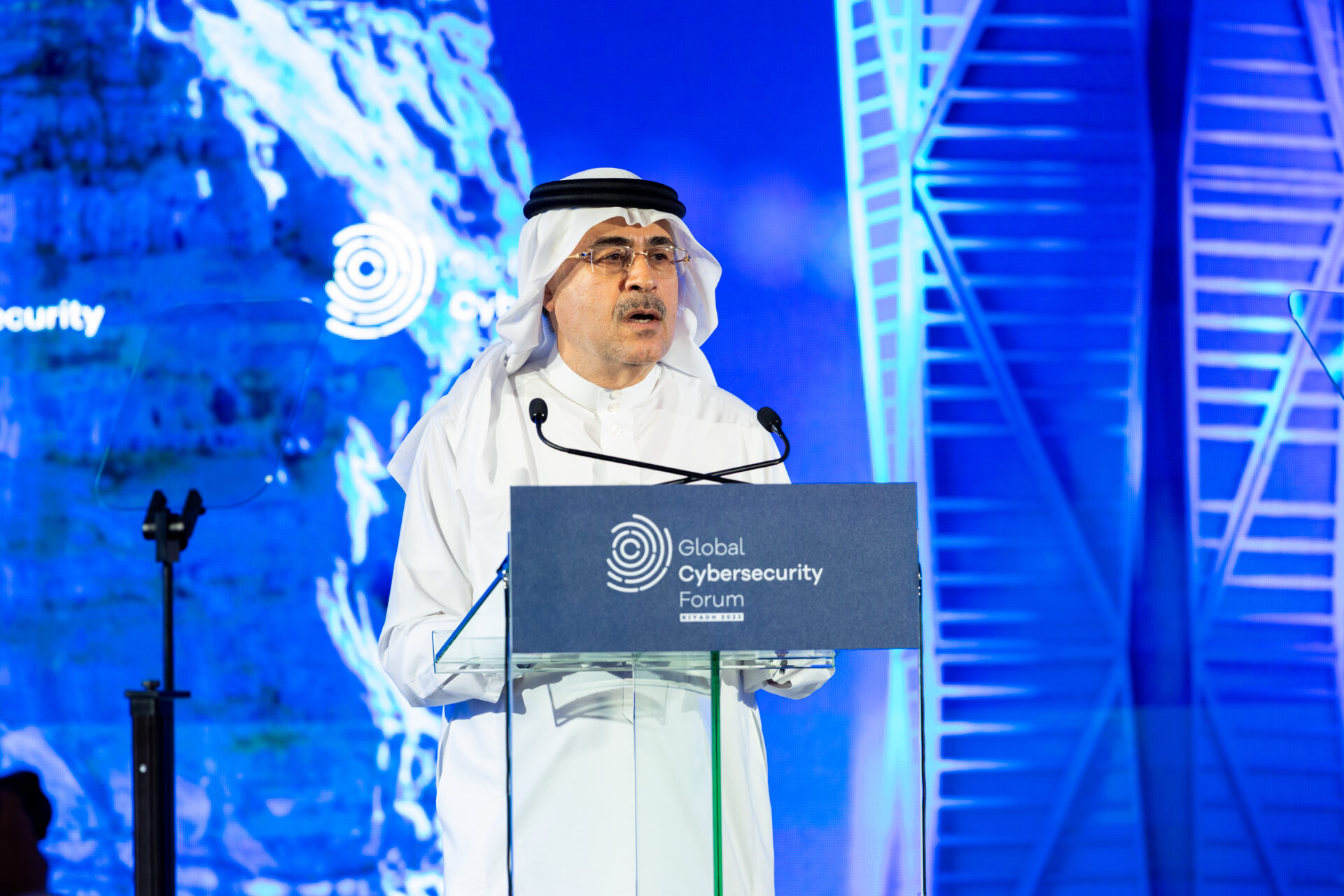
Amin Nasser speaks at the Global Cybersecurity Forum in Riyadh, Saudi Arabia on Nov. 1, 2023 (Courtesy GCF)
The head of Saudi Aramco called for an international set of rules to govern artificial intelligence and protect businesses from security breaches. CEO Amin Nasser told a packed hall today at the Global Cybersecurity Forum in Riyadh he believes in “international standards that can keep pace with the rapid development of AI,” The Circuit’s Kelsey Warner reports.
Ramping up: The stakes are high. Aramco was the victim of one of the biggest cyber attacks in the internet era in 2012 that threatened to shut off 10% of global oil supply. On Wednesday, Aramco’s venture capital arm, Wa’ed Ventures, invested in SpiderSilk, a UAE startup that offers AI-powered cybersecurity services. The $500 million fund led the $9 million round and signed a collaborative agreement as the state-oil business – and world’s No. 3 most valuable company – pushes to ramp up its cybersecurity offerings.
Decisive week: The Riyadh forum is being held against a backdrop of massive global interest in how the development of artificial intelligence will be governed and the direction of AI regulation starting to take shape. Technology leaders are reacting to an executive order from the Biden administration earlier this week, one of the farthest-reaching policies on the use of artificial intelligence ever set out. In a decisive week for the future of online safety, the forum in Riyadh is the Arab world’s part of the conversation.
Gulf locks in its own fintech unicorn with Tabby payment platform
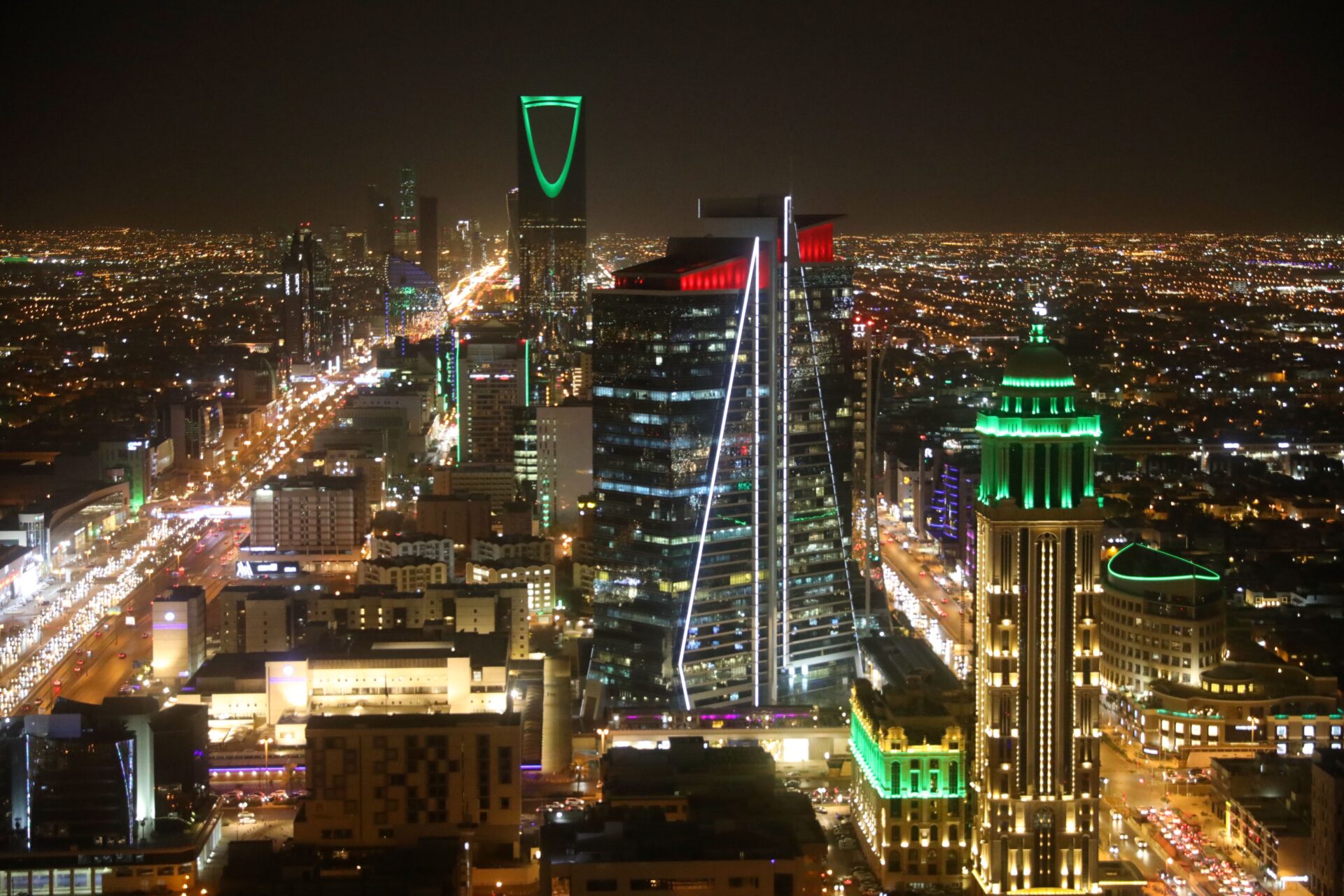
A nighttime view of Riyadh, Saudi Arabia (Sui Xiankai/Xinhua via Getty Images)
Bucking a global trend of valuation corrections, the Gulf has its first fintech unicorn with Tabby. The Saudi “buy now, pay later” (BNPL) startup has been valued at $1.5 billion after raising $200 million in a series D funding round as it prepares to go public on the kingdom’s stock exchange, The Circuit’s Kelsey Warner reports.
Raising funds: U.S.-based Wellington Management led the round, with participation from Hong Kong’s Blue Pool Capital and existing investors Abu Dhabi sovereign wealth fund Mubadala Investment Capital, Saudi Arabia’s STV Ventures, PayPal Ventures and Hong Kong’s Arbor Ventures.
IPO-Ready: Tabby, founded in Dubai in 2019, relocated to the Saudi capital of Riyadh in September as part of plans to list on the Tadawul stock market. The company manages over $6 billion in annual transaction volume and has 10 million users across Saudi Arabia, the UAE and Kuwait. The platform works with over 30,000 brands, including 10 of the largest retail groups in the MENA region as well as Amazon, H&M and SHEIN.
Jostling rivals: BNPL is a kind of short-term financing that lets online shoppers make purchases and pay for them in installments, with companies integrating their payment platform into e-commerce sites, an offering that has taken off in the Middle East with several players popping up: Tamara, Postpay and Cashew are among those jostling for share in the region.
Public Investment Fund: The Saudi fund is open to entering into more joint ventures with foreign companies, like its $500 million investment in a car factory with Hyundai, Abdulmajeed Alhagbani, head of MENA securities investments, told The National. PIF’s NEOM, meanwhile, produced a short video update showing its progress in building The Line urban living space, Trojena ski slopes, Sindalah resort island and other elements of the $500 billion project. And Bloomberg takes a deep dive into how PIF is both a force for modernizing Saudi Arabia and a tool for moderating the kingdom’s international image through investments in sports, tourism and the environment.
Mubadala: Mubadala issued $750 million of environmentally focused “green bonds” in an offering 9 times oversubscribed with high demand from the U.S., Europe and Asia. Meanwhile, the co-heads of Mubadala’s new Capital Solutions unit talked to Public Equity International about evergreen funds, separately managed accounts and a new Abu Dhabi platform for making acquisitions.
Abu Dhabi Investment Authority: ADIA participated in an anchor round by India startup Honasa Consumer, the parent firm of skincare brand Mamaearth, ahead of its dual listing on the National Stock Exchange and the Bombay Stock Exchange. Over three dozen asset managers, including ADIA, Fidelity, Norges Bank, Invesco and Goldman Sachs were issued shares totaling around $92 million.
Circuit Chatter
⛽ Pumped Up: Saudi Arabia recorded its first quarterly growth contraction since the start of 2021 after the kingdom cut oil production to push up prices.
💵 Founders Flocking: Abu Dhabi’s subsidized startup community Hub71 is welcoming a new cohort of 23 startups, with a significant number coming from the U.S.
🏭 Gas Rights: British Petroleum, Azerbaijan’s SOCAR and Italy’s Eni are partners in business groups that won Israeli licenses for offshore gas exploration projects.
🚘 Casablanca Carmaker: French automaker Renault said it will manufacture its new Kardian model car at its factory in Casablanca, Morocco.
✈️ Royal Gateway: Abu Dhabi International Airport, which opens its new Terminal A this week, will be renamed Zayed International Airport.
🏢 On the Brink: WeWork, which has Middle East coworking spaces in the UAE and Israel, plans to file for bankruptcy as early as next week, the Wall Street Journal reports.
🛢️Leaving Pakistan: Shell Petroleum Co. plans to sell its Pakistani unit to Saudi Arabia’s Wafi Energy by late 2024 after losses led to its decision to exit the country.
🛫 Desert Getaway: Saudi Arabia will build a second airport terminal in its ancient western heritage site of AlUla, boosting capacity to 6 million passengers from 400,000.
Closing Circuit
🚕On the Meter: The Dubai Taxi Authority will seek to raise $300 million from an IPO managed by Bank of America, Citigroup and Emirate NBD Capital, Bloomberg reports.
🛣️ Electrified Fleet: Uber is applying part of its $800 million global Green Future initiative to accelerate efforts to electrify its automotive fleet in the UAE.
💻Cyber Sale: Palo Alto Networks announced it will buy Israel’s Dig Security for an undisclosed price, which Calcalist reported to be $315 million.
🗞️ News Battle: First Abu Dhabi Bank provided the UK’s Barclays family with financing for its $1.2 billion to regain control of London’s Telegraph newspaper, Sky News reports.
🇿🇲Metal Miner: International Holding Co., Abu Dhabi’s largest publicly traded company, has expressed interest in buying control of Zambia’s Mopani Copper Mines in a deal that could cost more than $1.5 billion, the Financial Times reports.
🌟Golden Licenses: Samsung and three other companies received so-called golden licenses from the Egyptian government to facilitate some $487 million in investments.
🏡Prime Real Estate: UAE developer Aldar Properties posted a 48% year-on-year increase in third-quarter net profit, amounting to $245 million, and said it is eyeing Europe for expansion.
💵 Cyber Seeds: Tel Aviv-based SYN Ventures has raised $75 million for seed capital in Israeli cyber startups.
💵 AI Video: Guidde, an Israeli startup that uses AI for producing how-to guides videos, raised $11.6 million in a Series A financing round led by Norwest Venture Partners.
💵 Going Digital: One Zero, an Israeli digital bank, is seeking to raise as much as $100 million in a private placement led by Deutsche Bank, Globes reports.
On the Circuit
Greg Norman, CEO of LIV Golf, told reporters at Trump Doral he has zero concern for the league’s future or his role in it.
Abdulla bin Touq, the UAE’s Minister of Economy, called for boosting cooperation among Middle East countries to build tourism, speaking at the UN World Tourism Organization’s general assembly in Samarkand, Uzbekistan.
Tarek Amin, former CEO of Japan’s Rakuten Mobile and Rakuten Symphony, has been tapped as CEO of Aramco Digital, a business set up recently by Saudi oil giant Aramco.
Dana White, CEO of Ultimate Fighting Championship, called Abu Dhabi “one of my favorite places in the world” as he signed an agreement to extend a partnership – including more Fight Nights – with the emirate through 2028.
Adam Neumann, the founder of Flow, who hopes to disrupt the residential real estate industry like he did the office market with WeWork, held a pitch session for startups yesterday at the FII conference in Riyadh.
Akbar Al Baker, CEO of Qatar Airways for 25 years, is stepping down in November, to be succeeded by Badr Mohammed Al Meer, COO of Doha Hamad International Airport.
Culture Circuit
⚽ Sole Competitor: Saudi Arabia became the single bidder to host soccer’s 2034 World Cup after Australia decided not to submit an application to the FIFA organizing committee. The kingdom’s unopposed bid will accelerate its push into soccer, which is part of its broader expansion into global sports, according to the Financial Times. Saudi clubs spent more than $800mn on transfer fees over the summer to bring big-name players to its domestic league.
🏎️ At the Track: The Abu Dhabi Grand Prix is expected to take place as scheduled on Nov. 26 but Formula 1 officials are reportedly closely monitoring the situation in Gaza and Israel. The safety issue of holding races in the Middle East was raised during a meeting of team owners earlier this month in Austin, Texas. The annual event at Yas Marina Circuit is a major date for Abu Dhabi tourism. More than 160,000 visitors attended the F1 season finale last year, with more than 60% traveling from overseas.
🥊 Fight Capital: The growing popularity of championship boxing, professional wrestling and martial arts in the UAE and Saudi Arabia is propelling the two Gulf states into challenging Las Vegas as the world’s fight capital, the Guardian reports.
Ahead on the Circuit
Nov. 2, Dubai, UAE: Fast Company World Changing Ideas Summit. A gathering of government officials, venture capitalists and social entrepreneurs to discuss innovation trends in the Middle East. Dubai Museum of the Future.
Nov. 13-17, Dubai, UAE: Dubai Airshow. One of the largest gatherings of the aviation and aerospace industries in the world featuring live aircraft demonstrations. Dubai World Central.
Nov. 15 & 16, Riyadh, KSA. Misk Global Forum. The biggest youth gathering in the region, hosted by the Mohammed Bin Salman Foundation, this year under the theme “The Big Now” to encourage young people to think ambitiously and act quickly. Bujairi Terrace.
Nov. 17-19, Manama, Bahrain. IISS Manama Dialogue. A unique forum for government ministers and policymakers, as well as the private sector, to debate the Middle East’s most pressing foreign policy, defense and security challenges. The Ritz Carlton.
Nov. 22-26, Abu Dhabi, UAE: Abu Dhabi Art. The fair brings together a number of local and international galleries offering artworks for sale which are shown alongside exhibitions, artist commissions and installations both at the fair and across the emirate. Manarat Al Saadiyat.
Nov. 27-28, Dubai, UAE: Dubai Future Forum. The forum brings together futurists, foresight practitioners and experts from academia and various industries as well as government to anticipate challenges, share foresight and shape the future. Museum of the Future.
Nov. 27-29, Abu Dhabi, UAE: Fortune Global Forum. A gathering of leaders from the world’s biggest multinational companies discussing the dynamic frontiers of global business. Location to be announced.
UAE’s G42 teams up with Viola in Israel to address worldwide tech employee shortage
TEL AVIV – A government-owned technology company in the United Arab Emirates and Israel’s largest private investor in tech firms launched Thursday a joint venture aimed at providing computer engineers and other skilled employees to businesses around the world.
The new company, Global Valley, will be based in Abu Dhabi, the UAE’s capital, and address an international shortage of programming talent. It’s the product of collaboration between Abu Dhabi’s G42, which has interests ranging from biotechnology to artificial intelligence, the Abu Dhabi Investment Office (ADIO) and Israel’s Viola Ventures, which has $5 billion in assets under management, they said in a statement.
Global Valley is also a banner project for the Abraham Accords, which normalized ties between the UAE and Israel in September 2020 and has generated $3.8 billion of trade volume between the two countries. G42 is controlled by Sheikh Tahnoon bin Zayed, the UAE’s national security adviser and younger brother of UAE President Mohamed bin Zayed, ruler of Abu Dhabi.
The new company will strengthen Abu Dhabi as a “dynamic hub for technological advancement and business prowess,” G42 Group Chief Executive Peng Xiao said in a statement on Thursday. Avi Zeevi, a co-founder and general partner of Viola, said Global Valley “will provide tech companies, in Israel and globally, with the best-of-class tech talent to fuel their future growth and support their activities in the region.”
While the ongoing global economic slowdown has led to layoffs that increased the supply of tech workers, the industry expects the employee shortage to grow. A study by the consulting firm Korn Ferry predicts a global talent gap by 2030 of some 85 million employees in the telecommunications, media and technology sector.
Since the normalization agreements, ADIO has also collaborated with OurCrowd, a Jerusalem-based venture capital that established an AI development center in Abu Dhabi, and Liquidity Group, a Tel Aviv-based lender specializing in fintech companies that opened an R&D center in the UAE capital. In December, Abu Dhabi’s ADQ investment firm agreed to buy control of Phoenix Holdings, Israel’s biggest insurer, for about $675 million. The deal is under regulatory review in Israel.
Global Valley “builds on the enthusiasm generated by the Abraham Accords, which continues to create important collaborations in sectors focused on innovation and advanced technology,” said ADIO Director General Abdulla Abdul Aziz AlShamsi.
Israeli start-ups confront economic slowdown + Arab culture on DC’s National Mall
👋 Good Monday morning in the Middle East!
Israeli Prime Minister Naftali Bennett’s coalition government has collapsed and the business community is yawning. As the Knesset, Israel’s 120-seat parliament, debates this week when to schedule the next round of elections – likely to be held in early November – tech industry leaders who have been driving economic growth see little impact from the government’s instability. What does make a difference is the prospect of recession in the U.S., where funding for startups is getting harder to tap, as Entrée Capital founder Avi Eyal tells The Circuit below.
Techno Campus: Many of those leaders will be milling around Tel Aviv University for Cyber Week, the annual jamboree that draws prominent figures in the digital security realm. Among corporate figures expected on campus are Check Point Software CEO Gil Schwed, CyberArk CEO Udi Mokady and Jane Horvath, Apple’s chief privacy officer. From the White House come both National Cyber Director Chris Inglis and Deputy National Security Advisor for Cyber and Emerging Technologies Anne Neuberger. Prime Minister Bennett, a former cybersecurity CEO, had been scheduled to address the conference, but his appearance is in question due to recent political circumstances.
Trending in the Gulf: Analyzing future business trends in the Middle East was top of the agenda at last week’s Qatar Economic Forum, although more headlines were generated from a video interview during the conference with billionaire Elon Musk. In Washington, the United Arab Emirates introduced Americans to Gulf Arab culture with a weekend fair of music, crafts and food on the National Mall, as The Circuit’s Gabby Deutch reports.
Welcome to The Weekly Circuit, where we cover the Middle East through a business and cultural lens. Read on for the stories, deals and players at the top of the news. Please send comments and story tips to [email protected].
Circuit Interview
Entrée Capital’s Eyal pushed start-ups to raise cash quickly, prepare to slash expenses
Avi Eyal, co-founder of Israel-based Entrée Capital, said he and his partners have spent the past year trying to prepare cash-burning startups for the economic slowdown that has hit technology businesses around the world. The venture capital firm, one of the biggest operating in Israel, manages about $1 billion in assets and has current investments in some 150 companies internationally. His message last year — the most lucrative ever for Israeli technology — was that CEOs should accelerate fundraising efforts and determine where expenses could be reduced.
Backup Plan: “We actually went to most of our portfolio companies, and in between June and December, we raised money for the bulk of them,” Eyal said in an interview with The Circuit’s Jonathan Ferziger. “At the same time, we told all the companies to have a backup plan, have a simulation of how they would cut costs very quickly, and how they would use that money, not to achieve the same growth but to achieve a quarter of their profits or less,” he said, “Some did, some didn’t.”
Serial Entrepreneur: Born in Israel and raised from age 6 in South Africa, Eyal is an engineer and a serial founder of start-ups who opened Entrée Capital in 2010 with internet entrepreneur Martin Moshal, a childhood friend. The firm was an early investor in Monday.com, a maker of workplace management software that held its initial public offering on the Nasdaq a year ago, and fraud-detecting Riskified, which trades on the New York Stock Exchange. Tracking the markets, both have shrunk in value since their 2021 IPOs.
Gulf Investments: Recently, Entrée has been investing in the Gulf, deepening relationships with Mubadala, the $284 billion Abu Dhabi sovereign wealth fund, and other Emirati businesses, after starting quietly before the September 2020 Abraham Accords. As the collapse of Israel’s coalition government sets up the fifth national election in three years, Eyal, 51, said the political instability holds much less of a threat to tech companies than the prospect of recession in the U.S., where many seek to raise money. “Governments come and go and I don’t think it has any impact on the technology space,” he said.
Elon Musk, oil prices, World Cup soccer dominate stage at Qatar Economic Forum
Heads of state, oil executives and the richest man in the world pondered the prospects for a U.S. recession last week during the Qatar Economic Forum. The three-day conference in the capital city of Doha focused on matters ranging from the global economic slowdown and escalating crude prices to whether Qatar can rustle up enough beds to handle 1.2 million ticket-holders for soccer’s 2022 World Cup in November.
Twitter Riddle: Elon Musk, however, stole the show when he injected new uncertainty into the question of whether he will ultimately buy Twitter and talked about where he’s spending other portions of his $220 billion personal fortune. Musk, the 50-year-old chief executive of electric carmaker Tesla and rocket company SpaceX, said there were still “unresolved matters” holding up his $44 billion bid for the popular social media platform.
Recession Inevitable: Asked about the U.S. economy in an interview by video feed with John Micklethwait, editor-in-chief of Bloomberg News, Musk said a recession is inevitable and outlined the job cuts he’s ordered at Tesla that will reduce the salaried workforce by 10%. “As to whether there is a recession in the near-term, that is more likely than not.”
Energy Deals: Also at the conference was ExxonMobil CEO Darren Woods, who said oil companies will need three to five years to “catch up” on the investments required to assure adequate world supply. He spoke on a panel with Qatari Energy Minister Saad Al-Kaabi, with whom he also signed an investment agreement to take a 6.25% stake in Qatar’s $29 billion North Field liquefied natural gas project.
An Emirati ‘majlis’ presents Arab culture at Smithsonian Festival on the National Mall
On a scorching summer afternoon, tourists to Washington, D.C., came to relax in the shade of the makeshift wooden majlis, Arabic for a sitting room,on the National Mall. The Washington Monument towered in the background. Children picked up brushes to paint watercolor pictures of flowers. A veiled Emirati girl held a falcon on her wrist, demonstrating the Bedouin discipline of handling the predatory bird.
Traveling Falcons: The dozens of interactive demonstrations and events were part of this year’s Smithsonian Folklife Festival, spotlighting the culture of the United Arab Emirates. More than 90 participants flew in from the UAE to showcase the nation’s vibrant, diverse culture. (No special plane was needed for the falconry participants; travelers on Etihad Airways can bring a caged bird with them on the plane.)
Saffron Perfume: Mona Haddad, a young woman mixing scents from saffron and rosewood to create perfumes, said she learned the craft from her mother. She dabbed a bit of oil on her fingers and rubbed it behind one visitor’s ears, telling her the fresh scent would last for three days. The festival concludes its first week on June 27 and picks up again from June 30-July 4.
Russian Exit: Russian commodities dealers are leaving Switzerland and setting up businesses in Dubai because of sanctions stemming from Russia’s invasion of Ukraine, which are making it difficult for them to operate.
DXB-TLV: Emirates Air inaugurated daily flights between Dubai and Tel Aviv, joining five other UAE and Israeli carriers that fly the route.
Spanish Trains: Etihad Rail signed an agreement with Spain’s CAF Group worth $327 million to supply passenger trains for the UAE’s new rail network, connecting 11 cities across the country.
Friendly Skies: Qatar Airways said the company is trying to work with Saudia, Kuwait Airways and other Gulf airlines to enable soccer fans to get to Qatar for the World Cup in November.
Egyptian Spree: Saudi Arabia and Egypt signed 14 investment deals worth $7.7 billion during a visit to Egypt by Saudi Crown Prince Mohammed bin Salman, including an agreement to build the Egypt Center for Petroleum and Petroleum Products Storage.
Orbiting the UAE: Abu Dhabi-listed companies International Holding Company and Alpha Dhabi will invest a combined $50 million in Elon Musk’s SpaceX.
African Medicine: The UAE’s Etihad Credit Insurance Co. and Israel Export Insurance Corp. agreed to collaborate in financing construction of four hospitals and a medical storage facility in Ghana.
Closing Circuit
On the Radar: U.S. aerospace company Leonardo DRS will acquire Israel’s RADA Electronic Industries, which makes tactical radar systems, paying a 34% premium in a deal that values Rada at $775 million.
Energy Trade: The Abu Dhabi National Energy Company and Abu Dhabi National Oil Company will acquire major stakes in Masdar, an Emirati renewable energy company, from Abu Dhabi’s sovereign wealth fund, Mubadala Investment Company, in a deal that values Masdar at $1.9 billion.
No Borders: Israeli e-commerce platform Global-e Online said it will buy Borderfree, which specializes in international shipping, from Pitney Bowes in a $100 million cash deal.
Flying High: Israir, which runs a low-cost Israeli airline and tourism business, raised $7.3 million in an IPO on the Tel Aviv Stock Exchange.
Dream House: Huspy, a UAE-based home financing startup, raised $37 million in a Series A funding round led by Sequoia Capital India, with participation from the San Francisco-based Founders Fund.
No Hacking: U.S. media giant Comcast agreed to acquire Levl, an American-Israeli startup that develops technology for authenticating wireless devices, for an estimated $50 million.
Buy More: Israel’s Amy, which uses artificial intelligence to help sales representatives build relationships with customers, raised $6 million in a seed round of funding co-led by Next Coast Ventures and Lorne Abony.
Very Large: Abu Dhabi-based Al-Seer Marine bought two ships known as VLCCs (very large crude carriers) and worth $110 million to expand its fleet amid higher global oil demand.
Making Babies: AiVF,an Israelifertility tech startup, raised $25 million fromInsight Partners and WeWork founder Adam Neumann’s family office.
Startup Fund: Vine Ventures, a New York-based early-stage venture capital firm, raised $140 million for its second fund, with half of the money dedicated to Israeli startups.
On the Circuit
Yair Lapid: The Israeli foreign minister and leader of the Yesh Atid party is expected to become acting prime minister this week, replacing Naftali Bennett, as the Knesset decides when to schedule new elections after the splintering of the government coalition.
Ted Sarandos: The Netflix CEO met Israeli Communications Minister Yoaz Hendel in a bid to stop international streaming services from being required to produce original material in Israel. He said Netflix may reduce investment in Israel if the law is passed.
Moti Eliav: Intuit appointed Eliav as site leader and general manager for the U.S. software company’s activities in Israel, succeeding Gene Golovinsky.
Ahead on the Circuit
June 27-30, Tel Aviv: Cyber Week. International conference brings companies from 80 countries to talk about latest trends in digital security. Tel Aviv University.
July 4, Haifa: Blue 2022 Economy Conference. Maritime industry leaders meet with government, energy and environmental figures, launch National Center for Innovation and Blue Economy. Bahai World Centre.
July 19, Nazareth: Economic Conference on Arab Society in Israel, Central Bank Governor Amir Yaron meets business and government leaders. Golden Crown Hotel.
Circuit Culture
Saudi Netplay: After Saudi Arabia rattled the Professional Golf Association by organizing a rival tournament earlier this month and offering star players as much as $200 million to join, the kingdom has approached the Women’s Tennis Association about hosting an event. Golfers who participated in the LIV tour were accused of “sportswashing” Saudi human rights abuses, including the 2018 murder of dissident journalist Jamal Khashoggi.
Circle of Life: Abu Dhabi will host “The Lion King” in November when the Tony Award-winning Disney musical makes its Middle East debut with a four-week run at the Etihad Arena.
Classical to Klezmer: Israel’s annual Voice of Music Festival offers performances this week ranging from classical and jazz to klezmer and oud at Kibbutz Kfar Blum in the Upper Galilee. June 28 to July 2.
Top Israeli energy official describes role of investors in promoting sustainable energy
LOS ANGELES — Gideon Friedmann, the acting chief scientist at Israel’s Ministry of Energy detailed on Wednesday how the country plans to transition to renewable energy and urged private investors to fund research in the field. Government support is important, said Friedmann, but investors will need to more forcefully enter the market if countries hope to work toward net-zero emissions.
“The private sector is not doing very well, because everyone here wants to get their return, and [a] high return. And it’s not easy to get a high return on infrastructure,” or a quick return, Friedmann told attendees at a panel at the Milken Institute Global Conference. According to Friedmann, it takes up to 15 years to build a power line, for instance, so any kind of fast returns would be impossible.
At several sustainability-focused panels at Milken, environmental experts and financial professionals urged investors to consider putting more money into the research and development of technologies such as carbon capturing and bringing deep geothermal heat out of the ground.
Developing new technologies may yield smaller returns in the short-term, Friedmann argued, but it will pay dividends as more countries move away from fossil fuels.
“The money’s there,” Friedmann said, referring to private investments in established renewable companies focused on solar. “But it’s not, of course, geared towards research and development.”
Israel is looking at the transportation and electricity sectors — responsible for 85% of emissions in Israel — as the key areas to reduce emissions, said Friedmann.
Israel is a small country, “and so the way we think about innovation is that we are not going to set the trends. Trends are going to come from the outside,” noted Friedmann. Instead, Israel — due to its size — can be early to adopt new technologies and trends.
Israel discovered natural gas reserves off its coast more than a decade ago, and natural gas is now used “as a bridge” in the transition to sustainable energy “because it’s much less polluting” than oil, explained Friedmann. “So natural gas is a solution, but we want also to convert the natural gas to something cleaner. We want to invest in R&D to do that.”
Other investment into research and development can come from the government, Friedmann added. “It’s so important to have government investment in these areas,” he said. Last year the Israeli government invested $60 million in research and development, but the bulk of the investments will need to come from private capital.
“We also work on international collaboration,” Friedmann said. Israel is now collaborating with the United Arab Emirates, with which it normalized ties in late 2020, on a number of climate-related projects.
“There’s a lot of activity going on between the UAE and Israel,” Friedmann said. “It’s not in my area particularly. There’s a lot of discussion as well on R&D but nothing particularly yet. But I think in the near future there will be.”