Abu Dhabi hotels test checking in guests with facial recognition
Abu Dhabi is testing a facial recognition system to verify guests and speed up the check-in process at hotels across the emirate.
The system, unveiled this week during Dubai’s Arabian Travel Market conference, is now in its pilot phase at a handful of hotels.
If the test goes well, it will be rolled out to all five-star hotels in Abu Dhabi city and the Al Ain and Al Dhafra regions, with four-star establishments targeted for a future date.
The project, led by Abu Dhabi’s Department of Culture and Tourism and the Federal Authority for Identity, Citizenship, Customs & Port Security, is a part of the UAE’s wider push to use technology to boost government efficiency and improve customer service.
Through some are opposed to use of facial recognition on privacy grounds, travelers to the emirates are already familiar with biometric systems, which are widely used in the UAE’s airports.
Upgrades to Abu Dhabi’s Zayed International Airport are eventually expected to eliminate the need for travel documents altogether.
The Daily Circuit: Clinton tips Saudi real estate + QIA invests in quantum
👋 Hello from the Middle East!
In today’s Daily Circuit, we’re looking at Alpha Dhabi’s acquisition of the UAE’s national hotel company, the QIA’s investment in quantum computing, Ulta Beauty’s entry into the Middle East cosmetics market and the inauguration of a $17.4 billion Emirati-French fighter jet deal in Paris. But first, Bill Clinton recommends investment in Saudi real estate.
Developers of New Murabba, Neom, Diriyah and other multi-billion-dollar construction projects across Saudi Arabia occupied center stage this week at the Real Estate Future Forum in Riyadh.
Until former U.S. President Bill Clinton mounted the podium Wednesday night at the Four Seasons.
Praising Crown Prince Mohammed bin Salman’s Vision 2030 plan that set off a torrent of building activity across the kingdom, Clinton told a packed ballroom, “It’s worth investing in.”
The 78-year-old statesman, who met with MBS earlier in the day, added: “I think that we Americans should come here and study this 2030 plan and ask ourselves what is our equivalent,” Arab News reports.
Clinton capped the final day of the conference in Saudi Arabia’s capital, where the cube-shapped New Murabba development promises to be the “most complex structure known to man or woman,” the project’s CEO Michael Dyke told a conference panel.
“We will have something like two to three Empire State Buildings on each corner, which anchor the four corners of Mukaab,” Dyke said. At the center will be a residential tower the size of the Eiffel Tower “that will be the only skyscraper in the world that lives inside another building.” “Below the ground is enormous as well,” he said, adding, “It’s a complete cavernous labyrinth of various different asset classes” with retail space “the size of Dubai Mall that will be capable of extending to be bigger.”
Welcome to the Daily Circuit. Kindly let us know your thoughts and feedback by replying to this newsletter or emailing us at [email protected].
📰 Developing Stories
MERCI BEAUCOUP
The UAE’s Ministry of Defense inaugurated its first Rafale fighter jet at a ceremony in Paris, marking a milestone in its $17.4 billion deal with France’s Dassault Aviation. Considered one of the world’s most advanced combat aircraft, the acquisition of 80 Rafale jets is part of a broader modernization of the UAE’s defense capabilities. “Our strategy focuses on acquiring the most advanced weaponry and systems that align with the evolving nature of modern warfare and technological advancements,” Mohamed Al Mazrouei, Minister of State for Defense Affairs, said. Al Mazrouei was joined by French Defense Minister Sebastien Lecornu and other representatives from France and the UAE.
RAIN DANCE
The UAE is offering grants of up to $1.5 million for three winning projects in the sixth cycle of the UAE Research Program for Rain Enhancement Science. The country, which is largely desert, has been funding scientific research for cloud-seeding projects as part of broader attempts to improve water security and grow its agricultural sector. The grant will fund each winning project over three years, with a maximum annual amount of $550,000. Proposals are sought in five core areas: optimized seeding materials, novel cloud formation systems, autonomous UAS, limited-area climate interventions, and advanced models/software.
💲 Sovereign Circuit
International Holding Co.: Alpha Dhabi Holding, which is controlled by Sheikh Tahnoon bin Zayed’s IHC, acquired a 74% interest in the UAE’s National Corporation for Tourism and Hotels.
Qatar Investment Authority: The sovereign wealth fund, together with Bpifrance, raised $104 million for quantum computing company Alice & Bob, which is based in Boston and Paris.
Mumtalakat: A proposal to sell off parts of Bahrain-owned Gulf Air, with 51% retained by the kingdom’s Mumtalakat sovereign wealth fund, met strong opposition in Parliament on Wednesday, the Gulf Daily News reports.
↪↩ Closing Circuit
💲 Money Scout: Arcapita Group Holdings, a Bahrain-based alternative investment firm, is planning a $1 billion Middle East real estate investment trust, Bloomberg reports.
🏪 Shop Drop: Leading Saudi retailer BinDawood Holding secured an $80 million Sharia-compliant loan from Emirates NBD Saudi Arabia to partially fund its $118 million acquisition of Zahrat Al Rawdah Pharmacies.
☀️ African Energy: Ignite Power, an Abu Dhabi-based provider of distributed renewable energy, signed an agreement to acquire 100% of Engie Energy Access, creating a company to be named Ignite Energy Access that will operate in 14 African nations. Terms of the deal, pending regulatory approval, were not disclosed.
🚙 Car Check-Up: UVeye, an Israeli startup that uses AI to improve vehicle inspection systems, raised $191 million in a funding round led by Toyota’s Woven Fund, which made a $41 million equity investment.
🗣 Circuit Chatter
💄 Looking Good: Ulta Beauty, which runs a U.S. chain of cosmetic boutiques, is teaming up with franchise operator Alshaya Group to open its first stores in the Middle East.
💸 Heir Transplant: A historic shift in generational wealth is unfolding in the Middle East, with $1 trillion expected to be transferred by families to their heirs by 2030, according to a research paper by the DIFC Innovation Hub, Julius Baer, and Euroclear.
🌎 Culture Hub: Dubai Media Inc. launched Dar Al Bayan Publishing House, a new venture aimed at fostering innovation in publishing, at the 17th Emirates Airline Festival of Literature 2025.
✈️ Fly U.K.: A Saudi government delegation met in London with U.K. investors and government officials, seeking counsel and investment as the kingdom upgrades its airports and expands international routes
📚 Family Affairs: Dubai Centre for Family Businesses, operating under Dubai Chambers, has issued two toolkits to help family businesses resolve disputes and navigate complex relationships.
🌍 Power Circuit
Qatar’s Emir Sheikh Tamim bin Hamad Al-Thani landed in Damascus on Thursday, the first visit to Syria by an Arab head of state under the country’s interim government.
Sheikh Shakhboot bin Nahyan, UAE Minister of State, led the Emirati delegation participating in the African Heads of State Energy Summit in Dar es Salaam, the capital of Tanzania.
Sheikh Maktoum bin Mohammed, First Deputy Ruler of Dubai, UAE Deputy Prime Minister and Minister of Finance, chaired a meeting to review the government’s financial operational framework.
➿ On the Circuit
Faisal Al-Amadi, Director of Bilateral Reconciliation and External Offices at Qatar Development Bank, said in a statement that the ongoing Qatar-Saudi trade mission in Riyadh will open business opportunities between both countries.
Dr. Luca Delle Monache, Director of Research at the Center for Western Weather and Water Extremes, spoke to WAM about the UAE’s efforts to advance cloud seeding technology.
🎶 Circuit Culture
🖼️ Crowning Glory: Louvre Abu Dhabi is exploring the history and royalty of Sub-Saharan Africa in a new exhibition which opened on Wednesday. Kings and Queens of Africa: Forms and Figures of Power, in collaboration with Paris’ Musee du quad Branly – Jacques Chirac, brings together 350 artifacts and contemporary works delving into the traditions and mythologies of the region.
📷 Photo of the Day
Saudi Crown Prince Mohammed bin Salman received former US President Bill Clinton at his office in Riyadh on Wednesday. Also attending the meeting were Princess Reema bint Bandar, Saudi Ambassador to the U.S., and Dr. Musaed Al-Aiban, the kingdom’s National Security Advisor. (SPA)
📅 Circuit Calendar
Feb. 1-8, Abu Dhabi: Mubadala Abu Dhabi Open. Top women tennis stars compete in WTA 500 tournament. International Tennis Centre, Zayed Sports City.
Feb. 3-6, Dubai. Medlab Middle East 2025. The show attracts exhibitors whether global giants or emerging startups to discuss digital health solutions. Dubai World Trade Centre.
Feb. 4-5, Doha. Seatrade Maritime Qatar Conference and Exhibition. Conference brings industry experts, decision-makers, shipping companies and leaders in technology, energy, finance and investment. Sheraton Grand Doha Resort.
Feb. 9-12, Riyadh. Leap 2025. Riyadh’s tech event that brings in tech innovators and leading experts from around the world to discover new ideas, build new partnerships, and connect with inspiring mentors and investors. Riyadh Front Expo Centre.
Feb. 11-13, Dubai. World Government Summit 2025. Annual event brings in world leaders and business leaders from the region and outside to discuss the most pressing matters. Madinat Jumeirah.
Feb. 14-16,Munich Security Forum. Known as one of the world’s leading forums for debating international security policy. Hotel Bayerischer Hof.
Feb. 17-21, Abu Dhabi: IDEX 2025. Military contractors from around the world show their wares at one of the most prominent international defense exhibitions. ADNEC Center.
Feb. 17-21, Dubai. Gulf Food. In its 30th edition, the exhibition brings in many more companies to show their work on food and the industry’s use of technology. Dubai World Trade Center.
Feb. 18-19, Abu Dhabi. The Future of Asset Management Middle East. A two-day conference that gathers leading executives from top asset management companies in the Middle East region. The Ritz-Carlton, Grand Canal.
Feb. 22-23, Miami, Fla. FII Priority. Saudi Arabia’s Future Investment Initiative connects U.S. and Middle Eastern investors. Faena Hotel & Forum, Miami Beach.
Feb. 25, Dubai. Family Office Summit 2025. Global fund leaders managing $1 trillion in assets will meet under the theme, “Taking Money Out of Cash.” Ritz Carlton Jumeirah Beach
Saudi tourism attracts $13 billion in private sector investment
Saudi Arabia’s tourism industry has drawn about $13 billion in private sector investment, adding thrust to its campaign to attract international travelers.
The money will pay for the addition of 150,000 to 200,000 hotel rooms over the next two years, Princess Haifa M. Al Saud, Saudi Arabia’s vice minister for tourism, told Bloomberg.
Government projections call for $85 billion in tourism revenue in 2024, up from $66 billion last year.
The kingdom has been on a spending spree to spruce up historical sites such as the desert city of AlUla and the Diriyah section of Riyadh with luxury hotels and high-end restaurants.
It has also staged gaming conferences, MMA (mixed martial arts) matches and hip-hop concerts to attract younger visitors from abroad.
UAE restaurants to offer bottled water drawn from the air
PETAH TIKVA, Israel – Diners at a selection of top restaurants and hotels in the United Arab Emirates will soon find a new brand of bottled water on their tables produced from the humidity in the Gulf state’s air.
Presented in sleek blue-glass bottles with a silver cap, Ma Hawa non-carbonated water is being introduced in an Abu Dhabi-based joint venture with Watergen, the Israeli company that pioneered the process of extracting drinking water in commercial quantities from the atmosphere.
“We are now building the brand and working on a pricing strategy,” Watergen CEO Steve Elbaz told The Circuit in an interview at the company’s Petah Tikva main office near Tel Aviv.
Sales of Ma Hawa – which means water and air in Arabic – are scheduled to begin during late summer in the UAE. An official launch is planned to take place in Dubai at the United Nations climate conference COP28 in December.
Founded in 2009, Watergen is owned by Israeli-Georgian billionaire Michael Mirilashvili and uses technology developed by Israeli entrepreneur Arye Kohavi that requires only 20% humidity in the air and a temperature of least 15 C (59 F) in the facility where its generating station is housed.
“That means we can generate water everywhere around the world, except Antarctica for the moment,” Elbaz said.
Comparing the quality of Ma Hawa water to that of premium mineral water, the 38-year-old CEO offered me a glass. The chilled water, which has minerals added in the production process, was thirst-quenching, with a neutral taste. It came from one of the dispensers employees use throughout the building that are connected to two generating units on the roof.
Ma Hawa’s bottled water will initially be sold in the UAE through the joint venture, Abu Dhabi-based Baynunah Watergeneration Technologies SP LLC. The company is in talks with potential partners for its production and sale in other regions.
Watergen produces a variety of units that generate from 20 to 6,000 liters of drinking water per day. They are being used in schools, hospitals, army camps, rural villages, natural disaster areas, outdoor events and office buildings. Soon to be introduced is a unit for home use.
All the units are “plug and play” – meaning you bring them to a location, plug them into an electricity outlet and generate water. Watergen’s heat-exchange technology can produce up to five liters of water for one kilowatt of electricity. Generating water on location also helps save energy by reducing carbon-intensive transportation to remote areas and reduces the consumption of plastic bottles.
“For companies like Watergen, I think real disruption can happen when the technology is used for home use by the private consumer,” said Eliran Elimelech, vice president of strategic partnerships at Start-Up Nation Central, a Tel Aviv-based nonprofit. “For that, the price needs to be very attractive.”
SNC, which connects international governments and businesses with Israeli tech companies, has often showcased Watergen, Elimelech said. SNC also used two of the company’s units to provide 12 hours of drinking water for thousands of participants at the outdoor Climate Solutions Festival it held in Israel’s Hulda Forest last year.
“I have seen it in action,” Elimelech said. “It is fast and efficient, and there were no hiccups.”
Here’s how the Watergen technology works: a filtration system absorbs air from the environment and transfers it to the heat exchanger, which is the heart of the technology. Using proprietary software, the heat exchanger extracts the water and transfers it into a buffer tank. From there, it passes through filters and UV lamps to purify and add minerals to the water, according to specifications set out by Watergen researchers. The water is then transferred to a drinking water tank and ready for use.
In-house research teams continue to work on refining the company’s technology, along with the water’s mineralization and formula, Elbaz said. Watergen has also set up water research facilities at universities, including Tel Aviv University, Ben-Gurion University of the Negev, in Israel, and Khalifa University in Abu Dhabi, to make sure the company continues to be a leader in the field. At this point, Elbaz asserts, Watergen is “10 years ahead of any potential competitors.”
According to U.S. data firm CB Insights, competitors to Watergen include U.S. firm SOURCE Global, whose technology uses solar heat to generate water from air, India’s Uravu Labs, which in March raised $2.3 million in seed funding for its water technology that uses renewable energy to create water from air, and Kenya’s Majik Water.
Like Watergen, these firms are tapping into a need to quench the world’s growing thirst. According to the U.N., some 2 billion people globally don’t have access to safe drinking water today, and some half of the world’s population is experiencing severe water scarcity for at least part of the year. With climate change and population growth, these numbers are expected to become ever more severe.
Watergen’s units have been deployed in some 100 countries, including in hospitals and a municipality in the Gaza Strip, in a medical facility at a refugee camp in Syria and at a girls’ school in Sierra Leone.
To expand its scope, the company is now gearing up for the mass production of its units. “By year-end we will have seven production lines,” Elbaz said.
Watergen currently produces its machines through joint ventures in the UAE, the U.S., Israel and China, Elbaz said. Another joint venture with India’s SMV Jaipuria Group is in the process of opening production lines, he added, with two more partnerships on the way, though he declined to provide details.
In May, Israel’s TheMarkerreported that Watergen was going to lay off 30% of its local workforce and move its R&D lab to the UAE. Elbaz said that indeed some local workers had been laid off, but others had been relocated to the UAE, India and the U.S., to beef up local teams.
“We prefer to have those talents and brains that we have here, close to the production lines, to the customer,” he said. The company has 200 employees globally, with some 100 in Israel, though the numbers “are dynamic” because of the growing partnerships, he said. The company’s R&D will remain in Israel to continue the development of future products and solutions, he emphasized.
Watergen is a private company and reveals limited information about its finances.
Elbaz, a French immigrant to Israel 20 years ago, was appointed CEO in January after leading the firm’s mobility division for less than a year. He previously worked with VCs, startups and Skoda Auto’s innovation unit.
His role as CEO will be to steer the company through the mass production phase and seek out new markets and opportunities.
These will include making its water units mobile, utilizing solar power and putting them in cars and trucks. The firm has already forged a partnership with Skoda to equip one of its desert rally cars with a water-making device. It has teamed up with U.S. electric vehicle maker Mullen Automotive Inc. to put water generators in its EVs, and with Living Vehicle to put units powered by solar panels in its luxury trailers.
The company is also looking at creating lower-grade units to produce water for manufacturing purposes, like vehicle paint shops or textile manufacturers, and for aviation and aeronautical purposes.
Looking ahead, Elbaz said he believes Watergen’s bottled water “will gain a lot of traction” while the company develops units with lower electricity consumption and expands to wherever water is scarce.
“Water is a basic human right and this is what we can bring,” he said.
From white elephant to trendy, affordable tourism
TEL AVIV – From the outside, the Tel Aviv Textile and Fashion Center looks like a standard Israeli office building. Built starting in the 1960s in the era’s Brutalist architectural style, the center boasts six high-rise towers and a common space with a sprinkling of cheap stores and workman’s cafés that serve basic Israeli fare.
Architecturally daring for its day, this hulking whitewashed structure – one of the most iconic landmarks along the city’s coastline – has long been in decline both as an industry hub and an office option for emerging companies. Much of the expansive, concrete complex now stands peeling and neglected.
Cue the arrival of the Brown Hotel Group. One of the country’s fastest-growing hotel chains, its motif is setting up shop in unlikely places and in the process regenerating and reimagining some of the more down-and-out locations as sustainable and affordable tourist hubs.
Among its latest offering is Brut – a play on Brutalist – a 224-room boutique hotel that sits interspersed throughout various floors in Gaon House, one of the Textile and Fashion Center’s towers.
The hotel opened last April with just 182 rooms, but as business and companies ended their leases in the crumbling building, Brown took over the space, renovating and opening more rooms and facilities as travelers began to return to Israel amid relaxed COVID-19 restrictions.
It’s part of the hotel operator’s urban renewal philosophy, Shahaf Segal, PR manager and spokeswoman for the Brown Hotel Group, explained to The Circuit. She listed a similar process for the group’s 13 other hotels dotted around the city (there are also now Brown Hotels in Jerusalem, Eilat, Greece and Cyprus), as well as some now under construction in other iconic landmarks, including one slated to open in the historic former Histadrut worker’s union building.
Each hotel, some with just a handful of rooms and others more expansive like Brut, has a slightly different vibe, but the overall goal is to convert existing buildings, as well as the areas around them, into reasonably priced lodgings and tourist centers in expensive cities.
“We are taking unoccupied spaces and turning them into positive spaces,” Segal said, pointing to the reception desk, which still shares space with a security team servicing the remaining offices in the building, and to the hotel’s back office, which until recently was occupied by a hair clinic offering transplants in Turkey.
The intriguing and intricate process of renewal and replacement can be seen throughout the hotel. Brut’s rooms now occupy the first, second, third, seventh and 14th floors, and are still interspersed with a medical clinic, a car rental office, insurance brokers and accountants.
Brut Hotel lobby (Photo: Max Kovalsky)
And there is a range of different room styles, spanning from a basic “urban room” to an executive suite with a breathtaking sea view to a two-room family suite replete with a kitchenette. All the rooms are simple in design and practical, and all incorporate unique elements of the building’s original architecture with many of the signature features of a Brown Hotel: wire metal shelving, ecologically friendly soaps and a coffee maker.
In the executive suite on the 14th floor, unparalleled views of the Tel Aviv coastline and the sea beyond fill the purposely slanting windows, which the building’s designers hoped would be effective in deflecting the powerful rays of the Middle Eastern sun. Now they give guests the feeling they are floating above the earth or have been set adrift to sea.
On the seventh floor, the VIP lounge contains a modest conference center for business meetings or small gatherings. Its colorful decor captures the heart of the hotel’s urban renewal process, with re-upholstered and reconstructed ‘70s style furniture, couches, bookcases and even a collection of typically drab Israeli pottery from that era.
A third-floor sun deck also boasts views of the Mediterranean and Brown’s signature hot tubs. On the ground floor, the center’s long-neglected communal areas have been spruced up and furnished with comfortable outdoor couches, hammocks and oversized plants for both guests and the remaining office workers to enjoy.
Also on the ground floor, Brown has taken over a long-forgotten restaurant, reopening it as the Kilometrage, with dishes created by celebrity chef Idan Bushari, winner of Israel’s “Next Restaurant” reality show. In the morning, the restaurant space doubles as the hotel’s breakfast buffet (which is a modest but delicious Israeli-style breakfast), but in the evening the music is turned up and the well-stocked bar and taboun-themed menu attract young Tel Avivians looking to be wined and dined.
And the Brut is not the only Brown group hotel to find a new home in this aging office complex. In an adjacent tower sits WOM, one of the group’s less expensive affiliates. Not exactly a hotel, at least not in the classic sense, and though it veers towards the communal lodging style of a hostel that is popular across Europe and in Israel, Segal calls it a “boutique pod hotel.”
Inside the converted space, more than 100 rooms line three long hallways. Stacked like a Tetris, the tiny rooms (which feel unexpectedly spacious inside) offer both single, two singles and king-size beds either low down or up on a bunk. Aside from the bed, there’s space to store luggage, a desk, a sink and a safe. Toilets and showers are shared, one per three rooms, and are cleaned by hotel staff between each use – a phone app governs access.
WOM Hotel (Photo: Max Kovalsky)
“We are maximizing the space to allow affordable beds in an expensive city,” said Lihi Gerstner, co-founder, designer and owner of the WOM, who describes the concept as similar to WeWorks — but for travelers.
An architect by trade, Gerstner, who opened Tel Aviv’s first pod hotel in 2019 on nearby Allenby Street, explained that after years of traveling for work, she recognized the need to create a hotel for people who wanted a place to rest their heads while traveling but one that would not detract from the overall experience of visiting a city.
And, she believes that such accommodation, with enhanced communal space, is really the way forward for adventure seekers of all ages determined to travel the world.
“I think people are realizing that they want to spend more money on experiences when they travel and less on accommodation,” concluded Gerstner, who is in the process of expanding WOM into other parts of the office tower.
The writer was a guest of the Brown Hotel Group. A stay in WOM ranges from 142NIS-300NIS ($40-$85) depending on room type and season. Brut rooms range from 315NIS-1,200NIS ($90-$342).
A luxury Golan Heights hotel is preserving history, layer by layer
GOLAN HEIGHTS – It’s not very often in Israel that you wake up to the sight of more than a dozen gleaming Ferraris, but then again, there aren’t too many places far enough from the country’s bustling center to warrant a serious road trip for the Italian power rides – or exclusive enough to draw in the owners of such luxury.
That’s why, on a recent weekday morning, the Ferrari Owners Club of Israel roared onto the grounds of the Pereh Hotel – the year-and-a-half-old luxury resort that sits quietly tucked away on the majestic Golan Heights – and parked their colorful cars for a rich and pampering breakfast in the hotel’s sweet-tasting Rouge restaurant.
With sweeping views of the Galilee, the Pereh Mountain Resort sits on an expansive plot of Israel’s most northern plateau. Far from the country’s obvious tourist spots in Jerusalem or Tel Aviv, Pereh, which literally means wild in Hebrew, captures the raw and thorny beauty of the Golan Heights, while at the same time offering a tranquility that puts visitors immediately at one with nature.
It also captures a unique slice of history for Israel in particular and the broader region in general, with the hotel’s owner and an array of local designers working hard to preserve the past, while at the same time carefully adding a new layer of comfort and opulence.
In fact, sometimes it is hard to imagine, among the serenity and luxury, that this was once the scene of brutal conflict, wars and a geopolitical, colonial agreement that ultimately shaped the current Middle East.
Pereh stands along the old Haifa-Damascus Road at the site of what is known as the Upper or French Customs House. It was here in 1916 that the British and French diplomats, Mark Sykes and François Georges-Picot, signed a secret treaty at the end of World War I carving up the former Ottoman Empire to create the borders of the countries we know today: Lebanon, Syria, Iraq and what was British Mandated Palestine, now Jordan, Israel and the West Bank.
At the heart of the sprawling property, inside a ragged building that remains largely untouched, is a rudimentary museum paying homage to this game-changing agreement and to the creation of the hotel that now sits here.
An antique map with the demarcation lines and the original colonial contract hang without commentary high on scorched and peeling walls alongside black-and-white portraits of Sykes and Picot, as well as an ominous photograph of the handshake that essentially sealed the fate of the entire Middle East.
Nearby is a color photograph of Leo Glaser, Pereh’s founder and owner. A defense and security consultant, Glaser apparently became enchanted with the Golan Heights as a teenager in his native Buenos Aires after hearing the news that the notorious Israeli spy Eli Cohen had been hanged in Damascus, Syria. Cohen – who succeeded in infiltrating to the highest levels of the Syrian military before his execution in 1965 – quickly became Glaser’s hero and the impetus for his subsequent aliyah, and later a long military and secret service career.
It was also what pushed Glaser to purchase this parcel of land in 2014. According to legend, Cohen had succeeded in convincing the Syrian army to plant eucalyptus trees at army bases across the Golan, which was then in Syrian hands; he said it would keep the soldiers shielded from the sun. However, it is believed that knowing the location of these trees is what assisted the Israel Defense Forces in identifying Syrian military targets, allowing it to capture the area during the 1967 Six-Day war.
Israel formally annexed the Golan Heights in 1981, a move still not accepted by most of the world, although the U.S., under former President Donald Trump, recognized Israel’s sovereignty there in a contentious 2019 declaration.
A cluster of Cohen’s eucalyptus trees, as well as several abandoned Syrian army bunkers beneath them, now stand on the horizon not far from the young grapefruit, pomelo and lemon trees in Pereh’s newly planted garden. Below their swaying branches is a small plaque that stands as a tribute to Cohen, whose remains are still said to be buried somewhere in Damascus.
“It was Cohen’s story that prompted Glaser to make aliyah and eventually buy this land,” Pereh’s general manager, Neri Eldar, tells The Circuit as we tour the hotel and the grounds.
Eldar explained that Glaser’s rough plan to turn it into a hotel was slowed by the process of clearing and cleaning up the abandoned and crumbling structures, removing leftover landmines and navigating the snake-filled, booby-trapped bunkers. It took Glaser nine years to restore the Bauhaus buildings that still stand here, remove the war debris and reimagine the wild, often hostile Golan landscape into a luxury resort.
With the help of investors, he finally opened the doors to Pereh in June 2021.
“The vibe here is very much connected to the natural surroundings,” said Eldar, describing how the hotel aims to mix history, nature and tranquility, with luxury and exclusivity.
“It’s an homage to nature,” she said.
A short stay at Pereh is a uniquely pleasurable experience. From the moment of arrival at the grand metal gates to the well-shaded and welcoming courtyard, replete with a fire pit and seating area, the resort is refreshing and inspiring.
Two of the original French buildings have been finely restored to contain the more exclusive rooftop studios and garden suites. Two new constructions with an additional 22 rooms – a mix of garden and balcony accommodations – surround a tranquil infinity pool and open-air whirlpool.
Each room combines locally found, natural materials – think recycled wood, iron and stone – in its design. Discarded Syrian army beds have been reimagined into lounging chairs, the moody basalt rock found scattered across the Golan has been reused for flooring, walling and other detailed decoration. Also used to decorate the hotel’s walls inside and out are local and international artwork, many incorporating organic materials and themes.
Rooms at the hotel start at $650 per night for two persons, bed and breakfast; and from $890 on weekends and holidays.
In a low, stand-alone building that was once a horse stable sits the cozy reception area, which also features a well-stocked bar and, below, a wine cellar offering expertly presented tastings of boutique wines from Israeli vineyards.
Another of the newer buildings houses the spa, which offers an array of treatments by healers from the surrounding Druze villages, and the Rouge restaurant, which takes advantage of the local farms and their produce to provide a classy and delicious array of meals, including a modest but mouthwatering breakfast.
While it is the attention to such detail that has made Pereh now one of Israel’s most sought-after resorts – it was recently featured in the premier travel magazine Conde Nast, which touted the Galilee as one of the best destinations for 2023 – for many the resort’s intrigue is its wildly beautiful and remote location.
“In a country so condensed like Israel, there is a sense of space here,” said Eldar. “This is a place where you can really breathe.”
The writer was a guest of the Pereh Mountain Resort.
A relaxing retreat with a slice of history on Mount Carmel
ZICHRON YAAKOV, Israel – Guests arriving at the Elma Arts Complex and Luxury Hotel in this hilltop town nestled into the side of Mount Carmel will likely be struck by the light-filled lobby or the striking array of artwork that fills every wall and every corner. They’ll also be taken by the sweeping views of Israel’s majestic coastline, its sharp blue skies dotted with graceful paragliders, its lush green edged with pink bougainvillea.
Yet it is the story behind the building and of how it became one of Israel’s most exquisite lodgings that is perhaps most enthralling.
And it is all those elements pulled together that make Elma such a special place.
While every building might have its own unique back story, few have a history like the Elma. Tucked up high on the side of Mount Carmel, gazing over the fisheries of Kibbutz Maayan Tzvi and the picturesque stretch of beach known as Dor, the stacked whitewashed structure not only tells the story of Israel’s socialist origins, it also spotlights the inevitable clash as the country began embracing its capitalist present.
Add to that mix an indomitable scion of a notable Zionist family and a family of prize-winning Israeli architects, and Elma captures not only hearts but also minds of hotel-goers even during the shortest of stays.
Its story begins in 1951 with Israel’s passing of a national law requiring that all workers receive a weeklong vacation once a year. Based on that law, the Histadrut Labor Federation, the General Federation of Workers in Israel, opened wellness retreats around the country affording its members a short respite from work and daily life. One of those places was the Mivtachim Sanitarium, which was dedicated in 1968 and today forms the main body of the Elma hotel.
Designed by renowned Israeli architect Yaakov Rechter, who received the Israel Prize in architecture in 1972 for the flowing design that blends with the rolling mountaintop, the complex reflects the 1960s Brutalist style, as well as many of his other iconic structures in Israel – the Tel Aviv Museum of Art, the Cameri Theater and the Atarim Square.
Throughout the 1970s and through the 1980s, the complex housed workers for short breaks, hosting some of the country’s most iconic leaders such as former Prime Ministers David Ben-Gurion and Golda Meir. By the mid-’80s, however, Israelis had begun to seek family-style vacations and preferred resorts in more exotic places such as Eilat or Tiberias. The complex was frequently used as a convention center for large company events during the 1990s, until it was shuttered completely in the early 2000s.
In 2004, Lily Elstein, a then 75-year-old patron of Israeli arts and culture who hails from one of the country’s founding families, outbid and outmaneuvered fierce real estate developers vying for one of the country’s most picturesque spots to replace the historic compound with a luxury residential neighborhood. Incredibly, the Mivtachim Sanitarium, which had stood as an icon of Israel’s socialist days on the side of Mount Carmel, was not listed as a historical building or protected by the state.
Determined to see the complex preserved in all its glory, Elstein, whose late husband Moshe Elstein (grandson of Yoel Moshe Solomon) founded Teva Pharmaceuticals, hired Rechter’s son Amnon Rechter, and hotel architect Rani Ziss to ensure the building was renovated to its original grandeur.
The upgrade took more than 10 years to complete, with the architects working to preserve the original design, including the floors and airy interior, while adding modern touches such as high-tech infrastructure, creating larger rooms and building a new, more accessible, wing. The team also replaced the old entertainment hall – where patrons sent by the worker’s union enjoyed watching movies – with a state-of-the-art acoustic theater replete with a 1,414-tube organ and two grand pianos.
When the new Elma hotel finally opened in 2015, Elstein, now 91, relocated to the site, bringing her personal art collection, including specially commissioned works, to the hotel.
The bright, sun-filled lobby that first greets visitors is dominated by a huge marble sculpture depicting a man and a woman pushing a rock. Created by Israeli sculptor Sigalit Landau, one of Elstein’s patrons, the artwork is a rendering of Sisyphus, the figure from Greek mythology who cheated death twice but was eventually cursed with the eternal punishment of pushing a boulder up a hill.
More of Landau’s work, as well as installations by multiple other artists, create a vibrant art exhibition that heightens the senses and inspires. Inside, the hallways leading to the modern and well-designed rooms are filled with engaging abstract paintings and photography. Outside, the extensive gardens and terraces are also dotted with sculptures and offer glorious panoramic views of the coastal plain.
The original outdoor swimming pool has been refurbished and an adjacent café offers a range of cocktails, foods and other beverages. Beside it is a newly built indoor pool and spa facility with a variety of pampering and wellness services on offer.
And just a word about the food: Breakfast is included and, like with many other aspects of this hotel, is a carefully thought-out affair going above and beyond the standard Israeli hotel buffet – extensive salads line the counter and nearby chef stations offer cooked dishes. The kosher kitchen also caters dinner options for an additional price.
While it is the modern touches that make a stay at Elma both comfortable and luxurious, it is the unique history still lingering in the air that makes it a special experience.
The writer was a guest of the Elma Arts Complex and Luxury Hotel.
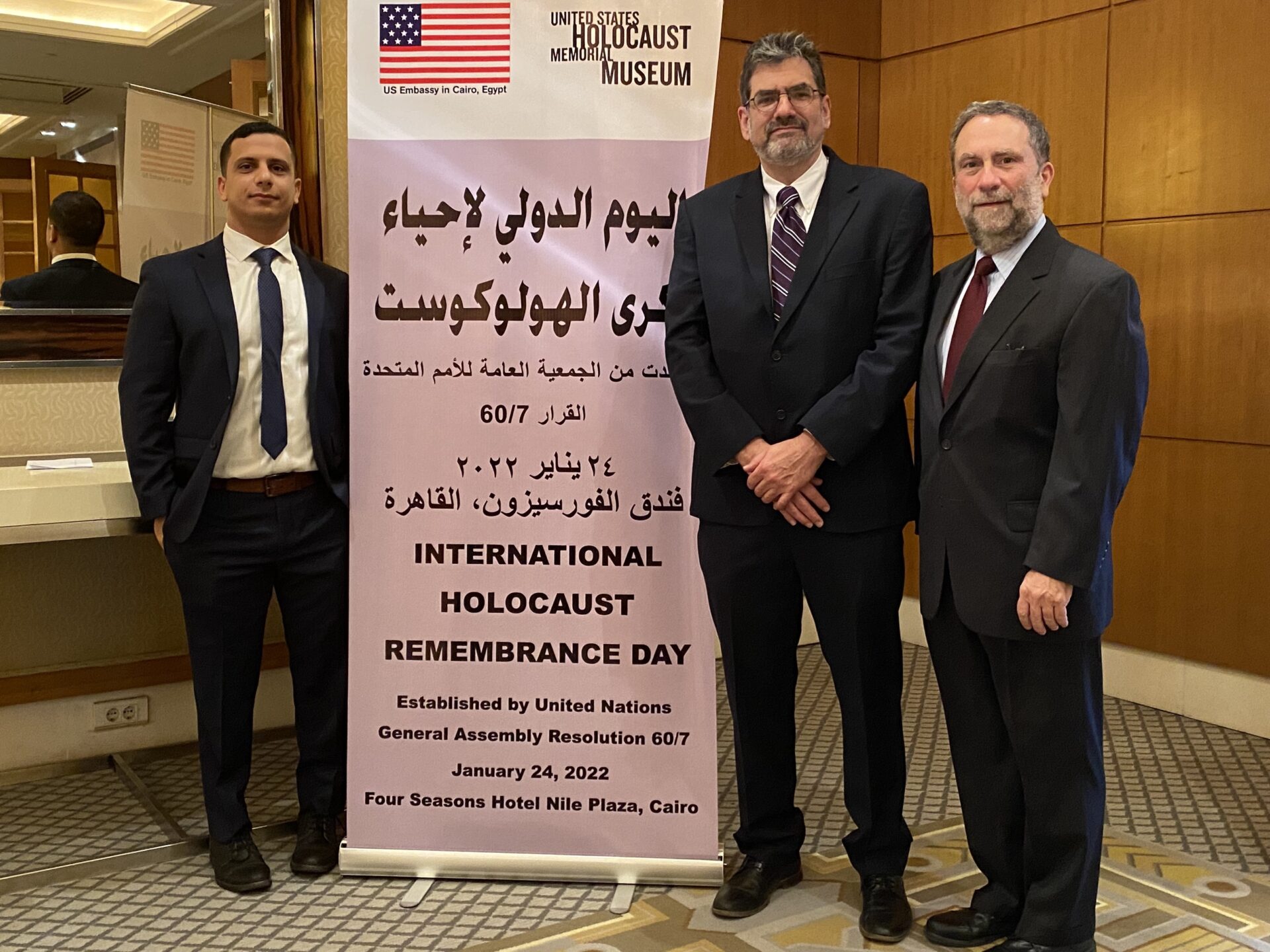
In a first, an official Holocaust Remembrance Day event in Egypt
Egyptian officials, American scholars and foreign diplomats gathered on Monday at a luxury hotel on the banks of the Nile to commemorate International Holocaust Remembrance Day, the first time such an event has ever been held in Egypt.
The gathering was hosted by the U.S. Embassy in Egypt and the U.S. Holocaust Memorial Museum (USHMM) in Washington, D.C. A similar event will take place later this week in Abu Dhabi, where Noura al Kaabi, the United Arab Emirates’ culture minister, is slated to speak. (International Holocaust Remembrance Day is commemorated on Jan. 27, the day the Auschwitz concentration camp was liberated.) Plans for additional events in Riyadh and Dubai were scrapped because of the COVID-19 pandemic.
“It was symbolically, I think, very important that we were able to do this in Egypt,” Robert Satloff, executive director of The Washington Institute for Near East Policy and a speaker at the event, told Jewish Insider from Cairo. “I was just delighted with what happened today and the fact that this occurred in the largest, most populous, trendsetting Arab state.”
The event is the latest symbol of changing attitudes in the Middle East in the wake of the Abraham Accords signed in September 2020. While Egypt was the first Arab nation to sign a peace treaty with Israel, in 1978, the Camp David Accords did not lead to a significant shift in Egyptian attitudes toward Israelis and Jews.
“There is a peace treaty between Egypt and Israel, but that peace has always been a cold peace,” said Mina Abdelmalak, who conducts Arabic outreach for the USHMM and was born and raised in Egypt. “It was never translated into the mainstream, people-to-people level. It was mostly government-to-government. So to be able to push this a little bit, that is significant.”
Abdelmalak and Tad Stahnke, the museum’s international outreach director, spoke at the event, as did Jonathan R. Cohen, the U.S. ambassador to Egypt, and Magda Haroun, the head of Egypt’s Jewish community. Satloff took questions from the audience following a screening of “Among the Righteous,” a documentary he produced about Arabs who helped protect and save Jews during the Holocaust.
“If you would have told me a few years ago that such an event would take place in Cairo, I would laugh,” Abdelmalak told JI on Monday. “Until this morning, it wouldn’t have completely surprised me if the government of Egypt would say, ‘Due to security reasons, this is not going to happen.’”
Some four dozen people attended the invitation-only event, including human rights activists, business people and former members of Egypt’s parliament.
“This wasn’t hidden away in some obscure corner of some small, out-of-the-way building. This was right smack in the middle of Cairo. This was an event to which diplomats from around the world — Middle East diplomats, European diplomats and ambassadors — were there,” explained Satloff.
From left: Mina Abdelmalak, Tad Stahnke, and Rob Satloff (U.S. Holocaust Memorial Museum)
The Abraham Accords “raised the bar for everyone,” Satloff said, including the “first-generation peacemakers” — Egypt and Jordan. But there were other factors at play, too: Egypt, like Israel, sees Iran as a foe. Last week, Egypt’s permanent representative to the United Nations gave a speech in Arabic on behalf of the Arab Group, condemning Holocaust denial as the United Nations General Assembly debated and then passed a resolution on the subject. The only country to vote against the resolution was Iran.
Satloff attributed the attitude change at least in part to Israel’s new leadership. With the “post-[Benjamin] Netanyahu enhancement of bilateral relations, it’s easier to be more public about it,” added Satloff. Domestically in Egypt, there is also “more consideration of the issues of religious minorities, countering extremism, interfaith relations. I think all these come together to make the environment more receptive and accessible to the type of event that we had today.”
The public event marked an important milestone for the USHMM, but came only after the USHMM’s efforts to build relationships in Arabic-speaking countries over many years.
“We have for the past several years been working to cultivate partnerships across the Middle East and North Africa to develop educational programming to reach young adults and emerging leaders in those countries with accurate and relevant information about the Holocaust,” said Stahnke. Education efforts have begun to have an effect in Morocco and Tunisia, he added. But yesterday’s event in Egypt, the most populous Arab country with nearly 100 million people, marked the most visible success.
Outright Holocaust denial is rarer than it used to be, Satloff said, explaining that it has been replaced by “relativism.” He defined the concept as “the idea that bad stuff happened, but bad stuff happens all the time, that sort of thing. Or: 600, 60,000, 600,000, 6 million, what’s the difference?”
Holocaust distortion has found a home in Egypt in the past because of the overall sentiment in the country regarding the Israeli-Palestinian conflict. Abdelmalak said the result is that “the Holocaust has been weaponized” in Egypt.
“It takes a lot of work with civil society to ensure that we push back against years and years of Holocaust denial being established in that part of the world,” Abdelmalak added. Attendees at the event also reflected upon Egypt’s own treatment of its Jewish community, including in the 1940s, when some Arab leaders spread Nazi propaganda and pogroms racked Cairo.
“I think everybody left with the sense that it was worthwhile and valuable,” said Satloff, “and perhaps just the first of many, which itself is a very important milestone.”