Gulf-Israel train project chugs into political, financial obstacles
AMMAN, Jordan – Knitting together the Middle East with a network of train tracks has been a dream of transportation planners for over a century. The vision persists today as part of ongoing efforts to link the six Gulf states through an east-west rail network that would span Saudi Arabia and connect with the Red Sea.
However, tying the project to a northern route that leads through Jordan to Israel’s Mediterranean port of Haifa – a notion floated amid the exuberance of the Abraham Accords – is still a long way off. Just as the megaproject was suspended more than 100 years ago, the politics and multibillion-dollar cost involved mean it will probably remain on the shelf for years to come.
“The success of a railway link would be dependent on the willingness of Saudi Arabia to support such a project,” RAND Corp. researcher Daniel Egel told The Circuit. “I think that they would have to be incentivized to include Haifa as a primary terminus for the railway” – given the current absence of diplomatic relations with Israel.
The history of the never-completed Hejaz railroad, which was built by the Ottomans in 1908 so that Muslims from parts of Asia and Europe could make the hajj pilgrimage to the holy city of Mecca, is a saga that illustrates the idea’s appeal and serial failures.
Designed at the beginning of the 20th century by German engineers, the railway ran some 820 miles (1,320 kilometers) of rocky desert trail from Damascus to Medina, Islam’s second holiest city, stopping 220 miles short of Mecca. It wasn’t until four years ago that Saudi Arabia built the high-speed Haramain rail line connecting the two sacred sites at a cost of about $16 billion. By then, the Hejaz was a tin-can artifact with no connection across the Saudi border.
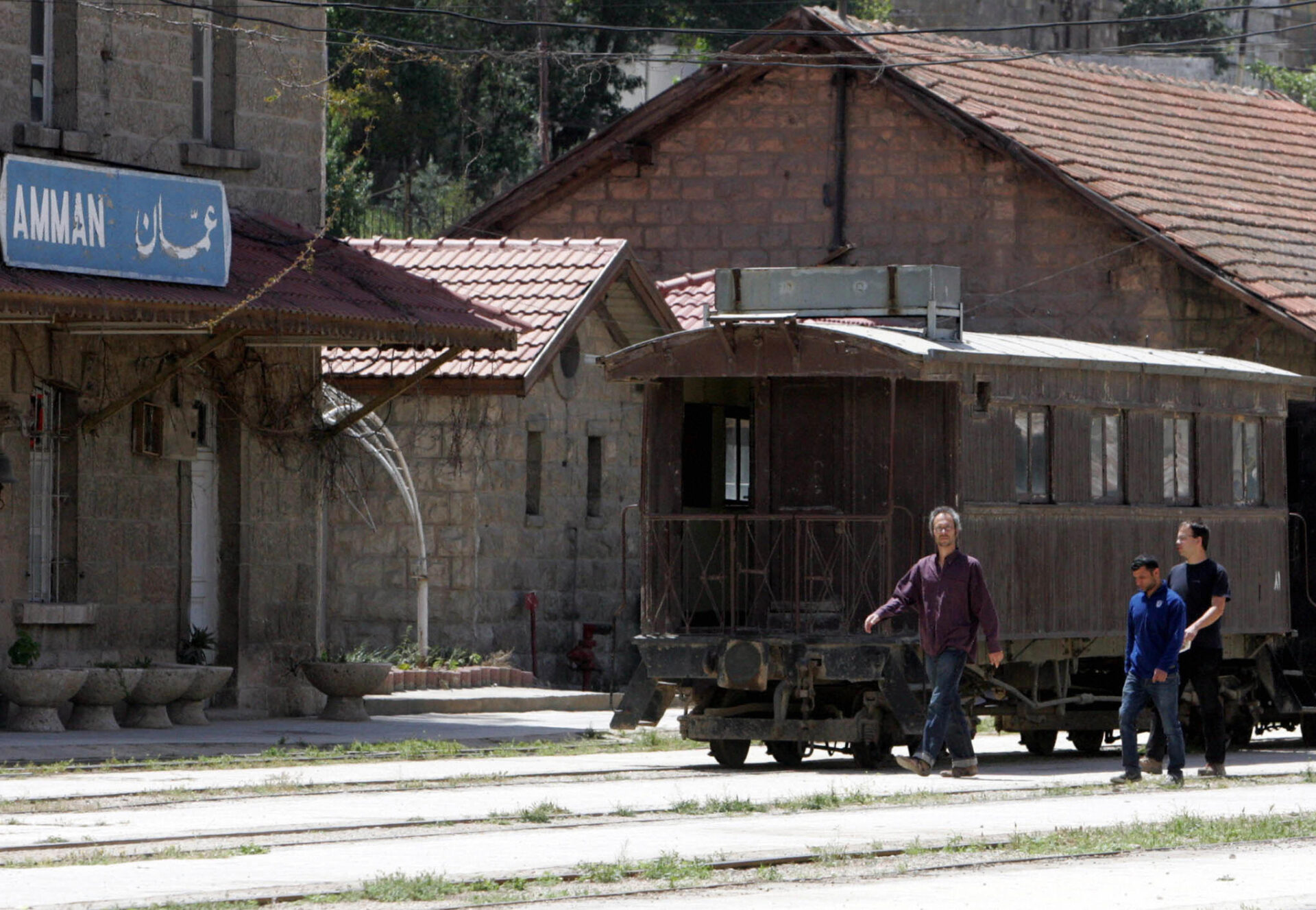
Jordanian men walk past aging train at the Hejaz Railway station in Amman (Khalil Mazraawi/AFP via Getty Images)
Besides its original north-south route, the Hejaz – named for the ancient western kingdom in Saudi Arabia – included a branch line running west through Palestine to connect with Haifa. The project was built solely through Islamic financing and donations from wealthy Muslims, under the principle that Western money was inappropriate for its religious nature.
Instead of the arduous 40-day journey by camel or horse, the Hejaz’s steam engines enabled pilgrims to complete the trip in three days. By 1912, train travel between Damascus and Medina carried an annual 300,000 passengers.
The railway’s builders had to overcome rocky terrain and other obstacles in southern Jordan and Saudi Arabia, where flooding in desert ravines required construction of bridges and viaducts. Bedouin tribes, which for many centuries lived off servicing pilgrims on the long overland routes to Mecca, lost business because of the Hejaz, leading them to attack the trains and sabotage the tracks.
“The railway reignited long-standing conflict between the Bedouin tribes and the Ottoman rulers of the Hejaz and Greater Syria,” Oxford archeologist John Winterburn told The Circuit.
The Hejaz line also connected the Ottoman Empire’s main urban centers with distant provinces in the south, facilitating movement of its military troops. The railway later became a security headache for the British Mandate forces, who saw it as a potential means for Germany to invade Egypt.
The Arab Revolt of 1916 against the Ottoman Empire interrupted use of the Hejaz railway, and it fell into disrepair as its tracks started to rot.
“After the First World War, the railway was split into three separate sections – the Syrian sector, run by the French; the Transjordanian section, run by the British; and the southern section, which became part of the Kingdom of the Hejaz,” said James Nicholson, author of The Hejaz Railway. “In the north, the railway was repaired and by 1921, regular services were running between Damascus and [Jordan’s southern city of] Ma’an,” Nicholson told The Circuit. “The southern line was also patched up and occasional trains ran through to Medina.”
Until the Syrian civil war over the past decade made travel too dangerous, the Hejaz ran passenger service between Amman and Damascus, while the line south of Amman was utilized to carry phosphate from mines near Ma’an to Aqaba. But instead of stimulating regional trade, urban development and agriculture, the railway stagnated and became a neglected relic of the past.
Because of the war, the Syrian portion hasn’t been included in current plans for the railway’s restoration. Still, Nicholson said, “there has been some talk about the possibility of restoring the main line back to use.” The central argument against the revival of the railway is the availability of other forms of transport,” such as air and road travel, he added.
A renewed Hejaz would require that the decrepit railbed be completely replaced with modern infrastructure and has been under Jordanian government review for 11 years. Prime Minister Bisher Khasawneh said last year that the government is looking for private investors as partners because it doesn’t have the money to fund the whole project, which would include a link between Amman and the Red Sea port of Aqaba.
Across the border from Jordan, Israel started pitching its “Tracks for Regional Peace” initiative in 2018 to connect Israel with its Arab neighbors. It sought to promote the plan two years later when the United Arab Emirates and Bahrain agreed to normalize relations through the U.S.-brokered Abraham Accords.
The idea was to use the new railway Israel built between Haifa and its eastern town of Beit She’an, extend it to the Jordanian border and connect to an overhauled Hejaz. From there it would cross into Saudi Arabia and end up in Dubai connecting the Mediterranean with the Persian Gulf. The regional railway network would transport cargo and tourists, providing a regional network that would include Jordan, the Palestinian Authority, Saudi Arabia, the UAE and the other member states of the Gulf Cooperation Council. Annual trade flow through the land bridge, it was estimated, could reach $250 billion by 2030.
If relations between Israel and Saudi Arabia change and rail links became acceptable, the project would still face significant challenges, said RAND’s Egel.
“First, I am not convinced that it is economically viable, given the availability of cheap transport options by water,” Egel told The Circuit. “It would expand options for the eastern GCC [Gulf Cooperation Council] nations to export to Saudi Arabia and Israel, and it would create a second option for transport if the security situation degrades in the Gulf of Aden” – the sea passage between Yemen and Somalia.
Egel said he would be surprised if such a railway became a key component in regional transport of goods given the alternatives. “It would undoubtedly provide a security hedge, but an expensive one,” he said.
“Building a railway link will lower the transport costs associated with trade, but it will not impact the restrictions on trade and movement of people that Jordan and the Palestinians face,” Egel said. “The primary impediment is political. If the railway link was augmented with bilateral free trade agreements or a multilateral [free trade agreement] with Jordan, the benefits to Jordan could be large. Benefits to the Palestinians would be much harder to obtain, as their external trade is controlled by Israel,” Egel said.
Steve Monroe, a political scientist at Yale-NUS College in Singapore, said the free trade agreement signed by the UAE and Israel in May could spur ambitious projects like the railroad.
“The UAE is one of the few places today with capital to invest in Israeli firms and Bahrain will also benefit from greater trade with Israel,” Monroe told The Circuit.
Meanwhile, the idea of a rail network connecting Israel and the Gulf states through Jordan remains on the drawing board. Building the transnational route would require a thorough regional political realignment at a cost of tens of billions of dollars. The saga of the last century indicates that won’t happen soon.
“It comes up from time to time,” said Ben Moore, an Israeli Foreign Ministry spokesman. “If we sign for peace, it could be considered.”
Noah’s Ark mosaic puts ancient Jordan synagogue on tourist map
JERASH, Jordan – When archeologists first excavated the remnants of a sixth-century church in the ancient city of Jerash in 1929, they uncovered a mosaic floor filled with images of gazelles, horses, birds, rabbits, snakes and other creatures that tell the biblical story of Noah’s Ark.
Also revealed by the American-British research team were a seven-branched menorah, a ram’s horn, a palm frond and other Jewish icons that indicated the Byzantine church had been built on the foundations of what was once a synagogue.
The “Synagogue-Church,” as it’s labeled on tourist maps, is located near the Temple of Artemis in the northwest quarter of Jordan’s vast Greco-Roman archeological park in Jerash, about 40 kilometers (28 miles) north of the capital city of Amman. It is one of several historical attractions in Jordan that are popular with Jewish and Christian visitors because of their biblical connections. Others include the town of Madaba, with its mosaic map at St. George’s Church that depicts the Holy Land and ancient Jerusalem; and nearby Mount Nebo, revered as the place where Moses looked out over the land of Canaan before his death.
As Arab countries from Egypt and Morocco to Bahrain reconnect with their Jewish pasts, the subject is still very sensitive in Jordan, where more than half the population has Palestinian roots. Three decades since the Hashemite Kingdom made peace with Israel, efforts to normalize those relations in the style of the Abraham Accords, signed two years ago, are opposed by most Jordanians.
Still, the Jordan-Israel peace treaty that was signed in 1994 has enabled hundreds of thousands of tourists to cross easily between the two countries and visit historical sites such as Jerash, once known as Gerasa. Amid the ruins, visitors can see the agglomeration of ethnicities, customs and faiths that have characterized the region throughout the centuries.
As part of a Hellenistic coalition of cities called the Decapolis, Gerasa was established in the mid-second century BC, during the reign of Antiochus IV Epiphanes, a Greek Seleucid king, according to historical evidence. The site’s magnificent colonnaded streets, bathhouses, amphitheaters and hippodrome attest to its development under centuries Greek and Roman rule. The city also bears the influence of the Hasmonean Jewish state to the west, whose King Alexander Jannaeus captured Gerasa in 85 BC, leading to an influx of Jews. Gerasa, which later came under Roman rule in the greater Syrian region, appears in an account by Flavius Josephus, the Roman-Jewish historian, of an attack on the city by Jewish rebels from the kingdom of Judea.
The combination of the historical texts, along with artifacts found at the site that were commonly used by Jews at the time, “shows that a big Jewish community dwelled in the city and was well-integrated,” Rubina Raja, a professor of classical archeology at Denmark’s Aarhus University, told The Circuit. Raja and Achim Lichtenberger, a University of Münster archeologist, are co-directors of the International Northwest Quarter Project, which continues to excavate the site.
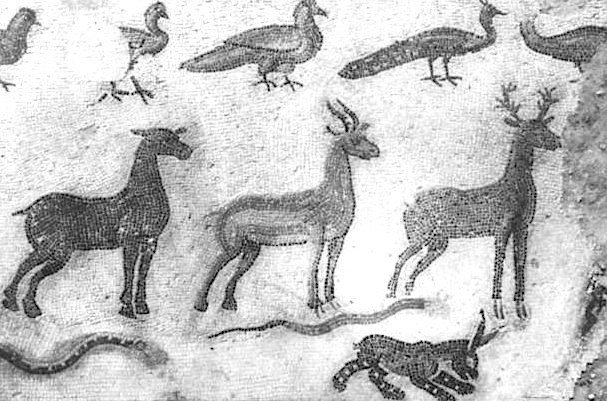
Jerash mosaic floor is filled with images from Noah’s Ark (Bezalel Narkiss Index of Jewish Art)
Among the images on the synagogue’s mosaic floor, one of the most striking is a bird perched on a tree branch holding a twig in its beak. It illustrates the verse from Chapter 8 in Genesis, when Noah releases a dove and it returns with an olive leaf, indicating that the floodwaters that covered the earth had receded.
Claudine Dauphin, a British-trained archeologist and longtime researcher of the site, was struck by how clearly the animals are demarcated by category when she described the mosaic in her writings.
“In the upper row are birds; wild and domesticated animals are in the middle row, and impure beasts and rodents are in the lowermost row,” Dauphin, a Senior Member of Somerville College, University of Oxford, told The Circuit. “Two black lines separated the biblical scene of the flood from a wide, predominantly geometric border, which also enclosed animals running from the right and left. Big game pursuing fleeing gazelles on the background of a flower semis, and between the border and the central panel, two birds facing each other and holding in their beaks a vegetal garland.”
Looking at the mosaic’s southern section, she explained, “only the back legs of a wild beast and other animals are visible.” She described a “menorah flanked on the right by a lulav and etrog,” referring to the palm frond and citron fruit that Jews hold during prayers on the festival of Sukkot. The floor also has “an incense shovel or a Torah scroll case, [and] is accompanied by an inscription fitted in between the hind legs of two leaping wild beasts.”
Besides the animals, two of Noah’s sons, Shem and Japheth, are depicted in the mosaic with their names labeled. The Greek inscription reads, “Holy place. Amen. Peace upon the congregation.”
The motif of Noah’s Ark has also been discovered in excavations at other ancient sites in the region including Huqoq in northern Israel and Mopsuestia in Turkey.
When the Gerasa synagogue was first erected has still not been determined conclusively, Dauphin said. “The plan of the synagogue is difficult to exactly determine in view of the alterations made in order to replace the synagogue with the church,” she said. “The synagogue was oriented east-west, thus opposite the orientation of the future church.”
Lichtenberg’s research indicated that the original synagogue was built between the late fourth and early fifth centuries CE. To turn the building into a church, he said, “the former eastern courtyard with the atrium was demolished, and an apse was erected above it,” he said, referring to a semicircular recess with an arched roof.
Why the synagogue was taken over in approximately 530 CE by the Byzantine Christian authorities remains a matter of debate. One theory is that the synagogue was simply abandoned by the Jews. Another is that the Jews were converted en masse to Christianity. The third hypothesis is that Christian authorities took over the synagogue just as they also appropriated mosques and pagan temples.
“The building of the church was part of the policy of confiscation of synagogues by the church and coincided with the peak of expansion of Christianity,” Dauphin said. “The takeover of the synagogue by Christians does not necessarily mean the end of the Jewish community of Gerasa. How long it survived after the Moslem Conquest [in 635 CE] remains unknown,” she said.
In 749 CE, an earthquake destroyed the church, along with many of Jerash’s other ancient structures. It wasn’t until 1925 that archeologists began to excavate the site and uncover the architectural splendor that has made it Jordan’s second-biggest tourist attraction after the ancient Nabatean city of Petra.
Three decades on, Israel-Jordan border project revives hope for peace dividend
Nearly three decades after signing a peace treaty, Israel and Jordan took a tiny step forward toward warming relations this week with the announcement by Israeli Prime Minister Yair Lapid that his government would accelerate a neglected project to build a joint Israeli-Jordanian industrial zone straddling the banks of the Jordan River.
Touted as a “breakthrough” and a step toward “civil peace,” the Jordan Gateway plan fits snugly within the broader process of normalization taking place between Israel and other Middle Eastern countries. However, although both Israel and Jordan stand to gain economically from this shared venture, tense relations between two countries, coupled with anti-Israel sentiment in Jordan and bureaucracy tied up with ongoing electoral chaos in Israel, analysts and those working on the project say not to expect any fast or immediate results.
“I’m hesitant to say this signifies a normalizing of relations between Israelis and Jordanians,” Oded Eran, Israel’s former ambassador to Jordan, told The Circuit. “However, if this project does finally come to a conclusion, it will be an important step, psychologically, because it has become a lingering symbol of the failure of the relations between Israel and Jordan,” said Eran, now a senior fellow at the Institute for National Security Studies in Tel Aviv.
The creation of a cross-border industrial park was initially outlined in the peace treaty Israel and Jordan signed on Oct. 26, 1994. Within three years, a Qualified Industrial Zones (QIZ) was established in the Jordanian city of Irbid with the aim of taking advantage of Israel’s Free Trade Agreement with the U.S. That concept soon transformed into the Jordan Gateway plan, an economic zone where citizens of each country could move freely within a designated “bubble.”
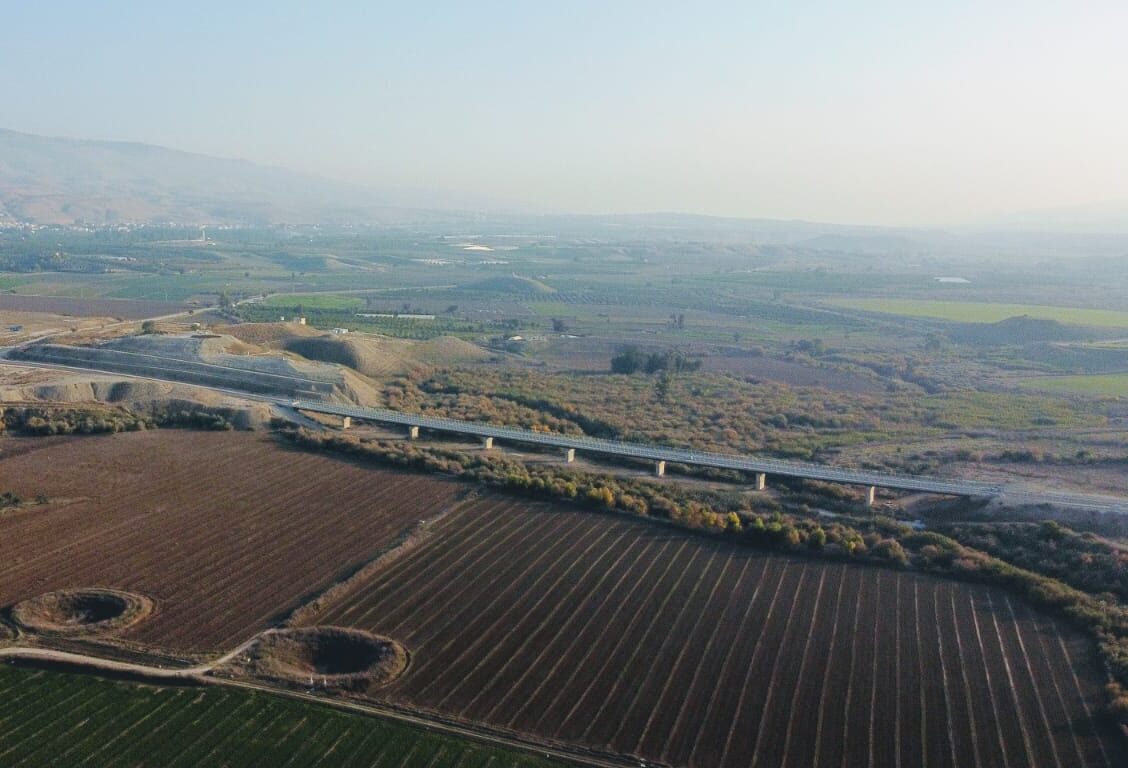
Jordan set aside an area of roughly 12,000 square meters (3 acres) for the project and today, on the Jordanian side, sit a handful of manufacturing plants employing around 500 workers. On the Israeli side, which is slated for a medical center and a high-tech park, the area remains empty, held up by internal bickering among various governmental bodies and security concerns. In 2012, Israel renewed efforts to fulfill its side of the project, appointing the Ministry of Regional Cooperation to take charge of the plan and coordinate between all the official parties. A bridge connecting the two banks of the river was completed in 2019, but still stands unused, waiting for an official authority to facilitate crossings.
Bridge built in 2019 connects Israeli side of Jordan Gateway Industrial Park (seen in foreground) with Jordanian side
Lapid, who met with Jordan’s King Abdullah II in Amman on July 27, noted the 28-year lag since the peace agreement at last Sunday’s weekly cabinet meeting and called the decision to move forward “a breakthrough that will contribute greatly to developing and strengthening the region.”
Israel’s regional cooperation minister, Issawi Frej, said the Jordan Gateway was “part of the major progress that we have carried out in strengthening relations with Jordan in the past year. We started with the agreement to export water in exchange for solar energy and now have this decision, which takes the vision of civil peace, not just between the countries but also between the peoples, an additional step further.”
Frej continued, “Advancing the project will facilitate the strengthening of economic cooperation with the kingdom and contribute greatly to the economies of both countries and of the region as a whole.”
A senior Israeli source, who was present in the meeting between Lapid and Abdullah, told The Circuit that the industrial park was discussed at length and there was a real eagerness to see the project come to life.
An official outline of Jordan Gateway, obtained by The Circuit, notes the benefits and political importance of this joint economic-civic venture to both Israel and Jordan, including providing Israel access to the wider Arab world and giving Jordan access to the West.
“Beyond the political importance of a joint economic-civic venture, the benefits to Jordan from the venture are access to advanced technology, methods, and knowledge and approximately 10,000 jobs, as well as the possibility of marketing products that will be manufactured in the Park to Israel and/or through the port of Haifa to Europe and the United States,” the document reads. “The benefits for the private sector in Israel include access for Israeli products to markets in the Arab world, production close to Israel at the costs of the Jordanian market and business cooperation with entrepreneurs and investors from Jordan and other Arab countries.”
“I think that in the Jordan-Israel context, this industrial park is very important and should not be underestimated,” said Eran, who served as envoy between 1997 and 2000. “General unemployment in Jordan stands at 25%, while for women and the younger generation it reaches 50%, so every additional place of employment is important, and in general, it is important for Jordan’s economy.”
For Israel, too, the benefits are broad, not only adding some 2,000 new jobs but also increasing the country’s GDP by some 3.6 billion shekels (about $1.2 billion) and its exports by 10 billion shekels (about $3.3 billion), according to Regional Cooperation Ministry predictions.
But, the former ambassador cautioned, the political and demographic situation in Jordan, where a significant percentage of the population is of Palestinian heritage, is tricky when it comes to Israel. Relations between the countries have long been tense, with Jordan watching anxiously whenever there is unrest at Jerusalem’s Muslim holy sites, which it formally oversees under the current status quo. Actions by former Prime Minister Benjamin Netanyahu, who proposed annexing the West Bank, and the launch of former U.S. President Donald Trump’s peace plan, only served to increase the pressure.
Perhaps most telling was Jordan’s silence following Lapid’s announcement this week about fast tracking the project. Palestinian-Jordanian journalist Daoud Kuttab writing in the Media Line noted the absence of comment from the Jordanian government and the press on the Gateway plan noting that “The Jordanian royal court, the Bisher Al Khasawneh government, and both the official and private media totally ignored a major Israeli announcement concerning Jordan that was made at the outset of the weekly Israeli cabinet meeting.”
He also wrote that in order for the project to move forward, “the king needed the acquiescence of the Palestinian leadership. That is why he sent two of his royal military helicopters to pick up Mahmoud Abbas and his aides for a short meeting at the palace on July 24.”
“The trend towards normalization in Jordan is not encouraged or developed,” because of Israel’s ongoing conflict with the Palestinians, said Eran, adding that there are even forces actively working “against Jordan joining the framework of the Abraham Accords,” the 2020 normalization agreements signed between Israel, the United Arab Emirates, and Bahrain. Sudan and Morocco agreed to normalize ties with Israel later that year.
Efraim Inbar, president of the Jerusalem Institute for Strategy and Security, said however, that the economic factors of this project “should not be exaggerated – what really counts is the politics.”
“This is not the first time that we have an industrial zone in Jordan, and it did not change the attitudes of the Jordanian people towards the peace process a bit,” he told The Circuit. “The Jordanian people still call it ‘the king’s peace.’”
Inbar said it was unclear if the project will move forward. “There is a big difference between announcing it and implementing it,” he said. “Even if it is implemented, its influence is marginal.”
He dismissed any connection between the project and the normalization agreements Israel signed in 2020 with four Arab states. “Jordan is a good neighbor,” he said. “They prevent terrorism and that is the important thing.”
However, Ksenia Svetlova, a senior non-resident fellow at the Atlantic Council, a Washington, D.C.-based think tank, and the Israel Middle East program director for Mitvim, an Israeli think tank, drew a parallel, saying that the project remained important and logical for both countries, even after a delay of 25 years.
“It was delayed because nobody really had an appetite for it and the relationship between Jordan and Israel soured, but during the last few years the relations were relaunched and this is the key to this important idea,” she explained, recalling meetings between Abdullah and Israeli Defense Minister Benny Gantz and former Foreign Minister Gabi Ashkenazi during the final year of Netanyahu’s government. Former Prime Minister Naftali Bennett also met with Abdullah last year.
A former member of Knesset, Svetlova said she believed that the Abraham Accords might be playing a role in renewing ties and reviving the joint economic plan.
“The generally optimistic and positive dynamics of the Abraham Accords have had an impact on Israel’s veteran normalization partners, Egypt and Jordan,” she maintained. “There have been more developments in the past two years than there were in the previous 10 years with both these countries, so I think that generally, there was more inspiration in promoting important economic projects between Israel and Arab countries in the region.
Svetlova added, “This could be another benefit of the Abraham Accords: that they not only motivate the direct members, but they also have a positive influence on the veteran normalization countries.”