A relaxing retreat with a slice of history on Mount Carmel
ZICHRON YAAKOV, Israel – Guests arriving at the Elma Arts Complex and Luxury Hotel in this hilltop town nestled into the side of Mount Carmel will likely be struck by the light-filled lobby or the striking array of artwork that fills every wall and every corner. They’ll also be taken by the sweeping views of Israel’s majestic coastline, its sharp blue skies dotted with graceful paragliders, its lush green edged with pink bougainvillea.
Yet it is the story behind the building and of how it became one of Israel’s most exquisite lodgings that is perhaps most enthralling.
And it is all those elements pulled together that make Elma such a special place.
While every building might have its own unique back story, few have a history like the Elma. Tucked up high on the side of Mount Carmel, gazing over the fisheries of Kibbutz Maayan Tzvi and the picturesque stretch of beach known as Dor, the stacked whitewashed structure not only tells the story of Israel’s socialist origins, it also spotlights the inevitable clash as the country began embracing its capitalist present.
Add to that mix an indomitable scion of a notable Zionist family and a family of prize-winning Israeli architects, and Elma captures not only hearts but also minds of hotel-goers even during the shortest of stays.
Its story begins in 1951 with Israel’s passing of a national law requiring that all workers receive a weeklong vacation once a year. Based on that law, the Histadrut Labor Federation, the General Federation of Workers in Israel, opened wellness retreats around the country affording its members a short respite from work and daily life. One of those places was the Mivtachim Sanitarium, which was dedicated in 1968 and today forms the main body of the Elma hotel.
Designed by renowned Israeli architect Yaakov Rechter, who received the Israel Prize in architecture in 1972 for the flowing design that blends with the rolling mountaintop, the complex reflects the 1960s Brutalist style, as well as many of his other iconic structures in Israel – the Tel Aviv Museum of Art, the Cameri Theater and the Atarim Square.
Throughout the 1970s and through the 1980s, the complex housed workers for short breaks, hosting some of the country’s most iconic leaders such as former Prime Ministers David Ben-Gurion and Golda Meir. By the mid-’80s, however, Israelis had begun to seek family-style vacations and preferred resorts in more exotic places such as Eilat or Tiberias. The complex was frequently used as a convention center for large company events during the 1990s, until it was shuttered completely in the early 2000s.
In 2004, Lily Elstein, a then 75-year-old patron of Israeli arts and culture who hails from one of the country’s founding families, outbid and outmaneuvered fierce real estate developers vying for one of the country’s most picturesque spots to replace the historic compound with a luxury residential neighborhood. Incredibly, the Mivtachim Sanitarium, which had stood as an icon of Israel’s socialist days on the side of Mount Carmel, was not listed as a historical building or protected by the state.
Determined to see the complex preserved in all its glory, Elstein, whose late husband Moshe Elstein (grandson of Yoel Moshe Solomon) founded Teva Pharmaceuticals, hired Rechter’s son Amnon Rechter, and hotel architect Rani Ziss to ensure the building was renovated to its original grandeur.
The upgrade took more than 10 years to complete, with the architects working to preserve the original design, including the floors and airy interior, while adding modern touches such as high-tech infrastructure, creating larger rooms and building a new, more accessible, wing. The team also replaced the old entertainment hall – where patrons sent by the worker’s union enjoyed watching movies – with a state-of-the-art acoustic theater replete with a 1,414-tube organ and two grand pianos.
When the new Elma hotel finally opened in 2015, Elstein, now 91, relocated to the site, bringing her personal art collection, including specially commissioned works, to the hotel.
The bright, sun-filled lobby that first greets visitors is dominated by a huge marble sculpture depicting a man and a woman pushing a rock. Created by Israeli sculptor Sigalit Landau, one of Elstein’s patrons, the artwork is a rendering of Sisyphus, the figure from Greek mythology who cheated death twice but was eventually cursed with the eternal punishment of pushing a boulder up a hill.
More of Landau’s work, as well as installations by multiple other artists, create a vibrant art exhibition that heightens the senses and inspires. Inside, the hallways leading to the modern and well-designed rooms are filled with engaging abstract paintings and photography. Outside, the extensive gardens and terraces are also dotted with sculptures and offer glorious panoramic views of the coastal plain.
The original outdoor swimming pool has been refurbished and an adjacent café offers a range of cocktails, foods and other beverages. Beside it is a newly built indoor pool and spa facility with a variety of pampering and wellness services on offer.
And just a word about the food: Breakfast is included and, like with many other aspects of this hotel, is a carefully thought-out affair going above and beyond the standard Israeli hotel buffet – extensive salads line the counter and nearby chef stations offer cooked dishes. The kosher kitchen also caters dinner options for an additional price.
While it is the modern touches that make a stay at Elma both comfortable and luxurious, it is the unique history still lingering in the air that makes it a special experience.
The writer was a guest of the Elma Arts Complex and Luxury Hotel.
In a first, an official Holocaust Remembrance Day event in Egypt
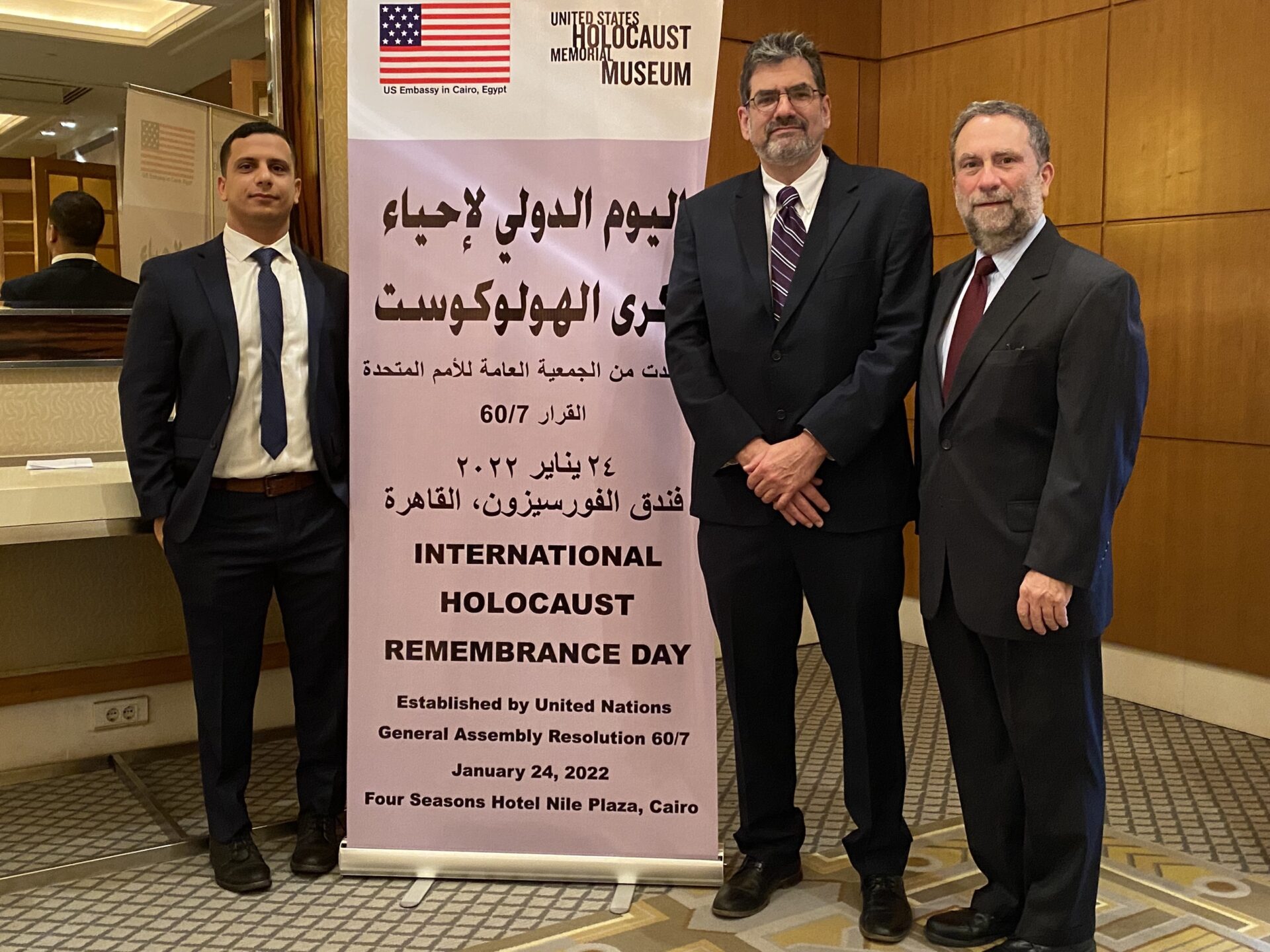
Egyptian officials, American scholars and foreign diplomats gathered on Monday at a luxury hotel on the banks of the Nile to commemorate International Holocaust Remembrance Day, the first time such an event has ever been held in Egypt.
The gathering was hosted by the U.S. Embassy in Egypt and the U.S. Holocaust Memorial Museum (USHMM) in Washington, D.C. A similar event will take place later this week in Abu Dhabi, where Noura al Kaabi, the United Arab Emirates’ culture minister, is slated to speak. (International Holocaust Remembrance Day is commemorated on Jan. 27, the day the Auschwitz concentration camp was liberated.) Plans for additional events in Riyadh and Dubai were scrapped because of the COVID-19 pandemic.
“It was symbolically, I think, very important that we were able to do this in Egypt,” Robert Satloff, executive director of The Washington Institute for Near East Policy and a speaker at the event, told Jewish Insider from Cairo. “I was just delighted with what happened today and the fact that this occurred in the largest, most populous, trendsetting Arab state.”
The event is the latest symbol of changing attitudes in the Middle East in the wake of the Abraham Accords signed in September 2020. While Egypt was the first Arab nation to sign a peace treaty with Israel, in 1978, the Camp David Accords did not lead to a significant shift in Egyptian attitudes toward Israelis and Jews.
“There is a peace treaty between Egypt and Israel, but that peace has always been a cold peace,” said Mina Abdelmalak, who conducts Arabic outreach for the USHMM and was born and raised in Egypt. “It was never translated into the mainstream, people-to-people level. It was mostly government-to-government. So to be able to push this a little bit, that is significant.”
Abdelmalak and Tad Stahnke, the museum’s international outreach director, spoke at the event, as did Jonathan R. Cohen, the U.S. ambassador to Egypt, and Magda Haroun, the head of Egypt’s Jewish community. Satloff took questions from the audience following a screening of “Among the Righteous,” a documentary he produced about Arabs who helped protect and save Jews during the Holocaust.
“If you would have told me a few years ago that such an event would take place in Cairo, I would laugh,” Abdelmalak told JI on Monday. “Until this morning, it wouldn’t have completely surprised me if the government of Egypt would say, ‘Due to security reasons, this is not going to happen.’”
Some four dozen people attended the invitation-only event, including human rights activists, business people and former members of Egypt’s parliament.
“This wasn’t hidden away in some obscure corner of some small, out-of-the-way building. This was right smack in the middle of Cairo. This was an event to which diplomats from around the world — Middle East diplomats, European diplomats and ambassadors — were there,” explained Satloff.
From left: Mina Abdelmalak, Tad Stahnke, and Rob Satloff (U.S. Holocaust Memorial Museum)
The Abraham Accords “raised the bar for everyone,” Satloff said, including the “first-generation peacemakers” — Egypt and Jordan. But there were other factors at play, too: Egypt, like Israel, sees Iran as a foe. Last week, Egypt’s permanent representative to the United Nations gave a speech in Arabic on behalf of the Arab Group, condemning Holocaust denial as the United Nations General Assembly debated and then passed a resolution on the subject. The only country to vote against the resolution was Iran.
Satloff attributed the attitude change at least in part to Israel’s new leadership. With the “post-[Benjamin] Netanyahu enhancement of bilateral relations, it’s easier to be more public about it,” added Satloff. Domestically in Egypt, there is also “more consideration of the issues of religious minorities, countering extremism, interfaith relations. I think all these come together to make the environment more receptive and accessible to the type of event that we had today.”
The public event marked an important milestone for the USHMM, but came only after the USHMM’s efforts to build relationships in Arabic-speaking countries over many years.
“We have for the past several years been working to cultivate partnerships across the Middle East and North Africa to develop educational programming to reach young adults and emerging leaders in those countries with accurate and relevant information about the Holocaust,” said Stahnke. Education efforts have begun to have an effect in Morocco and Tunisia, he added. But yesterday’s event in Egypt, the most populous Arab country with nearly 100 million people, marked the most visible success.
Outright Holocaust denial is rarer than it used to be, Satloff said, explaining that it has been replaced by “relativism.” He defined the concept as “the idea that bad stuff happened, but bad stuff happens all the time, that sort of thing. Or: 600, 60,000, 600,000, 6 million, what’s the difference?”
Holocaust distortion has found a home in Egypt in the past because of the overall sentiment in the country regarding the Israeli-Palestinian conflict. Abdelmalak said the result is that “the Holocaust has been weaponized” in Egypt.
“It takes a lot of work with civil society to ensure that we push back against years and years of Holocaust denial being established in that part of the world,” Abdelmalak added. Attendees at the event also reflected upon Egypt’s own treatment of its Jewish community, including in the 1940s, when some Arab leaders spread Nazi propaganda and pogroms racked Cairo.
“I think everybody left with the sense that it was worthwhile and valuable,” said Satloff, “and perhaps just the first of many, which itself is a very important milestone.”