Saudi Arabia pushes off its Red Sea Film Festival to 2027
Saudi Arabia is postponing its Red Sea International Film Festival, pushing the star-studded annual event to late 2027 as an escalating conflict with Yemen’s Houthis and continued disruption in the Strait of Hormuz deepen security concerns.
Organizers scrapped the red-carpet premiere scheduled for Dec. 3 in Jeddah, though they cited only the logistical demands of staging the international festival, The National reports.
Last year’s event drew Hollywood stars including Dakota Johnson, Uma Thurman, Queen Latifah and Vin Diesel. The decision to delay the Jeddah event comes just days after news that neighboring Dubai plans to revive its own international film festival in December 2027 after a decade-long break.
Despite the growing conflict with the Houthis, Saudi Aramco told several Asian refiners that oil shipments from the Red Sea port of Yanbu should resume soon. At least three processors received informal assurances from company executives, though no timetable was given, Bloomberg reports.
Loadings have largely stopped since drone attacks from Iraq shut the East-West pipeline on Sept. 10. The pipeline had carried about 4 million barrels a day to Yanbu, with Aramco now working to restore half its capacity.
UAE’s Mohammed bin Hamad, Faisal Al Bannai meet with Trump at Mar-a-Lago
Two UAE business leaders who advise President Sheikh Mohamed bin Zayed on security and technology matters visited U.S. President Donald Trump at Mar-a-Lago in Palm Beach, Florida, and made a swing through the U.S. to meet with SpaceX founder Elon Musk, investors Marc Andreessen and Ben Horowitz, and defense firm Anduril.
Sheikh Mohammed bin Hamad Al Nahyan, Chairman of Abu Dhabi Airports, and Faisal Al Bannai, Chairman of state-owned defense conglomerate EDGE Group, traveled to Palm Beach, Florida, for the weekend meeting at Trump’s residence and resort, they said in posts on X. Both hold senior advisory posts in the UAE Presidential Court.
The two also met separately with Jared Kushner, founder of Miami-based private equity firm Affinity Partners and Trump’s son-in-law. They were joined throughout the trip by Sheikh Zayed bin Mohammed bin Hamad Al Nahyan, Sheikh Mohammed bin Hamad’s son.
Before meeting Trump, the Emirati leaders traveled to San Francisco and discussed “possible areas of collaboration” with venture capitalists Andreessen and Horowitz, founders of A16Z, Al Bannai said in a post on X. Among those joining the various meeting was Abdallah Abu Sheikh, founder of Abu Dhabi-based Astra Tech, and CEO of Botim. Musk met them at another stop.
The group also visited U.S. defense contractor Anduril, with which EDGE signed an agreement in November to form a joint drone aircraft venture.
Millennium weighs moving some of Dubai staff to Channel Island
Millennium Management, led by investor Izzy Englander, may relocate some of its Dubai staff amid the disruptions and security concerns stemming from the Iran war.
The New York-based firm, which had more than 100 employees based in Dubai before the war began, is prepared to expand its presence in the Channel Island of Jersey to staff members who have requested the move, The Financial Times reports.
Other hedge funds and financial firms are weighing contingency plans, including splitting teams across locations, tightening travel and adjusting trading operations to manage risk.
Damage from drone debris to a building in Dubai’s International Financial Centre that houses Millennium employees added to the fears about safety, according to the FT.
Saudi Arabia launches first residential mortgage-backed securities
Saudi banks could offload as much as $48 billion in mortgages to the Saudi Real Estate Refinance Co. by 2030, as the kingdom launches its first residential mortgage-backed securities.
The SRC, which is wholly owned by the Public Investment Fund, recently executed its first RMBS transaction following regulatory approvals, Bloomberg reports.
The move is a step toward boosting liquidity and bank lending in the kingdom, which is seen as central to Saudi Arabia’s economic transformation agenda.
The SRC has also forged partnerships with global asset managers and domestic institutions to deepen the real estate financing market.
It comes as home ownership in the kingdom has risen to 65.4% of families, surpassing this year’s target, boosted by initiatives to support access to mortgages.
DP World issues sea protection blue bonds on Nasdaq Dubai
In the world of debt finance, blue bonds are an emerging class of securities used to support maritime projects that carry potential environmental benefits.
Nasdaq Dubai announced on Thursday it will host the MENA region’s first blue bond sale as DP World seeks to raise $100 million for its seaports and logistics businesses.
The bond issue is aimed at supporting a range of DP World projects this year, including development of alternative fuels to reduce maritime carbon emissions, upgrading port infrastructure to minimize environmental damage and restoring damaged ecosystems, the company said in a statement.
“As a responsible leader in global trade, we are committed to preserving the ocean’s ability to provide for future generations,” DP World Chairman and CEO Sultan Ahmed bin Sulayem said.
Based at the Dubai International Financial Centre, Nasdaq Dubai already issues green bonds, sustainability bonds and sustainability-linked bonds. The total value of its debt listings is $137 billion, of which $29 billion are linked to ESG – environmental, social, and governance – goals.
In the Weekly Circuit today, we’re looking at Saudi Arabia’s hiring BlackRock to help develop a mortgage-backed securities market, Mubadala-owned Sanad’s $408 million engine sale to Etihad Airways and the IMF’s latest forecast for Middle East economic growth. But first, HSBC tops Standard Chartered in investment banking fees and a Circuit interview with Nuwa Capital’s Khaled Talhouni.
A jump in dealmaking across the Middle Eastand North Africa has generated an estimated $1 billion in investment banking fees so far this year – a 27% boost over the first nine months of 2023, with HSBC leading the pack.
London-based HSBC earned $80.4 million in fees during the first three quarters of 2024, or 7.8% of the total investment banking pool, Zawya reports, citing LSEG Deals Intelligence.
Coming second in the banking field’s league tables was Standard Chartered with $56.5 million in fees, followed by First Abu Dhabi Bank with $56 million. The highest amount of investment banking fees were generated from Saudi Arabia ($470.7 million), followed by the UAE ($395.9 million), Qatar ($45 million), Kuwait ($41.7 million) and Egypt ($25.1 million).
The largest deal in the MENA region during the first nine months of 2024 was ADNOC’s $14.8 billion takeover offer for German chemicals company Covestro, according to the LSEG data. The largest during the third quarter was UAE clean energy firm Masdar’s offer to buy Spain’s Saeta Yield from Brookfield Renewable for $1.4 billion.
Saudi Arabia, meanwhile, is pouring money into health care with a new emphasis on showcasing the integration of artificial intelligence by its hospitals and growing pharmaceutical industry.
Speaking at the Global Health Exhibition in Riyadh this week, Saudi Health Minister Fahad Al-Jalajel announced investment deals worth more than $13 billion.
“Our goal is for the Kingdom of Saudi Arabia to serve as a hub for addressing global challenges by establishing a unified government approach, focusing on innovation, digital solutions and artificial intelligence,” Al-Jalajel said at the conference.
Nuwa Capital navigates evolving Middle East VC investment landscape
Khaled Talhouni, Managing Partner of Nuwa Capital, says the recent proliferation of tech IPOs in the Gulf demonstrates that a “window is opening” for investors on stock exchanges in the UAE, Saudi Arabia and their neighbors, The Circuit’s Omnia Al Desoukie reports.
Talhouni, 39, has a broad view of developments in regional finance having opened offices in both Dubai and Riyadh for the venture capital firm, which manages $100 million in assets.
Nuwa’s backers include Saudi Arabia’s Al Faisaliah Group, Abu Dhabi’s Mubadala Investment Co., Jada Fund of Funds and the Dubai Future District Fund. Among its portfolio companies are Calo, a Bahrain-based meal planning start-up; Zest Equity, an online platform for managing venture capital investments; and Raqamyah, a Saudi crowdfunding platform.
Mubadala: The Abu Dhabi sovereign wealth fund closed its latest fund, MIC Capital Partners IV, on $3.1 billion, well above the initial target of $2 billion, Pitchbook reports. Sanad, meanwhile, a Mubadala-owned aerospace engineering firm, announced the sale of 16 aircraft engines to Etihad Airways for about $408 million.
Saudi Real Estate Refinance Co.: The kingdom’s property finance arm has hired BlackRock, the world’s biggest fund manager, to help it develop a market for mortgage-backed securities as the kingdom looks to improve the affordability of its housing stock, Bloomberg reports.
Public Investment Fund: The Saudi sovereign wealth fund established a company to build and operate housing for staff of major construction and development projects across the kingdom.
Abu Dhabi Investment Authority: ADIA-backed Lake Shore, a management company, raised over $143 million through a green loan from HSBC Commercial Banking for Viviana Mall in Mumbai, marking India’s first sustainability-linked fundraising for a retail property.
Qatar Investment Authority: QIA Chairman Sheikh Bandar bin Mohammed Al Thani, who is also Governor of the Qatar Central Bank, held meetings in Washington last week with Howard Marks, Co-Chairman of Oaktree Capital Management, and Stephen Schwartzman, Chairman, CEO and Co-Founder of Blackstone.
↪↩ Closing Circuit
🇮🇹 Radar Development: Italian shipbuilder Fincantieri signed a draft agreement with Barzan Holdings, a company owned by Qatar’s Ministry of Defense, for the joint development of a short-range radar program valued at $108 million.
🍦 Keeping Cool: Kuwaiti dessert maker Pure Ice Cream, which makes products for Hershey’s and Kwality, announced plans to build an $21.8 million factory at Dubai Industrial City.
📈 HR Shares: Saudi Arabia’s Tamkeen Human Resources Co. set its IPO price at $13.31 per share, the top of the range, seeking to raise about $106 million when it starts trading next month.
☪️ Halal Insurance: Dubai-based Islamic insurance Takaful Emarat reduced its share capital by about $34 million to $7 million in a move to offset its accumulated losses.
🩺 Remote Diagnosis: OneStep, an Israeli startup that enables smartphones to be used as remote medical analytic tools, raised $36 million in a Series B funding round led by Team8 and Vintage Investment Partners.
🗣 Circuit Chatter
🇮🇹 Radar Development: Italian shipbuilder Fincantieri signed a draft agreement with Barzan Holdings, a company owned by Qatar’s Ministry of Defense, for the joint development of a short-range radar program valued at $108 million.
🍦 Keeping Cool: Kuwaiti dessert maker Pure Ice Cream, which makes products for Hershey’s and Kwality, announced plans to build an $21.8 million factory at Dubai Industrial City.
📈 HR Shares: Saudi Arabia’s Tamkeen Human Resources Co. set its IPO price at $13.31 per share, the top of the range, seeking to raise about $106 million when it starts trading next month.
☪️ Halal Insurance: Dubai-based Islamic insurance Takaful Emarat reduced its share capital by about $34 million to $7 million in a move to offset its accumulated losses.
🩺 Remote Diagnosis: OneStep, an Israeli startup that enables smartphones to be used as remote medical analytic tools, raised $36 million in a Series B funding round led by Team8 and Vintage Investment Partners.
🌍 Power Circuit
Saudi Crown Prince Mohammed bin Salman and Egyptian President Abdel Fattah al-Sisiagreed to deepen trade and investment cooperation during talks in Cairo on Tuesday.
Emir of Qatar Sheikh Tamim bin Hamad Al Thanilanded in Brussels to lead his country’s delegation participating in the first summit between the GCC and the European Union.
Sheikh Mohamed bin Rashid, Vice President and Prime Minister of the UAE, and Ruler of Dubai, said in an X post on Sunday as GITEX week opened that “Technology is growing rapidly and Dubai is growing with it at the same pace.”
Sheikh Tahnoon bin Zayed, Deputy Ruler of Abu Dhabi and Chairman of ADIA, led the sovereign wealth fund’s board meeting on Monday in a session joined by Sheikh Mansour bin Zayed, Vice President, Deputy Prime Minister and Chairman of the Presidential Court, and Sheikh Khaled bin Mohamed, Crown Prince of Abu Dhabi and Chairman of the Abu Dhabi Executive Council.
PLUGGED IN
GITEX was a whirlwind – What should I be doing now to follow up
GITEX was a behemoth conference that welcomed 6,000 delegates and over 100,000 visitors to Dubai last week.
Sheikh Mohammed bin Rashid, Vice President and Prime Minister of the UAE and Ruler of Dubai, said a strong partnership between the public and private sectors in the UAE continues to reinforce its status as a global economic hub. He spoke today during a meeting with business executives, investors and senior government officials at Zabeel Palace in Dubai.
Emir of Qatar Sheikh Tamim bin Hamad Al Thani, met with German Chancellor Olaf Scholz at a palace north of Berlin on Tuesday for talks aimed at deepening economic and diplomatic ties, Reuters reports.
French President Emmanuel Macron will travel to Morocco next week for a three-day state visit starting Oct. 28 at the invitation of Moroccan King Mohammed VI following years of strained relations.
Sheikh Hamdan bin Mohammed, Crown Prince of Dubai, Deputy Prime Minister, Minister of Defense, Chairman of The Executive Council of Dubai, and Chairman of the Higher Committee for Future Technology and Digital Economy, approved a series of new projects to boost startups, support talent, and promote innovation and entrepreneurship.
🎶 Culture Circuit
Mohammed Al-Jadaan, Saudi Arabia’s Minister of Finance, is in Washington this week heading the kingdom’s delegation to the annual IMF/World Bank meetings.
Ali Dalloul, a longtime former Microsoft executive, was appointed as Group Chief Strategy Officer for the Abu Dhabi-owned AI firm G42.
Mahmood Al Aweini, Secretary General of Oman’s Ministry of Finance, said on Tuesday that Muscat can become a leading player in sustainable green financing in the Gulf, as the country makes reforms as part of its Vision 2040 agenda.
Dr. Thani Al Zeyoudi, UAE Minister of State for Foreign Trade, has launched a TradeTech Accelerator to support startups developing advanced technology solutions for the trade sector.
Dr. Amna bint Abdullah Al Dahak, UAE Minister of Climate Change and Environment, visited the farm of Abdulrahman Al Shamsi, an Emirati agricultural entrepreneur, in Al Ain on Monday to highlight innovative agricultural practices and technologies.
📷 Photo of the Week
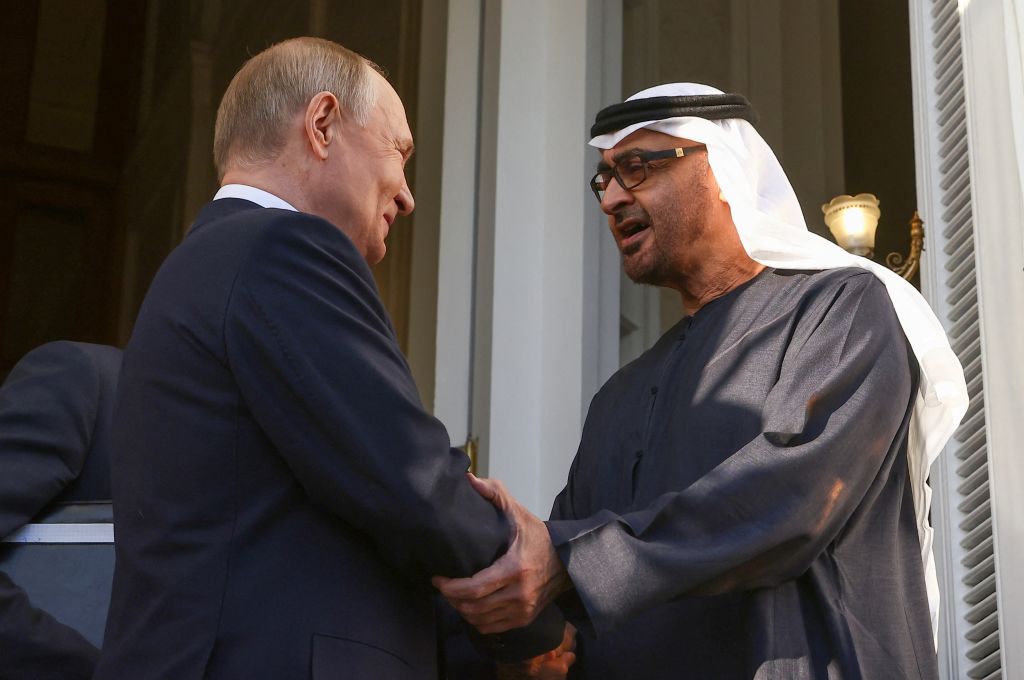
Russia’s President Vladimir Putin shakes hands with UAE President Sheikh Mohamed bin Zayed following their talks in Moscow on Monday. (Getty Images)
🗓️ Ahead on The Circuit
Oct.22-24, Dubai, UAE: Dubai Helishow. The event will feature a series of insightful talks, panel discussions, and keynotes, focusing on critical innovations in hybrid and electric helicopters, AI integration, UAV combat operations, and civil aviation. Skydive Dubai.
Oct. 29-31, Riyadh, Saudi Arabia. Future Investment Initiative Conference. More than 6,000 global participants registered, including world leaders, policymakers, CEOs and investors. King AbdulAziz International Conference Center.
Oct. 31, Abu Dhabi, UAE: Transition Investment Workshop. NYU Abu Dhabi’s Transition Investment Lab holds a day of discussions on aligning investment decisions with social values. NYU Abu Dhabi, East Forum.
Nov 4-7, Abu Dhabi, UAE: ADIPEC. The event is the biggest gathering for energy leaders, policy makers, and key industry players. It is often attended by heads of multilateral organizations, ADNEC.
Nov. 12-13, Abu Dhabi, UAE: CyberQ: Security in the Quantum Era. Brings together international experts, key policymakers and industry players to discuss challenges in the quantum age of cybersecurity. ADNEC.
Almarai to invest $4.8 billion in Saudi dairy farms, food security
Almarai Co., Saudi Arabia’s biggest dairy business, announced a $4.8 billion investment program to diversify production over the next five years and strengthen food security in the kingdom.
The Riyadh-based company which is 16%-owned by Saudi Arabia’s Public Investment Fund, will put money into its core dairy, juice and baked-good products while setting aside funds for technology development.
Almarai also plans to strengthen supply chain logistics, expand poultry sales and introduce new products, the company said in a report to the stock exchange on Monday.
While Saudi Arabia is the world’s largest exporter of oil, it depends on imports for some 80% of its food supply. The company said its strategy is aligned with Saudi Arabia’s Vision 2030 plan to diversify the economy away from oil by investing in other industries and selling state assets. Saudi Arabia’s largest food products company Savola said last month it planned to distribute its entire 35% stake in Almarai to its eligible shareholders.
“Investment in the food industry contributes to achieving food security in the kingdom and the region while adding value to shareholders,” Almarai said in the statement.
Air traffic challenge draws Emiratis to Israeli drone firm
TEL AVIV – From intelligence gathering to pizza delivery, drone aircraft are increasingly performing new tasks that saturate the skies with the buzz of quadcopters and raise the risks of mid-air collisions.
The threat to passenger flights is especially alarming with 2.2 million unmanned aerial vehicles registered in the U.S. and the number swiftly growing everywhere else. As the world addresses the technological and regulatory challenges, Abu Dhabi-based Edge Group, the largest Arab weapons manufacturer, announced last month a $14 million investment in Israel’s High Lander Aviation to help develop its traffic management software.
“When flown by our system, the drone will monitor its environment, avoid collisions… and be guided by our algorithm, which is like a control tower,” High Lander CEO Alon Abelson told The Circuit.
High Lander is among some 50 Israeli companies that will be exhibiting in the United Arab Emirates next week at IDEX, the biggest security conference in the Middle East. Others at the show, which runs from Feb. 20-24 in Abu Dhabi, include state-owned Israel Aerospace Industries; Elbit Systems, the largest Israeli defense contractor selling shares on the Nasdaq exchange; Heven Drones, which specializes in delivering heavy equipment by UAV, and Plasan, which makes armored vehicles.
Edge was founded four years ago in a consolidation of 25 military and technology companies owned by the emirate of Abu Dhabi. In the initial burst of activity following the normalization agreements between Israel, the UAE, Bahrain and Morocco known as the Abraham Accords, Edge signed a memorandum of understanding with Israel Aerospace in 2021 to develop defensive systems that can use electronic warfare equipment against enemy drones.
The new deal with High Lander gives Edge a “strategic opportunity” to develop drone technology further in both the military and civilian domains, according to the Emirati company. Edge Chairman Faisal Al Bannai said in a statement after the High Lander deal was announced that developing a traffic-management platform for drones “could not be more urgent” because of the rapid proliferation of the unmanned vehicles.
Joining High Lander’s board last week were Edge CFO Rodrigo Torres and Waleid Al Mesmari, senior vice president for electronic warfare and cyber technologies.
Working with Emirati military industries is “strategic for Israel and part of our ongoing cooperation with Gulf countries,” Edouard Cukierman, managing partner of Tel Aviv-based Catalyst Investments, a matchmaker for UAE investors with Israeli tech companies, toldThe Circuit.
Abelson, a reserve major in the Israel Air Force, co-founded High Lander after serving as a flight supervisor in northern Israel in his last military role. The experience led him to develop technology that focuses on command-and-control functions, rather than building drones themselves. “We wanted to empower the platforms,” he said. Now High Lander is promoting its product as a drone traffic controller at the national level. “This is the goal,” he said. “Taking an algorithm that managed 20, 30 or 40 drones, and using it to protect against collisions in the entire country.”
In recent months, the company has begun testing its software in southern Israel’s Ilan Ramon Airport on large-scale drones. High Lander’s Universal Unmanned Traffic Management system can also be supplemented with a range of digital maps to guide the drones autonomously. If satellite signals are lost, that enables the drone to employ on-board cameras and adjust its route. “The best solution is to replace the human operators — take technology and use it to bypass issues caused by pressure, personal calculations and tiredness,” he said.
High Lander’s drone traffic system is in use by clients in Israel, including the national police force’s counterterrorism unit; the Tel Aviv municipal government, which uses drones to monitor demonstrations; and the Jewish National Fund, whose drones patrol state lands administered by the agency. High Lander managed the air traffic routing in a 2021 test of drone delivery for Pizza Hut.
Edge, which had 2021 sales exceeding $5 billion, is well-positioned as a business partner to help High Lander develop its traffic-management software for greater volume and new directions, said Eden Avraham Attias, a retired IAF brigadier general and combat pilot who is managing partner of Impactive Capital in Tel Aviv. Among Edge’s greatest interests is autonomous flight, which can be significantly advanced by High Lander’s technology, he told The Circuit.
“Autonomous air vehicles will be part of our day-to-day lives,” Attias said. “Whether you’re doing security, sensing hazardous materials, monitoring natural gas or doing deliveries, to implement all of this, you need a management system.”
UAE foreign minister marks Abraham Accords anniversary in Israel
JERUSALEM – Israel and the United Arab Emirates celebrated the second anniversary of the Abraham Accords with a series of diplomatic meetings, hailing the rapid development of business and security ties since the White House signing of the normalization agreements.
At the center of last week’s events was UAE Foreign Minister Abdullah bin Zayed al-Nahyan, who met Sept. 15 with Israeli Prime Minister Yair Lapid and President Isaac Herzog on his first visit to Jerusalem, later going to the Yad Vashem, the World Holocaust Remembrance Center, to lay a wreath. In the evening, the UAE’s embassy in Israel hosted a celebratory dinner in the seaside city of Herzliya.
“What began as a wish and as an aspiration uniting us all is now an established fact,” Herzog said during the reception at the Ritz-Carlton Hotel, according to a statement from his office. “The Abraham Accords transformed, and continue to transform, our region beyond recognition.”
Bin Zayed said it was an honor to be in Israel, telling Herzog earlier in the day at the President’s Residence in Jerusalem, “This is historic, but I think in many ways this is a relationship which very few thought that in two years it would be as successful.”
Lapid greeted Bin Zayed at his office in Jerusalem, saying the trip “will advance the regional architecture we have been building this past year in the Middle East.”
The two leaders discussed efforts to strengthen ties between their countries, focusing on economic development and cooperation in the fields of agriculture, energy, water and food security, according to a statement.
Lapid described Bin Zayed’s trip to Israel as “a visit of a close and dear friend, with whom I can talk about everything.”
The UAE foreign minister also stayed through the weekend and held low-key visits on Sunday to the Technion – Israel Institute of Technology in Haifa, the Tel Aviv Museum of Art and the Peres Center for Peace and Innovation.
The UAE and Israel signed a free trade agreement in May that officials said would generate $10 billion a year in bilateral trade within five years. At least 450,000 Israelis have traveled to the UAE since the Abraham Accords were signed, according to Israel’s ambassador to the UAE, Amir Hayek.
Traveling to Israel with the foreign minister were Reem Ebrahim Al Hashimy, the UAE minister of state for international cooperation; Noura bint Mohammed Al Kaabi, minister of culture and youth; and other senior officials. They were joined during the meeting with Lapid by a group of Israeli government officials including Energy Minister Karine Elharrar, National Security Adviser Eyal Hulata and the prime minister’s military secretary Maj.-Gen. Avi Gil.
Lapid and bin Zayed forged a friendship when they worked closely together on creating the Negev Forum before Lapid became prime minister in June – he previously served as Israel’s foreign minister. The event last March brought together foreign ministers from Israel, the UAE, Bahrain, Egypt, Morocco and the United States.
On Sunday, Lapid’s cabinet approved funding to extend the Negev Forum’s multilateral activities in the fields of food security and water, energy, tourism, health, education and tolerance, and regional security, according to a statement.
“These working groups will create economic and security links which, just a few years ago, we could not have even dreamed of,” Lapid said.
During his visit to Yad Vashem last week, Bin Zayed laid a wreath at the stark Hall of Remembrance: “I am here today to remind ourselves of the lessons that history teaches us and the great responsibility upon us to act with tolerance for building our community and society,” he wrote in the guestbook, according to the Times of Israel. “We must take the brave step of building a bridge of true peace for the coming generations.”
While at Herzog’s residence, Bin Zayed invited the Israeli president to attend the Abu Dhabi Space Dialogue conference in December, according to a UAE government statement. Later, Herzog announced that he plans in the next few months to visit Bahrain, the other Gulf state that signed the Abraham Accords on Sept. 15, 2020. Morocco and Sudan subsequently agreed to normalize relations with Israel.
“The Abraham Accords heralded the return of hope, of dramatic regional change, of a horizon of cooperation and prosperity, of a future that draws its power from the togetherness created in the present,” Herzog said in his dinner speech. “I hope that we shall see more and more groundbreaking accords, including with our close neighbors, the Palestinians, and that the historic process, gaining unimaginable momentum, of Israel’s integration into this region will continue, layer upon layer.”
Israel-Bahrain cooperation on display in Munich
Cooperation between Bahrain and Israel stepped up a level this weekend with the prominent participation of both countries in the Munich Security Conference.
Undersecretary for Political Affairs of the Foreign Ministry Dr. Sheikh Abdullah bin Ahmed Al Khalifa represented Bahrain in the session titled “Abrahamic Agreements and Peace Options,” and shed light on a strong alliance between two countries in the Middle East that have common interests aimed at creating a more secure region in the face of the rise of extremism and terrorism that has threatened both countries and has destabilised others nations of the Middle East.
“If this security cooperation between Bahrain and Israel would mean providing more stability and security, so be it. If it would mean saving the lives of innocent civilians, so be it. That is why during a number of visits of the head of the Mossad to Bahrain, it was publicly announced in the Bahrain News Agency. Probably, the first time it was announced was in September 2020 and in May 2021 that yes the head of the Mossad was received by his counterpart in Bahrain. So we do believe that security cooperation, intelligence cooperation is part of our ongoing partnership between Bahrain and Israel,” Abdullah said.
The meeting in Munich followed two historical visits made by Israeli Prime Minister Naftali Bennett and Defence Minister Benny Gantz within 10 days to Bahrain and Abdullah’s words make it clear that Bahrain would exert utmost effort into any political or diplomatic initiative and co-operation that could lead to saving the lives of innocent civilians.
The Abraham Accords that marked a transitional point in the Middle East’s history and future and consolidated strategic cooperation between two countries that believe in peace as a consistent approach to confronting destructive ideas and ideologies that perpetuate hatred and promote terrorism — this has been the main focus of discussion and cooperation between the two states.
Both suffer from threats by terrorist entities and countries harbouring terrorists. Iran has been the focal point of all threats, directly and indirectly.
The participation of Anwar Mohammad Gargash, diplomatic adviser to His Highness the president of the United Arab Emirates, in the Munich Security Conference also gave weight to the discussions as the UAE continues — through genuine diplomatic efforts — to achieve stability and security in the region; the UAE has always been known for such efforts and stands as a great example for resolving several regional and international issues through its diplomatic effort, experience and in-depth analysis of the different players in the region.
History books will document the Abraham Accords that brought the UAE, Bahrain and Israel together, thanks to the brave decisions taken by their leaders in a part of the world where the some countries countries funding terrorism have created a turbulent region.
Munich brought together diplomatic and defense leaders who addressed a number of challenges facing the region, foremost among them terrorism based on extremist ideology, and the rejection of coexistence and diversity, which represents another challenge as it is linked to the spread of sectarianism and negative ideas. Antisemitism and Islamophobia have been the unfortunate results of hatred and demonizing Israel in many parts of the Muslim world.
Sheikh Abdullah al Khalifa focused on the challenge of armed proxy militias and the threat to maritime security, in addition to targeting oil and vital facilities in the countries of the region through drones and guided missiles to destabilize the region. This comes at a time that the Houthis, funded by Iran, continue to target Saudi Arabia and Abu Dhabi, causing the death of innocent civilians. Munich came during the same week that Australia classified Hamas as a terrorist entity, months after the U.K. had done so, and after Germany classified the political wing of Hezbollah as terrorists.
The Munich conference has come to a close but the mission to eliminate the enemies of peace has just begun.