Trump heads home after sewing up $200 billion in UAE deals
President Donald Trump wrapped up his four-day tour of the Gulf with a pomp-filled visit to the UAE, locking in some $200 billion in contracts that starts to fulfill the UAE’s pledge to spend $1.4 trillion in the U.S. over the next decade. He took off for Washington in the early afternoon.
With attention focused on the U.S. leader’s commitment to ease restrictions on selling advanced AI semiconductor chips to the UAE and Saudi Arabia, the two countries signed an agreement to build an AI development campus in Abu Dhabi that would be the world’s largest outside the U.S.
Though specifics on the AI tech purchases were not disclosed, Trump and Sheikh Mohamed met together with Jensen Huang, the CEO of Nvidia, which is the largest maker of the most advanced chips.
“We’re making great progress for the $1.4 trillion that the UAE has announced that it intends to spend in the United States over the next couple of years,” Trump told the UAE-U.S. Business Forum in an address early today. “This will generate billions and billions of dollars in business and accelerate the UAE plans to become a really major player in artificial intelligence.”
Trump also met with Dr. Sultan Al Jaber, the UAE Minister of Industry and Advanced Technology and CEO of ADNOC, at the business summit.
Among the deals were a $14.5 billion commitment from Etihad Airways for the purchase of 28 Boeing aircraft and a $60 billion oil and gas deal with ADNOC involving ExxonMobil, Occidental Petroleum, and EOG Resources. UAE officials said today the country will increase the value of its energy investments in the U.S. to $440 billion over the next 10 years.
Before returning to Washington, Trump visited the Abrahamic Family House on Abu Dhabi’s Saadiyat Island, the monumental prayer compound built by the UAE that contains a mosque, a church and a synagogue.
Gliding into President Sheikh Mohamed Bin Zayed’s Qasr Al Watan palace grounds on Thursday night for a state dinner, Trump’s motorcade was flanked by mounted camels to the right and Arabian stallions to the left, The Circuit’s Omnia Al Desoukie reports from Abu Dhabi.
The Emirati and American leaders then strode together through the palace’s grand marble halls, where Emirati children waved flags while the national anthems of both countries were played. President Trump was presented by Sheikh Mohammed with the Order of Zayed, the country’s highest civilian award, which was also given to former U.S. President George W. Bush in 2008.
Among the guests at the state dinner were Sheikh Mansour bin Zayed; UAE Vice President; Sheikh Khaled bin Mohamed, Crown Prince of Abu Dhabi; Sheikh Hamdan bin Mohammed, Crown Prince of Dubai, Sheikh Tahnoon bin Zayed, UAE National Security Adviser; Sheikh Abdallah bin Zayed, the UAE Foreign Minister; and Yousef Al Otaiba, the UAE Ambassador to the U.S.
Khaldoon Al Mubarak, Managing Director and Group CEO of the Mubadala sovereign wealth fund, and Peng Xiao, CEO of AI tech company G42 were also present.
Senior U.S. officials at the state dinner included U.S. Commerce Secretary Howard Lutnick, Treasury Secretary Scott Bessent, Defense Secretary Pete Hegseth and Martina Strong, U.S. Ambassador to the UAE.
Youth poll ranks Israel as third most influential in Arab world
Young people across the Middle East see Israel as an increasingly influential presence in the region, topped only by the United States and Saudi Arabia in its impact on the area, according to the 2022 annual Arab Youth Survey, released Sept. 21. Last year, Israel also trailed the United Arab Emirates, which fell to No. 4 in the current edition.
The perception of Israel, though, was broadly negative, with 88% of the respondents describing the Jewish state as an enemy. Iran was seen as an enemy by 62% of those surveyed. China, by contrast, was viewed as an ally by 78%; Turkey by 77%; Russia by 72% and the U.S. by 63%.
The poll, commissioned by ASDA’A-BSW, a Dubai-based unit of the world’s largest advertising and public relations agency, WPP, involved face-to-face interviews with 3,400 people ages 18 to 24. It was conducted in 17 countries and territories across the MENA region by IDS Research & Consultancy from May 13-June 16.
The survey, which has been published annually for 14 years, indicated that the normalization of Israel’s ties with the UAE, Bahrain, Morocco and Sudan through the 2020 Abraham Accords has some distance to go in softening the hostility with which it is perceived among Arab youth. Other Arab countries, including Saudi Arabia and Qatar, have said continued friction with the Palestinians has prevented them from joining the agreements and establishing official ties with Israel.
The rising cost of living was cited by 35% of the respondents as the greatest obstacle facing the region, with unemployment cited by 32%. Next was the Israeli-Palestinian conflict (28%), the COVID-19 pandemic (23%), the threat of terrorism (17%) and lack of opportunity for women (13%).
The UAE was viewed as the most desirable country to live in by 57% of the respondents, followed by the U.S., Canada, France and Germany. At the same time, 73% said they favor U.S. disengagement from the region. Many more Arabs hold the U.S. and its NATO allies as responsible for the Russia-Ukraine conflict (31%) than blame Russia (18%) and Ukraine (15%).
More than eight in 10 respondents said social stability in their countries is more important to them than democracy, and 64% said that democracy will never work in the Middle East.
The survey found that WhatsApp, Facebook, Instagram and YouTube are the most commonly used social media platforms among Arab youth. Use of TikTok has more than doubled in the past three years while that of Facebook and Twitter have declined.
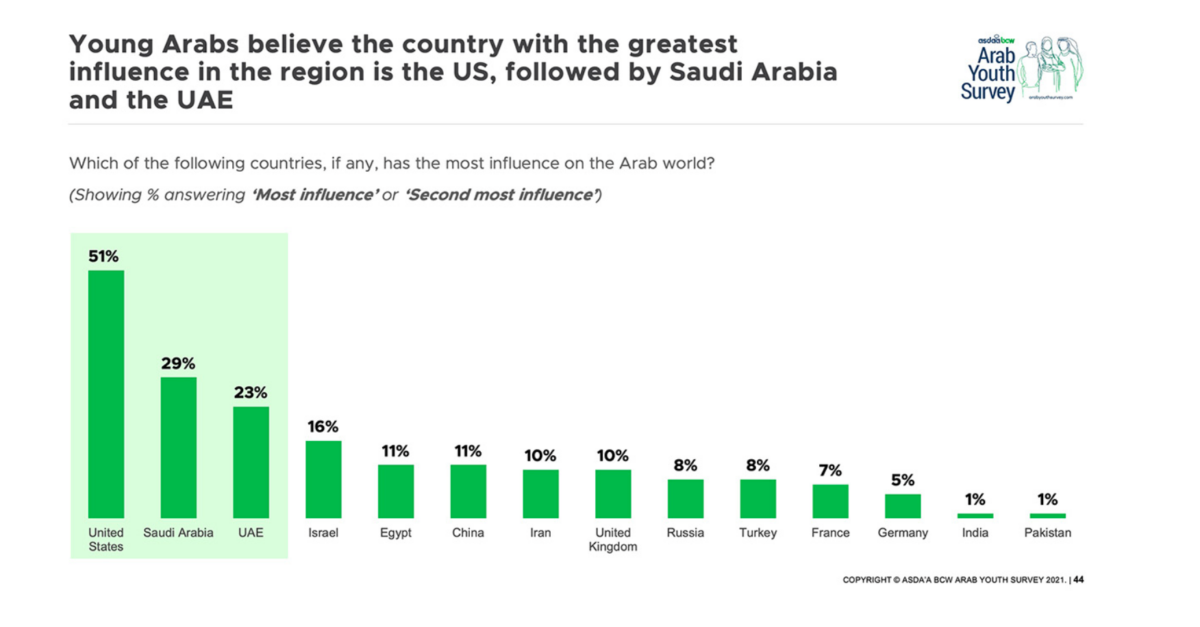
Young Arabs rank Israel as the fourth most influential country on the Arab world
Arab youth consider Israel a formidable presence in the Middle East, trailing behind the United States, Saudi Arabia and the United Arab Emirates in terms of perceived influence in the region, according to the 2021 annual Arab Youth Survey, which seeks to measure the pulse of some 200 million Arab youths.
The poll, conducted by consulting group PSB Insights from June 6-30 also found that, for the 10th consecutive year, a plurality of respondents ranked the United Arab Emirates as the most desirable country to live in (with 47% of respondents viewing the country as the best place to live), with the U.S. and Canada trailing in second and third places, respectively.
The 13th annual survey, which polled 3,400 people aged 18 to 24 across the Middle East and North Africa, found that 88% of respondents viewed Israel as an enemy, compared to 11% who classified the Jewish state as an ally. The results seem to indicate that recently minted ties between Israel and other Arab countries as part of the Abraham Accords have done little to change Israel’s reputation in the eyes of young Arabs, and that clashes between Israel and Palestinians contribute more to Israel’s image than its recent peace agreements.
Previous surveys have asked respondents if they consider countries such as Iran and Russia to be their enemies. The 2021 survey is the first to include Israel in the question.
Recent fighting in Gaza and the Israeli-Palestinian conflict left young Arabs disillusioned about the prospects for peace: 80% of respondents said they were “very concerned” or “somewhat concerned” about the Israeli-Palestinian conflict, placing concern for the conflict ahead of levels of concern about government corruption or personal debt.
Despite the affinity for the UAE and Western countries, few young Arabs (12%) are actively considering emigration, and many of those who are seeking to leave their countries hail from nations experiencing political and economic turmoil, such as Sudan, Morocco and Lebanon. Young Arabs who are considering emigrating cited the economy and educational opportunities as the top two reasons they’d consider leaving their home countries.
The results of the 2021 survey reflect optimistic sentiments: a majority of young Arabs believe their best days lie ahead, an improvement on the past four years, and desire to emigrate has decreased from the amount reflected in the 2020 poll.