














Home
Features
Quick Hits
The Daily Circuit
About
Facebook
Twitter
Instagram
Subscribe
SIGN IN
Features Quick Hits The Daily Circuit SWFs Org Charts
Facebook
Twitter
Instagram
Subscribe
SIGN IN
Search

Quick Hits

football fever

Khaldoon Al Mubarak opens Manchester City Women’s new $13.5 million training center

ARABIAN FREEWAY

Gulf trucks cruise desert corridor as war chokes Strait of Hormuz

The Daily Circuit: Trucking across Saudi Arabia + Aramco’s $10B property sale

royal holdings

Dubai’s ruling family boosts Emaar stake in $6.5B transfer

RED & Green

Jordan signs $1 billion deal for green ammonia plant in Aqaba

The Daily Circuit: Emaar’s royal infusion + Partners Capital opens in Abu Dhabi

managing wealth

Partners Capital opens in Abu Dhabi with family business pact

all that glitters

Dubai envisions boost to luxury market in visit by Cartier CEO

The Daily Circuit: Aramco’s dim oil outlook + Mubadala boosts Aldar stake

supply crunch

Aramco’s Nasser sees slow recovery of oil when Strait opens

gulf gridlock

DP World rolls out war-risk insurance for Iran-blocked cargo

The Daily Circuit: DP World’s Hormuz cargo insurance + Emirates cuts bonuses

American dream

G42 expands U.S. footprint with AI data center in Minneapolis

FLIGHT grounded

Riyadh Air launch delayed again as FAA holds up jet certification

The Daily Circuit: G42’s Minneapolis data center + OPEC hits 36-year low

security hub

UAE to build free zone for defense manufacturers amid Iran attacks

Gulf Gamble

Wynn faces pressure over UAE casino debut after Iran attacks

FALLING SHORT

Saudi Arabia posts its largest budget deficit since 2018

The Daily Circuit: Wynn mulls casino delay + UAE defense investment fund

No worries

Bustling Abu Dhabi business expo defies renewed Iran conflict

Quick Hits

Take-Two Takeover

Strauss Zelnick’s Take-Two buys Mark Pincus’s Zynga in $12.7 billion deal

One of the largest deals in video game history will align a mobile-gaming firm with a PC- and console-focused developer under the same leadership

Liz Hafalia/The San Francisco Chronicle via Getty Images and Stuart C. Wilson/Getty Images

Marc Pincus and Strauss Zelnick

By
Jacob Miller
January 11, 2022
Share
Facebook
Twitter
Email
Add The Circuit on Google

Video game company Take-Two Interactive has reached a $12.7 billion deal to acquire rival company Zynga, catapulting the “Grand Theft Auto” creator into one of the industry’s most formidable game publishers.

The deal, one of the largest in video game history, was announced on Monday by Take-Two CEO Strauss Zelnick and Zynga CEO Frank Gibeau. Expected to be finalized later this year, the merger will unite Take-Two, which specializes in PC and console gaming, with Zynga, a free-to-play mobile-game behemoth.

The two executives, which described the purchase as a “hand-in-glove fit” in a Monday morning conference call, anticipate the merger will result in an annual cost savings of $100 million and an additional $500 million from improved collaboration between the two firms.

Under the terms of the deal, Take-Two will buy all outstanding shares of Zynga’s stock for $9.86 a share, a 64% premium on the company’s share price as of Friday afternoon. The acquisition will be paid in both cash and Take-Two’s stock, granting Zynga’s shareholders one-third ownership of Take-Two.

Zynga was founded by Mark Pincus in 2007 when it piloted an online poker game played on Facebook. Since then, Zynga has grown into a large company with $2.3 billion in sales in FY2020. 

In a Medium post discussing the deal, Pincus described the “bittersweet moment” and thanked his colleagues over the years for his business’s success. “We’re seeing games expand in every direction from hyper casual to entire persistent worlds,” wrote Pincus. “I believe the company will have the franchises and scale to lead in every category.”

The different specializations of the two firms will complement each other as they now work together. Take-Two, which boasts hits including “Grand Theft Auto,” “NBA2K” and “Borderlands” produces games designed for PCs and consoles, but does not have free mobile versions. Zynga’s business model, which offers free mobile entertainment with in-app premium purchase options, has pioneered successes including “FarmVille” and “Words With Friends.”

With mobile gaming ascendant, Take-Two will benefit from Zynga’s mobile development team, which is expected to develop mobile options for Take-Two’s offerings. Under the planned acquisition, more than half of Take-Two’s projected bookings in Fiscal Year 2023 will come from mobile, diversifying Take-Two’s offerings and making it competitive with other developers as mobile gaming gains traction.

Zelnick called rolling out mobile options for Take-Two games a “high-priority initiative,” saying, “We see tremendous untapped potential to bring Take-Two’s renowned console and PC properties to mobile.”

Take-Two will also benefit from Zynga’s in-house advertising team, removing the added costs of outsourcing advertising operations.

The deal comes after the gaming industry enjoyed a boom during the pandemic, as social distancing interventions and lockdown restrictions pushed consumers to spend more time gaming, a trend that translated to large share price increases for both Take-Two and Zynga over the past two years. Yet Zynga’s stock tumbled last summer amidst societal reopening following COVID-19 shutdowns and after Apple instituted privacy reforms restricting how advertisers can track consumers on its devices, which made gaming less profitable.

Zynga has consistently maintained that its stock downturn from reopenings and Apple’s new privacy policy are transitory, and has remained optimistic about a stock rebound. On the Monday call, Zynga’s Gibeau said that these factors will not contribute to long-term drags on gaming, and explained that Zynga accepted a deal despite a feeling that its stock is undervalued because of the growth opportunities afforded in the new partnership.

“We saw incredible strengths available to us with regards to scale, data, audience expansion into new categories and product capabilities that would help us aggressively pursue cross platform. So from our perspective, we would be able to grow faster together. And the deal that was constructed in the framework with a 64% premium really put us into a position where we felt that this was the right course of action for our shareholders,” explained Gibeau.

The mammoth merger was evaluated by a strategic committee of independent directors from Zynga’s board and decided with unanimous approval from Zynga’s board of directors. Combined, the two companies reach over one billion users and employ 8,000 developers.

Zelnick will continue serving as Take-Two’s CEO, with the rest of Take-Two’s management remaining intact, while Zynga’s leadership team will assume responsibility for Take-Two’s mobile operations. Take-Two will also expand its board to accept two new directors from Zynga’s board.

Read More
Exclusive

Congress launches bipartisan Abraham Accords Caucus

The House-Senate caucus will be a ‘cheerleading squad’ for the normalization agreements, co-chair Sen. James Lankford told JI

Samuel Corum/Getty Images

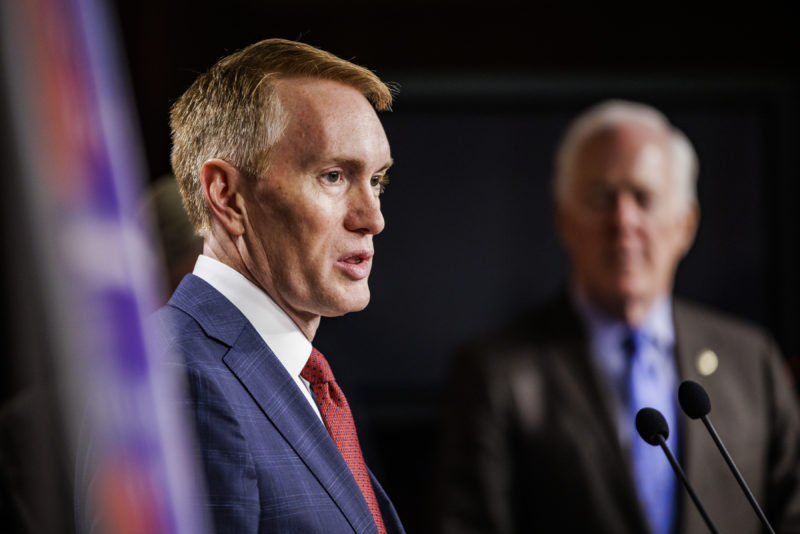
Sen. James Lankford (R-OK) speaks alongside other Republican Senators during a press conference at the U.S. Capitol.

January 10, 2022
Share
Facebook
Twitter
Email
Add The Circuit on Google

At a time when Congress appears increasingly fractured along party lines and between chambers, a group of eight House and Senate lawmakers will come together this week to launch a bipartisan Abraham Accords Caucus, focused on supporting and promoting the normalization agreements between Israel and Arab states.

The caucus’s co-chairs will be Sens. James Lankford (R-OK), Jacky Rosen (D-NV), Joni Ernst (R-IA) and Cory Booker (D-NJ), and Reps. Cathy McMorris Rodgers (R-WA), David Trone (D-MD), Ann Wagner (R-MO) and Brad Schneider (D-IL). Lankford described the new group as a “cheerleading squad” for the Accords in an interview with Jewish Insiderlast week.

“The bipartisan, bicameral Abraham Accords Caucus will provide a unique opportunity for world leaders to come together in our common pursuit of creating a better, safer and more prosperous world for our children and grandchildren,” Rodgers told JI. “I am encouraged by the progress we have made, and I look forward to the amazing things we can accomplish together through our shared commitment to a better future in the name of peace.”

Lankford and Trone said the group came together around a shared goal of supporting the Accords, which were signed in September 2020 between Israel, the United Arab Emirates and Bahrain, working to expand the agreements and promoting economic activity among the countries in the agreement.

“In just one year, the Abraham Accords have already transformed the Middle East by contributing to regional peace and stability, promoting U.S. interests, and enhancing Israel’s security,” Rosen added. “The Abraham Accords Caucus will build on that success by providing bipartisan leadership to strengthen existing partnerships and widen the circle of peace to new countries.” Since the signing of the Accords, Sudan and Morocco have also normalized relations with Israel.

Lankford said that the group can also help keep the executive branch focused on adding more countries to the agreement, both during the Biden administration as well as those of future presidents.

“I don’t want this getting lost in the State Department,” he said. “So this is a way that we can actually reach out to State and continue to push that, and continue to be able to encourage those countries… and we have relationships with them as well.”

The group has not yet sketched out any specific projects or initiatives that it plans to pursue, but Lankford said the group has discussed trips to and conferences with the signatory countries.

“Finalizing the Abraham Accords was a historic step toward peace in the Middle East,” Ernst said. “We must continue these efforts to further our nation’s partnership with Israel and promote peace and prosperity, and I look forward to working with my Democratic and Republican colleagues in the Abraham Accords Caucus to do so.”

Lankford also anticipates that the caucus will urge companies to engage economically with countries in the bloc and collaborate with members of the Knesset and government officials in the Arab states. Trone said the group will also work to support U.S. government investments in the Accords countries, as well as reach out to Egypt, Jordan and Palestinian leaders.

“The United States must continue to play an active role in fostering further dialogue and partnership between Israel and other Arab countries, and I look forward to doing just that as part of this bipartisan group,” Booker told JI.

The path to forming the caucus has not been without a few hurdles: The original plan was to launch the group around the first anniversary of the Accords last September.

Lankford primarily blamed the pandemic for the delays, adding that the Biden State Department’s calibration of its policy on the Accords also took time and that Democratic colleagues told him that they wanted “know exactly where State is on this” before joining the caucus.

“My concern initially was [that the] State Department was hesitant on it, to try to figure out, ‘Are we going to continue [the Accords]? Is this larger?’ They were slow to the trigger last year,” Lankford said. “I’m not not trying to throw anybody on the bus under it. State’s got to figure out what they’re going to do — I think they’re on board now… and working to be able to gain support on both sides of the aisle.”

Trone said, “The biggest focus has been that we really wanted to make it bipartisan and it took a little while for everybody to understand why the caucus will matter and what the caucus is trying to do… and that is a bipartisan — no politics, no party”

Trone said he expects the caucus, which will add members in matched bipartisan pairs, to grow quickly.

It’s less clear at this stage how the caucus might engage with the other major congressional initiative, the Israel Relations Normalization Act, which has garnered support from nearly three-quarters of both chambers but has stalled since being introduced last year. Rosen, Booker, Schneider and Wagner are the original sponsors of that legislation in their respective chambers, and all of the caucus’s members are listed as co-sponsors.

In the Senate, Sen. Ted Cruz (R-TX) is blocking fast-tracked unanimous passage of the legislation, citing concerns about language in the bill establishing U.S. policy as supporting a two-state solution between Israel and the Palestinians. In the House, the bill passed the Foreign Affairs Committee in September but has not yet received a floor vote.

Lankford declined to say specifically how the caucus might engage on the bill, explaining, “I don’t want to try to say for the other three that are helping me get this thing off the ground what’s going to be a priority at the beginning. So let me not say that as a priority. I’m just telling you, anything solidifies the agreement and expands the agreement, we’re going to be for.”

Lankford said he had not discussed Cruz’s objections to the bill with him.

A spokesperson for Rosen, one of the bill’s original Senate sponsors, offered a similar response saying, “Senator Rosen is a co-sponsor and a strong supporter of the Israel Relations Normalization Act, and the Senate Abraham Accords Caucus will explore a range of legislative opportunities once launched.”

Trone said that the caucus can “without question” help to move the bill through the House.

The leaders of the Israeli Knesset’s Abraham Accords Caucus congratulated their U.S. counterparts on the announcement in a statement Monday. 

“I deeply cherish the support from the United States and offer my congratulations on the establishment of a sister-caucus in America, with whom we can advance further frameworks for regional cooperation,” Knesset Member Ruth Wasserman Lande said.

The Abraham Accords Peace Institute, a group founded last year by former Trump administration senior adviser Jared Kushner to promote trade and tourism between Israel and the Accords countries, will be collaborating with the caucus.

The caucus “will play a role in a number of ways but the most important I think is to strongly show the support that exists in the U.S. popularly and within the government for the Accords and for their continuing growth and expansion,” the institute’s executive director, Rob Greenway, told JI. He expects the caucus can “do a great deal” to support the Accords’ expansion, keep the Accords top of mind in Congress and help shape pending legislation.

Read More
survey says

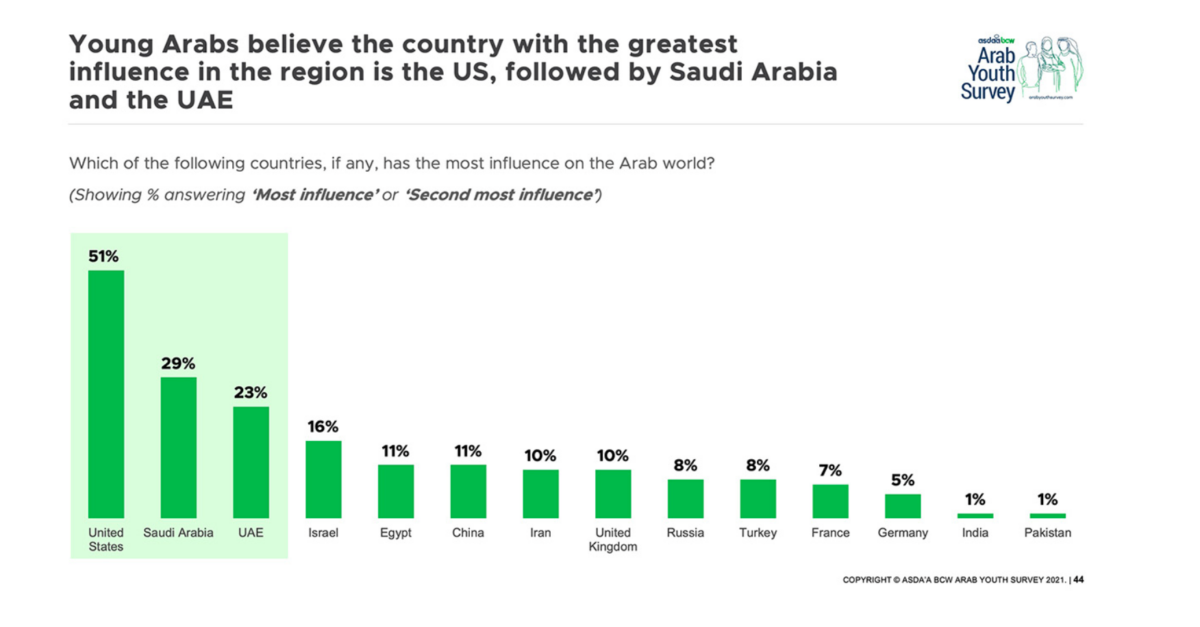
Young Arabs rank Israel as the fourth most influential country on the Arab world

A plurality of respondents ranked the United Arab Emirates as the most desirable place to live

John Moore/Getty Images

Kurdish teenagers pose for selfies with a U.S. Army soldier on joint patrol with local allies on May 25, 2021 near the Turkish border in northeastern Syria.

By
Jacob Miller
October 22, 2021
Share
Facebook
Twitter
Email
Add The Circuit on Google

Arab youth consider Israel a formidable presence in the Middle East, trailing behind the United States, Saudi Arabia and the United Arab Emirates in terms of perceived influence in the region, according to the 2021 annual Arab Youth Survey, which seeks to measure the pulse of some 200 million Arab youths. 

The poll, conducted by consulting group PSB Insights from June 6-30 also found that, for the 10th consecutive year, a plurality of respondents ranked the United Arab Emirates as the most desirable country to live in (with 47% of respondents viewing the country as the best place to live), with the U.S. and Canada trailing in second and third places, respectively.

The 13th annual survey, which polled 3,400 people aged 18 to 24 across the Middle East and North Africa, found that 88% of respondents viewed Israel as an enemy, compared to 11% who classified the Jewish state as an ally. The results seem to indicate that recently minted ties between Israel and other Arab countries as part of the Abraham Accords have done little to change Israel’s reputation in the eyes of young Arabs, and that clashes between Israel and Palestinians contribute more to Israel’s image than its recent peace agreements.

Previous surveys have asked respondents if they consider countries such as Iran and Russia to be their enemies. The 2021 survey is the first to include Israel in the question.

Recent fighting in Gaza and the Israeli-Palestinian conflict left young Arabs disillusioned about the prospects for peace: 80% of respondents said they were “very concerned” or “somewhat concerned” about the Israeli-Palestinian conflict, placing concern for the conflict ahead of levels of concern about government corruption or personal debt.

Despite the affinity for the UAE and Western countries, few young Arabs (12%) are actively considering emigration, and many of those who are seeking to leave their countries hail from nations experiencing political and economic turmoil, such as Sudan, Morocco and Lebanon. Young Arabs who are considering emigrating cited the economy and educational opportunities as the top two reasons they’d consider leaving their home countries.

The results of the 2021 survey reflect optimistic sentiments: a majority of young Arabs believe their best days lie ahead, an improvement on the past four years, and desire to emigrate has decreased from the amount reflected in the 2020 poll.

Read More

Posts pagination

Prev 1 … 123 124 125 126 127
Navigation
Home
Features
Quick Hits
The Daily Circuit
Org Charts
About
Social
Facebook
Twitter
Instagram
Subscribe
Subscribe

Copyright © 2025 · All Rights Reserved · The Circuit

Sign into your account

Email me a link to sign in

I don't have an account

Sign in or subscribe to continue to read this article

Enter your email and create a password to gain access to our exclusive content

Already a subscriber? Sign in

Unlock full access
Become a premium subscriber

Don't miss out! A paid subscription is required to access this page