


Home
Features
Quick Hits
The Daily Circuit
About
Facebook
Twitter
Instagram
Subscribe
SIGN IN
Features Quick Hits The Daily Circuit SWFs Org Charts
Facebook
Twitter
Instagram
Subscribe
SIGN IN
Search

Quick Hits

STARTING early

Saudi Arabia invests to turn young generation into sports fans

The Daily Circuit: Milken quizzes Mubadala chief + Abu Dhabi F1 Grand Prix

GULF TALKFEST

What’s on tap at the Milken Middle East and Africa Summit today – Day 2

REGIONAL SUMMITRY

Milken conference wrestles with AI’s impact on Mideast, Africa

GLOBAL PUSH

Mubadala Capital, Aldar team up on $1 billion investment fund

The Daily Circuit: Milken summit ponders AI + Aldar-Mubadala $1B fund

GULF TALKFEST

What’s on tap at the Milken Middle East and Africa Summit today

sovereign support

Ellison gets support from Gulf funds for Warner Discovery bid

The Daily Circuit: Gulf sovereigns back Ellison + QIA cuts Sainsbury’s stake

high octane

Ellison’s Sail GP coasts to season finale in waters of Abu Dhabi

CITY PLAY

Qiddiya confirms sovereign funding for $40B “city for play”

BUYING ITALY

Eagle Hills, Coima launch $463 million redevelopment of Rome’s Guido Reni Barracks

The Daily Circuit: SailGP’s UAE spectacle + ACWA Power secures $5.9B

GAMING SPREE

Saudi Arabia’s Savvy eyes next big move with ByteDance talks

TRUMP TUMBLE

Trump $1.5 billion crypto gamble backfires amid spiraling Alt5

The Daily Circuit: Savvy Games eyes ByteDance unit + Aramco selects Citi

DIGITAL DICE

UAE’s TrueWin, Dream Island online betting platforms go live

FRENCH OUTPOST

Aramco Ventures opens Paris office for European investments

The Daily Circuit: Aramco opens Paris VC outpost + BlackRock’s Saudi strategy

energy future

ADNOC sets course for next five years with $150B spending plan

Quick Hits

CIRCUIT INTERVIEW

ROSHN seeks to transform Saudi market with upscale housing

Senior Director of Strategy and Planning Waleed Bawaked and Program Management Director Roger Fatovic outline ROSHN’s blueprint for growth in kingdom and abroad

ROSHN’s Waleed Bawaked, Senior Director of Strategy and Planning, and Roger Fatovic, Executive Director of Program Management, at Future Investment Initiative conference in Riyadh

By
Omnia Al Desoukie
October 30, 2024
Share
Facebook
Twitter
Email
Add The Circuit on Google

As Saudi Arabia broadens its economy beyond dependence on oil, the kingdom has sought to create a business environment that acts as a magnet for international investment.

Central to the mission is state-owned real estate developer ROSHN, which has started to seed greater metropolitan Riyadh and other urban areas with upscale residential communities aimed at both Saudi and expat professionals.

The emerging neighborhoods cater to families by incorporating schools, parks, mosques, supermarkets and retail shops into the developments amid tens of thousands of homes.

In an interview with The Circuit, ROSHN’s Waleed Bawaked, Senior Director of Strategy and Planning, and Roger Fatovic, Executive Director of Program Management, outline the company’s blueprint for growth – first across Saudi Arabia and ultimately through expansion abroad.

ROSHN was established in 2020 by the Saudi Public Investment Fund and has raised $4.3 billion in the past two years. Its flagship project, Sedra, will contain 30,000 residential units on a plot of land measuring 20 million square meters and located near Riyadh’s King Khaled International Airport.
The company has also announced projects in Jeddah, Mecca and Dammam.

Are you expecting a boom in the Saudi real estate industry?

Waleed Bawaked: We are already seeing this, particularly in Riyadh, where demand and prices are rising. We are striving to support the market, and with the country’s broader aims, real estate will continue booming and contribute to sustained profitability.

Roger Fatovic: Saudi Arabia is a significant market with around 30 million people, including expatriates. With 22 to 23 million Saudis, it’s the largest market in the GCC and has the fastest-growing population. It is flowing. 

What is your strategy for reaching your goals?

Bawaked: Our mandate is to redefine and reshape the real estate sector in the country. We are mainly contributing to one of the key visions, focusing on quality of life, and this is our way of doing it. So, ROSHN was created to support the development of integrated communities, redefining what the locals and residents of Saudi Arabia should expect in a residence. We aim to provide communities supported by diverse assets within walking distance, incorporating the latest technology and ensuring sustainability from an environmental standpoint.

How do you determine which projects are worth moving forward with for implementation?

Fatovic: Our core business, one of the key focuses, is large residential and master-planned communities – complete turnkey solutions. So we don’t just build 100 villas here and 100 villas there. We do the villas, schools, mosques, parks, and all the supporting developments. This includes commercial spaces, retail, leisure, and hospitality. Our entry point is around 2,500 to 3,000 units ; we find that’s the number we need to achieve critical mass for schools, retail, and healthcare.

What factors guide your decision to prioritize a specific area for project development and implementation?

Bawaked: We’ve been mandated to focus on select regions and cities, mainly because these areas encompass over 80% of the population and are key economic anchors. We recognize a strong demand with a shortage of good-quality supply, which serves as our entry point. Within these cities, we leverage data analytics to understand urban growth trends, target market segments, and tailor our projects accordingly. As a profit-driven company, we aim to meet the needs of specific market segments. For example, in areas with higher income levels, our product offerings vary accordingly. Throughout the process, we ensure engagement from both the private and public sectors to shape the area’s future, accounting for other upcoming projects, connectivity, and customer preferences. This approach helps us design and build with a clear understanding of what will elevate our target segment’s experience.

How is the market shaping up for luxury real estate in Saudi Arabia? Are we seeing increased demand, and is it driven more by local or international interest?

Bawaked: I think it’s a bit of both, stemming from significant investment in Saudi, whether in projects or human capital. We see many Saudis in higher positions with substantial incomes seeking premium products locally. Externally, various government-led initiatives, as well as efforts by the Ministry of Investment and PIF, are attracting foreign direct investment and talent, which creates demand for premium and luxury offerings.

Is there a particular project you’ve implemented in Saudi Arabia that you’re interested in replicating?

Fatovic: We are doing that all over Saudi Arabia at the moment. A prime example is Sedra, our first and landmark project. ROSHN was the first PIF entity to generate revenue, sell to end-users, and hand over properties to end-users. Sedra, located near the airport, will see around 4,000 units handed over to end-users by the end of this year. For us, it’s about continuous improvement. We’ve learned from Sedra one, applied those lessons to Sedra two, Al Rus in Jeddah, and the Dammam project. It’s always about learning what works in the market and building on it for our future projects.

Have you considered expanding your efforts beyond Saudi Arabia?

Bawaked: At the moment, our focus is mainly on Saudi Arabia. We envision ROSHN as a leading real estate developer, not only locally but on a global scale. Right now, however, we have enough to deliver within the local market.

How do you assess whether a project has the potential to be profitable?

Bawaked: We work closely with external advisors and consultants to help us understand the market in terms of supply and demand, and we conduct feasibility and financial studies to meet specific ROI thresholds. Of course, we’re aware that market dynamics can change, so we proceed cautiously, adjusting our approach as needed to align with market perceptions and enhance our projects accordingly.

Fatovic: We maintain a continuous feedback loop, especially in the early stages of a project, involving Waleed’s team, development, and delivery. Once land is identified, we determine its highest and best use. We use many external consultants, but after five years, I don’t think there’s a consultant with a better cost database for residential development than we have. It’s a constant feedback loop involving strategy, development, construction, cost validation, and revenue assessment to decide the optimal product.
Read More
TIME TO PAY

Saudi leaders say investors should put money into kingdom

Economic overhaul has unleashed torrent of construction, which has soaked up Saudi funds and prompted new emphasis on foreign investment

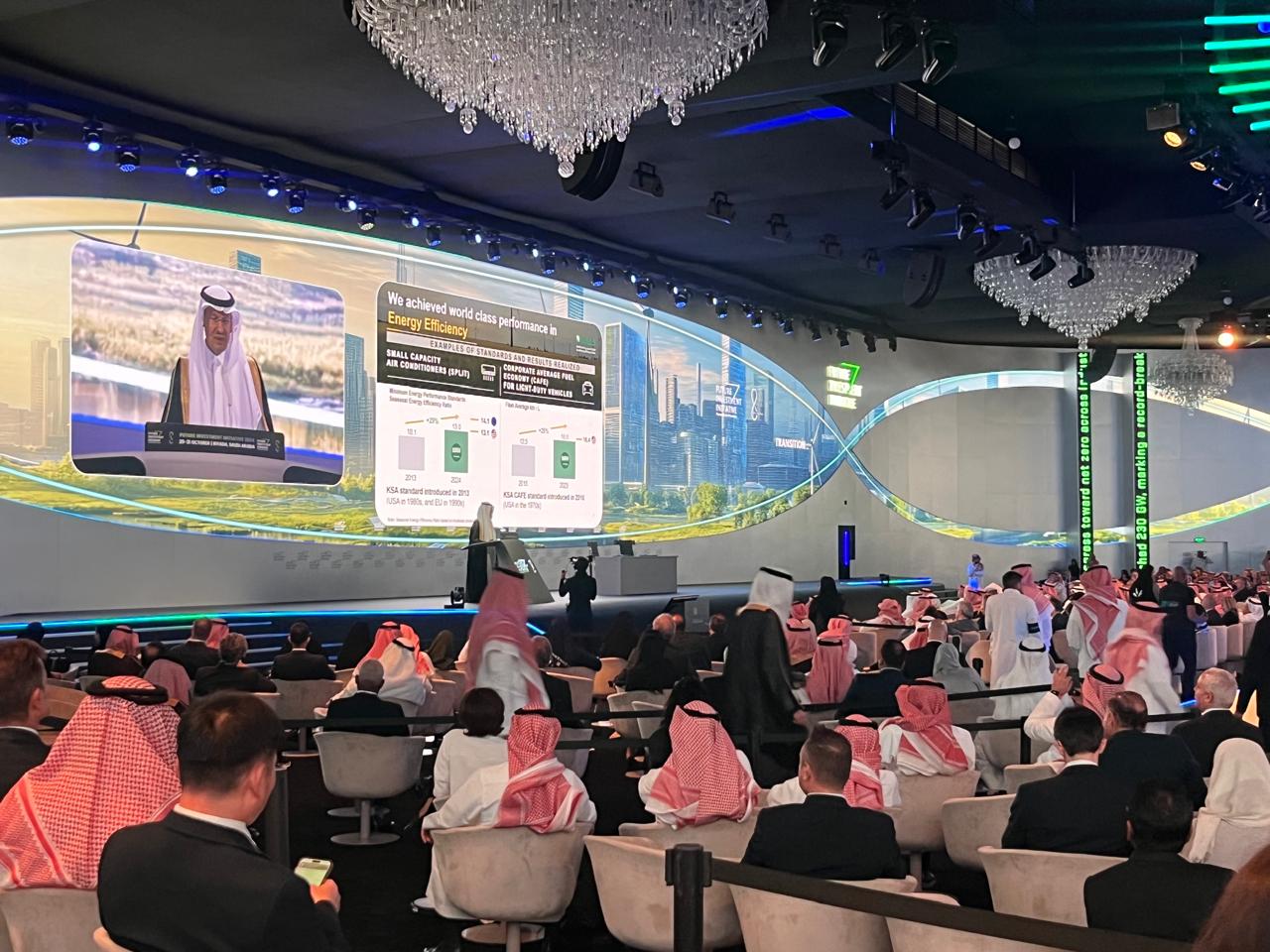
Saudi Energy Minister Prince Abdulaziz bin Salman addresses FII conference (Photo: Omnia Al Desoukie)

By
Jonathan H. Ferziger
Omnia Al Desoukie
October 29, 2024
Share
Facebook
Twitter
Email
Add The Circuit on Google

Saudi Arabia is shifting gears, emphasizing its own needs for foreign capital over investing the kingdom’s wealth abroad.

That’s the message being delivered this week to some 7,100 participants from across the finance world at the eighth annual edition of the Future Investment Initiative.

Addressing a packed hall at the King Abdul Aziz International Conference Center in Riyadh’s diplomatic quarter on Tuesday, Saudi leaders put it simply:

“People used to come to us and ask for money,” said Yasir Al Rumayyan, Governor of the kingdom’s near trillion-dollar Public Investment Fund and Chairman of Saudi Aramco, the world’s largest oil company. “We are now seeing a shift from people wanting to take our money to people wanting to co-invest.”

Since its inception in 2017, the FII conference has been a key tool for outlining Saudi Crown Prince Muhammed bin Salman’s Vision 2030 blueprint for overhauling the economy to reduce its dependence on fossil fuels. That strategy has unleashed a torrent of construction projects across the country, including the $1.5 trillion Neom development on the kingdom’s west coast, which have soaked up Saudi funds and prompted the new emphasis on foreign investment.

Like the World Economic Forum in Davos, Switzerland, after which the Saudi conference is modeled, FII features some of the biggest names on Wall Street who are asked to prognosticate on prospects for the global economy.

Headliners on Day 1 included Ray Dalio, Founder of Bridgewater Associates; Harvey Schwartz, CEO of Carlyle; Jenny Johnson, President and CEO of Franklin Templeton; David Solomon, Chairman and CEO of Goldman Sachs; Marc Rowan, Co-Founder and CEO of Apollo Global Management and Jane Fraser, CEO of Citi.

FII is also a showcase for Saudi companies, which have lined the conference center and adjoining Ritz Carlton Hotel with booths to entice investors and hawk their wares. Aramco, which sponsors golf tournaments around the world, set up a putting green at FII to attract conference visitors, while Saudia Group parked one of its Lilium electric vertical take-off and landing (eVTOL) jets outside the conference site.

While outlining the kingdom’s commitment to developing sustainable fuels, Saudi Energy Minister Prince Abdulaziz bin Salman said oil will remain a key driver of the economy. “We will monetize every molecule of energy this land has, period,” he said.

Read More
GLOBAL AMBITIONS

Saudi Arabia’s annual ‘Davos’ conference gets started in Riyadh

Some 7,000 movers and shakers pour into the kingdom for the Future Investment Initiative meeting that takes place at the opulent Ritz Carlton

OMNIA AL DESOUKIE

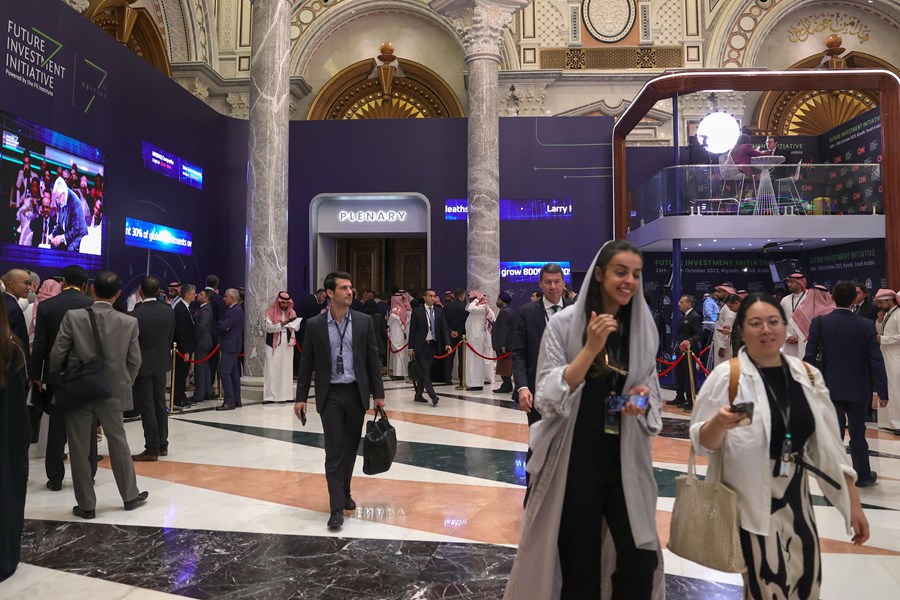
Saudi-U.S. Investment Conference will take place at the King Abdulaziz International Conference Center in Riyadh, home to the kingdom's annual Future Investment Initiative summit

By
Jonathan H. Ferziger
October 28, 2024
Share
Facebook
Twitter
Email
Add The Circuit on Google

Saudi Arabia is in full swing this week in its effort to wow Wall Street and the rest of the financial world as Crown Prince Mohammed bin Salman hits the midpoint of his Vision 2030 plan to transform the economy.

Some 7,000 movers and shakers are pouring into Riyadh for the Future Investment Initiative conference that takes place annually at the opulent Ritz Carlton hotel and in the vast halls of the adjacent King Abdul Aziz International Conference Center.

Getting a jump on the confab in Riyadh, the developers of Saudi Arabia’s trillion-dollar-plus Neom project invited a select group of financiers, celebrities and influencers to a kickoff event over the weekend at Sindalah Island, five kilometers off the kingdom’s west coast, Bloomberg reports.

The Red Sea resort island, where an ecosystem is rising of super-luxury hotels, swank night clubs and an 86-berth yacht marina, hosted a beach party headlined by Grammy Award winner Alicia Keys. She sang to an audience that included actor Will Smith, tennis champ Rafael Nidal and former NFL quarterback Tom Brady.

Back in the capital, FII opens on Tuesday with a bevy of investment bankers, hedge fund founders and corporate titans who have become regulars at the conference that was originally billed as “Davos in the Desert,” to highlight its aspirations for global influence.

Among the speakers slated for the main stage are Larry Fink, Chairman and CEO of BlackRock; Ben Horowitz, co-founder of Andreesen Horowitz, Jane Fraser, CEO of Citi; Ken Griffin, Founder and CEO of Citadel; Dame Julia Hoggett, CEO of the London Stock Exchange; Ruth Porat, President and Chief Investment Officer of Alphabet and Google; and David Rubenstein, Co-Founder and Co-Chairman of The Carlyle Group.
|
The three-day event will be introduced by Yasir Al-Rumayyan, who is Governor of the Saudi Public Investment Fund and Chairman of Aramco. Richard Attias, CEO of the FII Institute, said at a press conference that he expects some $28 billion in business deals to be announced during the course of the conference.

Read More
PLUGGED IN

GITEX was a whirlwind – What should I do now to follow up?

Reach out while memories are fresh, connect on LinkedIn, provide value, send promised materials and keep your message short and sweet

The conference floor at GITEX Global 2024 (Getty Images)

October 23, 2024
Share
Facebook
Twitter
Email
Add The Circuit on Google

GITEX was a behemoth conference that welcomed 6,000 delegates and over 100,000 visitors to Dubai last week. Those who participated found a whirlwind of innovation, tech insights, and networking, but the real magic happens after the event – when you follow up.

If you’re wondering how to turn those connections into new opportunities, here’s a quick guide on best practices after getting home from the investment extravaganza.

The golden rule is don’t wait too long. Ideally, you should reach out within 48 to 72 hours of the event while the conversation is still fresh in everyone’s mind. On the other hand, huge conferences put you together with so many people that follow-up can be a bit different.

Given the amount of time required to attend the conference and then travel back home, folks are pretty waterlogged until midweek with catching up from what they missed, and there’s a decent chance your message will fall into the “respond later” category.

Try to target follow-up for a 10-day window from the end of the conference so the connection is still recent but you haven’t bombarded your new contacts as soon as they are back online. Additionally, put a reminder on your calendar for three days after you’ve sent these notes to ping anyone who hasn’t responded. 

Follow-up Tips

1. Personalize Your Message: Refer to a specific detail from your conversation – whether it’s about their business, a shared interest, or a session you both attended. This makes your follow-up feel more genuine and thoughtful.

2. Keep It Short and Sweet: People are busy so get to the point quickly. Your follow-up should be friendly, clear, and concise. Don’t overwhelm them with too much information at once.

3. Offer Value: When possible, offer something valuable in your message, whether it’s a relevant article, a connection they might benefit from, or simply the next steps for continuing your discussion. Make it about them, not just you.

4. Connect on LinkedIn: If you haven’t already, connect with them on LinkedIn. Send a brief message mentioning where you met and express excitement about staying in touch.

5. Follow Up on Promises: If you promised to send more information, do it. Send the presentation, the additional info, or the proposal as promised. Being reliable goes a long way in building trust.

Email Follow-up Template

Let’s make this easy – here is an email template you can edit to your liking: 

Subject: Great meeting you at GITEX!

Hi [Name],

It was a pleasure meeting you at GITEX! I really enjoyed our chat about [specific topic]. I’d love to explore how we can collaborate further. Let me know if you’re available for a quick call in the next week.

Looking forward to staying connected!

Best,

[Your Name]

Planning for Next Year

GITEX 2025 might seem far away, but the best time to start planning is now! Take notes on what worked this year and what didn’t. Did you attend enough sessions? Did you focus on the right networking opportunities? Start setting your goals for next year based on this experience.

It’s also worth revisiting the connections you made periodically throughout the year. You don’t need to wait until GITEX 2025 to reconnect – check in periodically to see how things are progressing in their world, and you’ll find yourself in a much better position when the next GITEX rolls around.

Remember, successful networking is about nurturing relationships. Your follow-up is where the seeds planted last week at GITEX start to grow.

Read More
Circuit interview

Nuwa Capital navigates evolving Mideast investment landscape

Nuwa Managing Partner Khaled Talhouni looks at Gulf markets as a venture capital investor with one foot in Dubai and the other in Riyadh

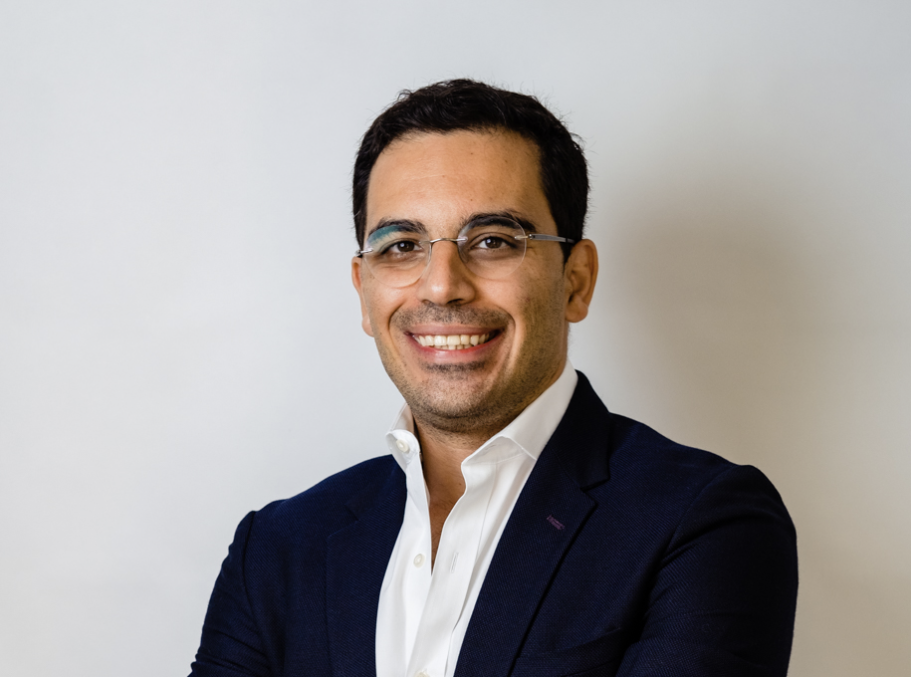
Khaled Talhouni, Managing Partner of Nuwa Capital

By
Omnia Al Desoukie
October 23, 2024
Share
Facebook
Twitter
Email
Add The Circuit on Google

Khaled Talhouni, Managing Partner of Nuwa Capital, says the recent proliferation of tech IPOs in the Gulf demonstrates that a “window is opening” for investors on stock exchanges in the UAE, Saudi Arabia and some of their neighbors.

Talhouni, 39, has a broad view of developments in regional finance, having opened offices in both Dubai and Riyadh for the venture capital firm, which manages $100 million in assets.

After attending college at Duke University in the U.S., Talhouni returned to the UAE for a job at Dubai International Capital, where he worked on the region’s first seed capital fund. He directed investments and strategy at twofour54 in Abu Dhabi and went on to become a Managing Partner at Wamda Capital. He started Nuwa in 2020.

Nuwa’s backers include Saudi Arabia’s Al Faisaliah Group, Abu Dhabi’s Mubadala Investment Co., Jada Fund of Funds and the Dubai Future District Fund. Among its 30 portfolio companies are Calo, a Bahrain-based meal planning start-up; Zest Equity, an online platform for managing venture capital investments; and Raqamyah, a Saudi crowdfunding platform.

The interview has been edited for length and clarity.

What are the major trends you see these days among investors in Middle East businesses?

I think with what’s going on in Saudi Arabia with a lot of very successful IPOs having happened in the past 24 months – particularly but not necessarily in tech, but across the board – we are seeing huge interest in participating in late-stage tech or late-stage, pre-IPO types of deals. That is because investors are seeing how there is a quick return on the back of that.

Also in the UAE, there is the Talabat deal coming up soon as well. So IPOs seem to be the hottest topic in town. I would say that is kind of moving in a big way.

One thing you see a lot more are direct deals, a lot more, so you do see people much more interested in going direct, as opposed to funds. You do see an interest in profitability. I would say that’s kind of increasingly of interest.

As we head into 2025, do you see further new companies being founded, or do you see more acquisitions than founding opportunities?

I think a couple of things are going to happen. First, I think funding is going to pick up because a lot of people are coming into some new dry powders. Some new funds are closing so things are moving. Then those who are sitting on the side have some deployment pressure that they need to deploy.

Secondly, I think a lot of early-stage companies, as funding has dried up relative to what it was in 2020-2021, [are going to be acquired]. We are going to see a lot of mid-tier companies and startups start consolidating into larger ones. So there is a lot of consolidation. More “aqua” (acquisition) hires. So bigger tech companies buying up talent or buying companies, or aqua hiring, or merging with companies that are smaller than them, that basically augment their offering, or add to their existing offering. 

 In terms of founding companies,  that trend is secular. So that trend is continuing no matter what. So you see more and more every year, more companies being founded, regardless of what’s going on in the capital market.

Do we foresee a market correction where only the best companies will survive and move on to series A and beyond? 

That’s the natural state of affairs. It should be like that. The unusual period was those couple of years in 2020, 2021, 2022, when everything was getting funded all the time. That’s unusual, but I think the natural [way that things] occur is actually, the majority of companies don’t survive going from Series A to Series B.

We are seeing movement within the IPO space while, at the same time, smaller businesses are struggling. What’s going on in the market? 

There is a slowdown, a little bit of a consumer slowdown, particularly in Saudi a little bit. That’s definitely kind of happening in some small way. I think there’s also some liquidity constraints. So that’s definitely happening overall. I think it is very sector-specific. 

However, consumer spend overall is being stretched. Which is why, on the other hand, companies, in BNPL (Buy-now-pay-later) and consumer credit seem to be doing so well. So they are really growing very, very aggressively. It is a little bit of a tale of specificities depending on which segment you’re in, you’re having a very different reality.

How has the wave of IPOs and exits shaped the current venture capital environment within the region? What do you think is going to happen in the next coming years?

So on the IPO front, it is extremely positive. I don’t know if you remember this, this whole route was not open. You know, as early as three, four years ago, there were no tech IPOs in the region, and there are very few IPOs overall. Right? Like, it was not a very vibrant capital market generally. So I think the fact that this window is opening, and there is demand, and there’s regulatory reform, and there’s opening up, especially on the Tadawul exchange in Saudi but even on the DFM in Dubai and ADX in Abu Dhabi, I think is extremely positive. 

So that’s kind of spurring all kinds of more activity in the space to create validation that you can exit your startup through an IPO, which is typically, if you look at in other developed markets, it’s not the main way companies exit, but it’s not the majority of how startups exit, but it’s where the largest exit has happened. That had not really been open to our region before. And now this opening up really kind of creates some ability, some exit paths for startups at the larger base.

How does Nuwa Capital see the whole startup ecosystem moving forward? What role do you play in this within the region? 

We see that the sovereign system is maturing. We do still think that there is still a huge room for more and more companies, for more and more companies to get funded, and more capital to throw on the startup ecosystem. I think there are probably too many individual VCs. So I think it’s a bit fragmented, and I can see that the market is also consolidating and or kind of getting a bit more concentrated, with the larger firms and the more established firms getting disproportionate amounts of the capital in the long run.

As for us, we are very keen on continuing on our mission, which is to kind of really invest in early-stage companies, impact the very best founders, and grow our business on the back of that.  We have some companies that are beginning to mature within our portfolio. So we are hoping to position for exit in the coming two to three years. But then we also have a very young portfolio as well, so we will see how that kind of evolves over the coming years.


Read More
COST OF BUSINESS

HSBC tops Standard Chartered in Mideast investment banking fees

The highest amount of investment banking fees were generated from Saudi Arabia, followed by the UAE, Qatar, Kuwait and Egypt

View of Dubai International Financial Centre (Getty Images)

By
Jonathan H. Ferziger
October 22, 2024
Share
Facebook
Twitter
Email
Add The Circuit on Google

A jump in dealmaking across the Middle East and North Africa has generated an estimated $1 billion in investment banking fees so far this year – a 27% boost over the first nine months of 2023, with HSBC leading the pack.

London-based HSBC earned $80.4 million in fees during the first three quarters of 2024, or 7.8% of the total investment banking pool, Zawya reports, citing LSEG Deals Intelligence.

Coming second in the banking field’s league tables was Standard Chartered with $56.5 million in fees, followed by First Abu Dhabi Bank with $56 million. The highest amount of investment banking fees were generated from Saudi Arabia ($470.7 million), followed by the UAE ($395.9 million), Qatar ($45 million), Kuwait ($41.7 million) and Egypt ($25.1 million).

The largest deal in the MENA region during the first nine months of 2024 was ADNOC’s $14.8 billion takeover offer for German chemicals company Covestro, according to the LSEG data. The largest during the third quarter was UAE clean energy firm Masdar’s offer to buy Spain’s Saeta Yield from Brookfield Renewable for $1.4 billion.

Read More
KREMLIN SUMMIT

UAE President meets with Putin weeks after White House visit

Trade has tripled to $7 billion over the last three years, even as Russia has been subject to sanctions applied by the U.S., the U.K. and the EU

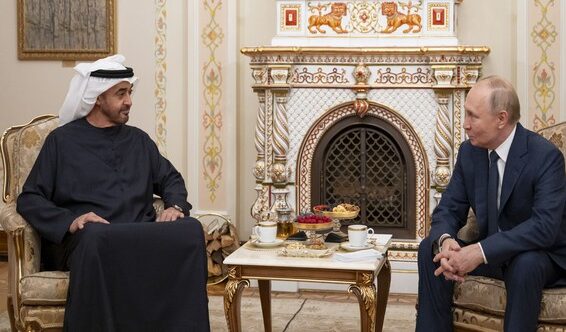
UAE President Sheikh Mohamed binn Zayed meets Russian President Vladimir Putin at the Kremlin on Sunday (Photo: WAM)

By
Jonathan H. Ferziger
October 21, 2024
Share
Facebook
Twitter
Email
Add The Circuit on Google

Having visited U.S. President Joe Biden earlier in the month at the White House, UAE President Sheikh Mohamed bin Zayed is continuing his international travels with a stop in Moscow.

Russian President Vladimir Putin hosted the Emirati leader for dinner on Sunday, with an official meeting set for today that will focus both on commercial relations, as well as the conflicts with Ukraine and in the Middle East, according to a Kremlin statement.

Trade between the two countries has tripled to $7 billion over the last three years, even as Russia has been subject to sanctions applied by the U.S., the U.K. and the European Union.

Putin personally thanked the UAE President for mediating a prisoner exchange between Russia and Ukraine, the statement said.

Following the Moscow visit, Sheikh Mohammed will travel on Tuesday to the Russian city of Kazan for a summit of the BRICS group of nations, which it joined in January.

Read More
SHOPPING FOR SHARES

UAE retail giant LuLu to sell 25% stake in supermarket chain

The Abu Dhabi-based company founded by Yussuf Ali counts ADQ as an investor, having sold the sovereign wealth fund a 20% stake in 2020

thecircuit-circuit-luluhypermarket

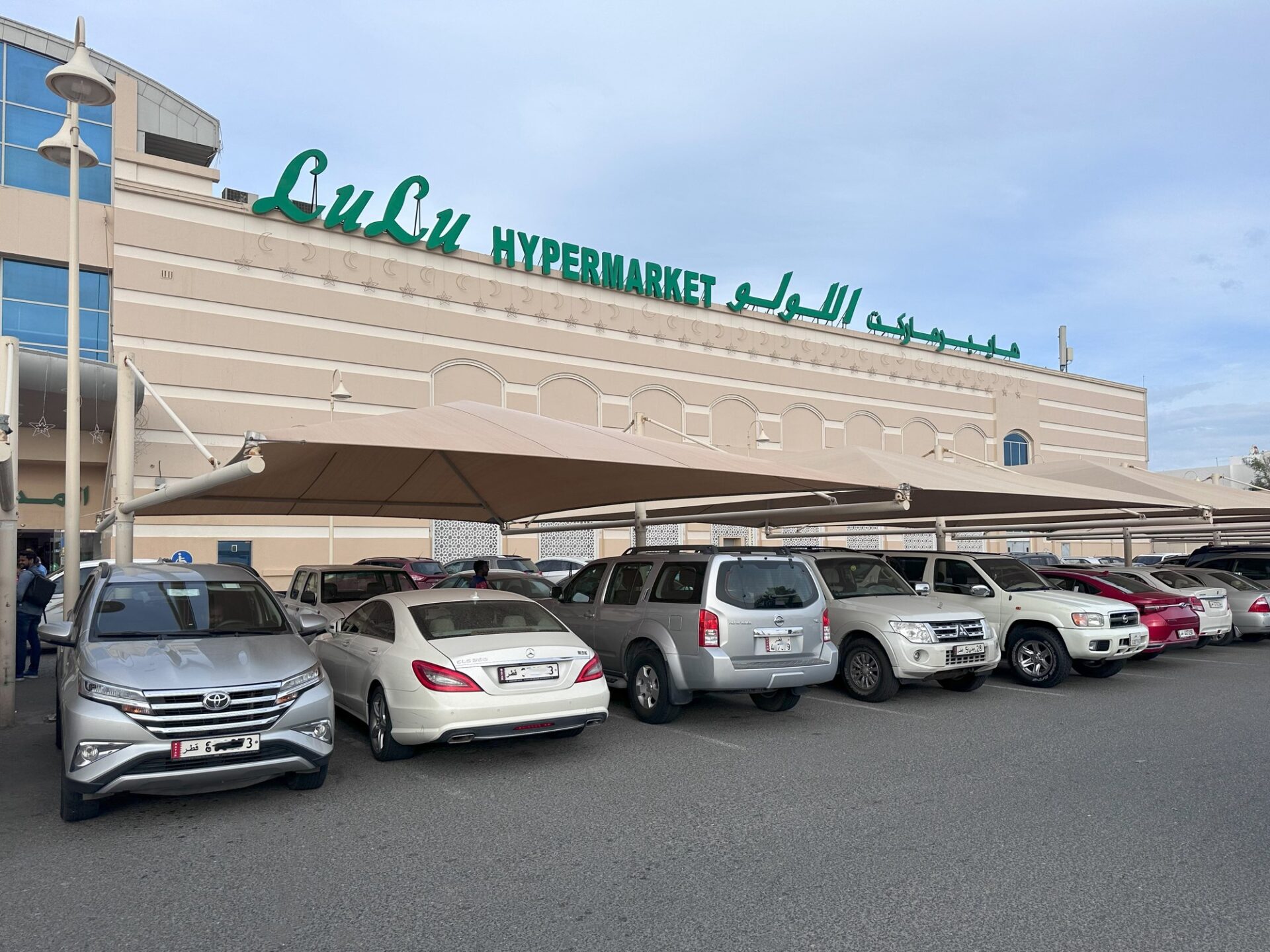
LuLu hypermarket and mall at D ring Road Doha.

By
Omnia Al Desoukie
October 21, 2024
Share
Facebook
Twitter
Email
Add The Circuit on Google

UAE retail giant LuLu plans to sell a 25% stake of the company in an IPO starting Oct. 28, with its shares hitting the ADX trading floor on Nov. 14.

The business, which owns hypermarkets, supermarkets and malls across the MENA region, as well as in India and Malaysia, is looking to raise as much as $1.8 billion through the share sale, Zawya reports.

The Abu Dhabi-based company founded by Yussuf Ali counts ADQ as an investor, having sold the sovereign wealth fund a 20% stake in 2020.

Emirates NBD Capital, HSBC Holdings, Abu Dhabi Commercial Bank and Citigroup are joint bookrunners on the IPO, with Moelis & Co. retained as financial advisor.

Read More

Posts pagination

Prev 1 … 51 52 53 54 55 56 57 58 59 … 101 Next
Navigation
Home
Features
Quick Hits
The Daily Circuit
Org Charts
About
Social
Facebook
Twitter
Instagram
Subscribe
Subscribe

Copyright © 2025 · All Rights Reserved · The Circuit

Sign into your account

Email me a link to sign in

I don't have an account

Sign in or subscribe to continue to read this article

Enter your email and create a password to gain access to our exclusive content

Already a subscriber? Sign in

Unlock full access
Become a premium subscriber

Don't miss out! A paid subscription is required to access this page